Skip to content
In an emergencyAustriaEmergency numbers →
SurviveBetter
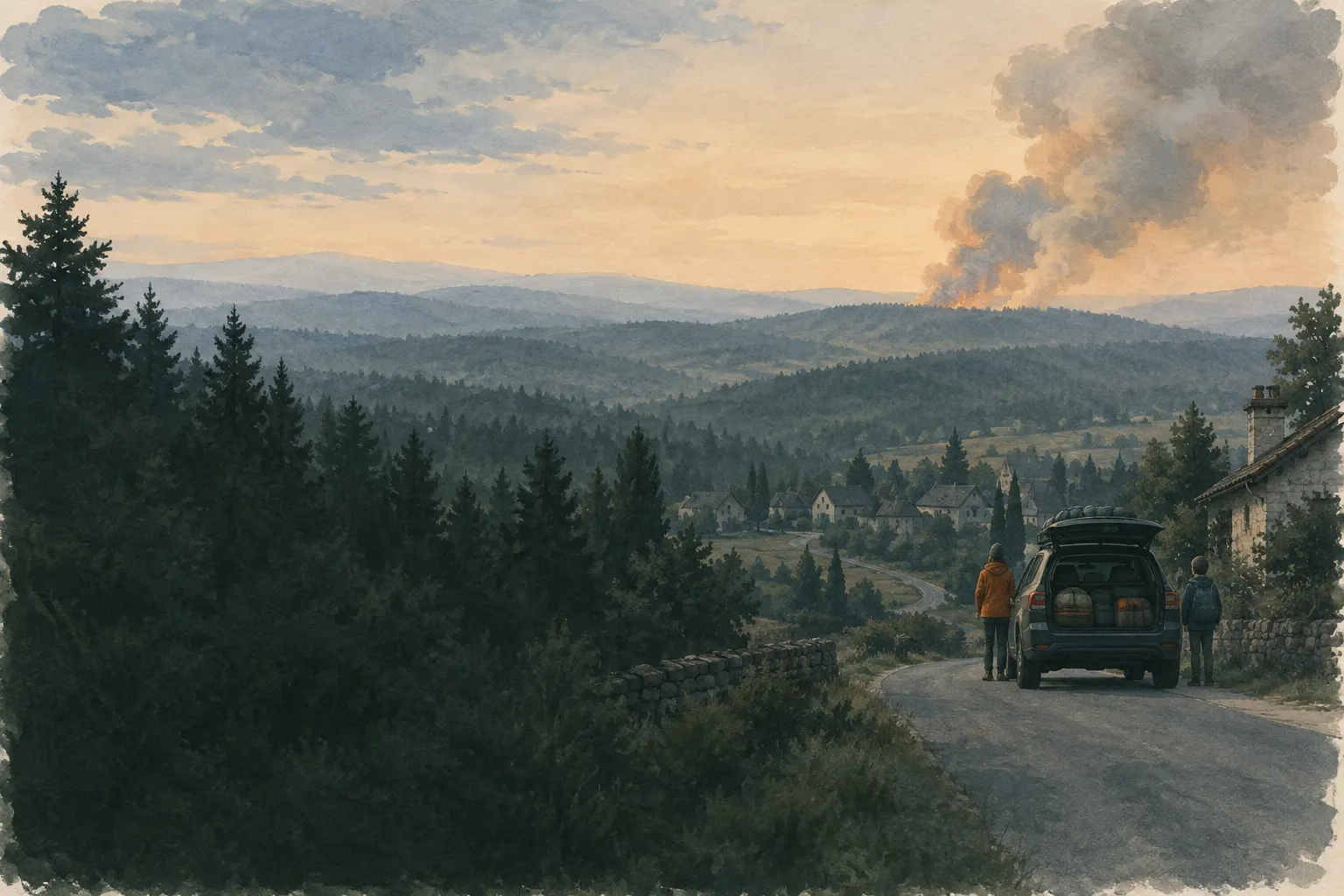
Distant wildfire smoke column, village road with a packed car

There is a wildfire or wildfire smoke near us

Smoke on the horizon, the smell of burning, ash on the car – a fire in the region can come closer faster than it looks.

First

  1. Follow warnings and instructions from the authorities (radio, warning app, official websites).
  2. If evacuation is ordered, leave at once – if you are threatened, leave even without an order. Leaving early is safer than leaving late.
  3. If you see flames nearby or are cut off: call the local emergency number (112 in the EU).
  4. Have your go bag, documents, medication and pets ready; park the car facing the way out and inform your contact person.

Call emergency services if

  • Flames or flying embers nearby, way out cut off
  • Breathing difficulty, chest pain or impaired consciousness from smoke
  • People or buildings in danger
  • Someone cannot be evacuated in time

What is happening

A wildfire usually announces itself with smoke first: the sky turns yellowish or orange, there is a smell of burning, fine ash drifts down. How fast the fire spreads depends mainly on wind, dryness and terrain. In strong wind a fire front can cover long distances quickly, and flying embers can start new fires far ahead of the actual front – including on houses, hedges and woodpiles.

Fire burns faster uphill than downhill, because the flames preheat the vegetation above them. Narrow valleys and gullies act like chimneys. Dense smoke takes away visibility, irritates eyes and airways and can make roads impassable within a short time. Even far from the fire, smoke can harm health, especially for children, pregnant women, older people and people with heart or lung conditions.

The most common misjudgement is staying too long: “The fire is still miles away.” If you only leave when you see flames, you may end up in a queue on the only access road, in smoke, while emergency vehicles come the other way. Others try to defend their house themselves and underestimate the heat, smoke and speed of a fire.

What realistically matters most: take official warnings seriously, prepare your go bag and vehicle early, leave early when threatened and protect yourself from smoke at home. If you see the fire yourself or are cut off, call the emergency number at once.

Step by step

  1. Phase 1

    Smoke in the air, no evacuation yet

    • Follow the warning app, radio and official advice – including on air quality.
    • Close windows and doors, switch ventilation off or to recirculation; if you have one, use an air purifier with a HEPA filter.
    • Avoid adding smoke indoors: no candles, no frying, no smoking.
    • Avoid exertion outdoors; outside, only a well-fitting FFP2/N95 mask helps against fine particles – cloth masks do not.
  2. Phase 2

    Fire in the region: get ready

    • Put your go bag, documents, medication, glasses, chargers and pet supplies in the car or by the door.
    • Fill up or charge the car and park it so you can drive straight off; keep the keys in a fixed place.
    • Move flammable things away from the house: garden furniture, cushions, firewood, tarps, bins.
    • Agree a route and meeting point, inform your contact person; know at least one alternative route.
    • Have long clothing made of cotton or wool and sturdy shoes ready – synthetic fibres can melt in heat.
  3. Phase 3

    Evacuation or immediate threat

    • Leave at once – do not wait for the next announcement if you feel threatened.
    • Close windows and doors but do not lock them; leave lights on so firefighters can see the house in the smoke.
    • Use the routes named by the authorities, respect closures and do not go back to fetch belongings.
    • In the car: lights on, windows closed, ventilation on recirculation, drive slowly and watch for emergency vehicles, pedestrians and animals.
    • If you are outdoors and the fire is approaching: move away from it, not uphill ahead of it, not into gullies – call the emergency number and give your location.
  4. Phase 4

    Returning after the fire

    • Only return when the authorities clear the area.
    • Watch for smouldering spots, trees that may fall, damaged lines and collapsed floors – fires can flare up again days later.
    • Do not stir up ash and fire debris; wear gloves, long clothing and an FFP2/N95 mask when cleaning up.
    • Follow drinking-water advisories; throw away food exposed to heat, smoke or firefighting water.
    • Document damage before cleaning up.

What to watch out for

  • Flying embers

    Glowing particles can land far ahead of the fire front and ignite gutters full of leaves, wooden decks, hedges or open windows. That is why the area around the house matters, not just the distance to the forest.

  • Terrain and wind

    Fire runs faster uphill, and a change of wind can switch its direction suddenly. Never seek shelter above a fire on a slope, and avoid gullies or narrow valleys.

  • Smoke on the road

    In smoke, visibility drops abruptly, and obstacles, stranded vehicles or people appear late. Do not knowingly drive into dense smoke; closures exist for a reason.

  • Health in smoke

    Coughing, stinging eyes and headaches are common. Breathing difficulty, chest pain or confusion are an emergency – call the local emergency number (112 in the EU).

  • False security behind the garden hose

    A fire brings heat, smoke and embers at the same time, and water pressure or power can fail. Defending house and garden is no alternative to evacuating in time.

  • Dangers after the fire

    Burnt trees can fall without warning, smouldering spots in the ground are often invisible, and ash can contain harmful substances. After heavy rain, burnt slopes can produce mudflows and debris flows.

Common mistakes

  • Waiting too long, until flames are visible.
  • Driving back into the evacuation zone for valuables or animals.
  • Driving to the fire as a spectator and blocking emergency routes.
  • Opening windows in smoke or leaving ventilation on fresh air.
  • Relying on simple cloth masks or damp cloths for protection against smoke.

Prepare in advance

  • Reduce flammable material around the house: leaves out of gutters, woodpiles and combustibles away from the house.
  • Know two ways out of your neighbourhood and drive them once.
  • Prepare a go bag, documents and a list of “what must come with us in 10 minutes?”.
  • Keep FFP2/N95 masks and, if possible, an air purifier with a HEPA filter.
  • Install a warning app and follow the weather service's wildfire danger information during the season.
  • Keep a carrier, lead, food and vaccination records ready for pets.

Special consideration

People with heart or lung conditions
Smoke is especially hard on them. Keep medication and aids within reach, discuss treatment plans with a doctor in advance and, when smoke is forecast, leave earlier than others or go somewhere with clean air.
Pets and livestock
Animals sense smoke early and often hide. So catch them and put them in carriers as soon as the warning comes. Horses and livestock need a plan made long before any fire.

Sources

  • Wildfires · Ready.gov – U.S. Federal Emergency Management Agency (FEMA)
  • Wildfire Smoke: A Guide for Public Health Officials · U.S. Environmental Protection Agency (EPA) with partner agencies
  • Ratgeber für Notfallvorsorge und richtiges Handeln in Notsituationen · Bundesamt für Bevölkerungsschutz und Katastrophenhilfe (BBK), Deutschland
  • Evacuation · Ready.gov – U.S. Federal Emergency Management Agency (FEMA)

Your situation

Situation
Where you are
Household

Matching entries

0 rules apply

No AI decides here. Every recommendation is based on a visible rule.

Add details about your situation above to get more specific guidance.

Basics for this situation

Why: Always applies to this situation – regardless of your answers.

All rules of this situation (8)
  1. [not active] If Situation = Smoke only, no evacuation

    Stay indoors, close windows and doors, switch ventilation off or to recirculation. Smoke can harm health far from the fire.

  2. [not active] If Situation = Fire in the region, warning

    Use the time before an evacuation: pack the go bag, secure documents, agree route and meeting point.

  3. [not active] If Situation = Evacuation ordered

    Leave at once and use the routes named by the authorities. Do not go back to fetch belongings.

  4. [not active] If Situation = Fire out, returning

    Return only when cleared. Smouldering spots, damaged lines and unstable trees remain dangerous; follow drinking-water advisories.

  5. [not active] If Where you are = Outdoors, in forest or open country

    Smoke or fire noticed: move away from the fire at once, not uphill ahead of it and not into gullies; call the emergency number and give your location.

  6. [not active] If Where you are = On the road by car

    Respect road closures and do not drive into dense smoke. Lights on, windows closed, ventilation on recirculation.

  7. [not active] If Household = Children or pets

    Get pets into carriers early; involve children in the preparations and reassure them.

  8. [not active] If Household = Older, sick or people needing care

    Anyone who needs help to leave the home should leave early. Smoke is especially hard on people with heart or lung conditions.