Folded bark container – only from bark of dead, fallen wood
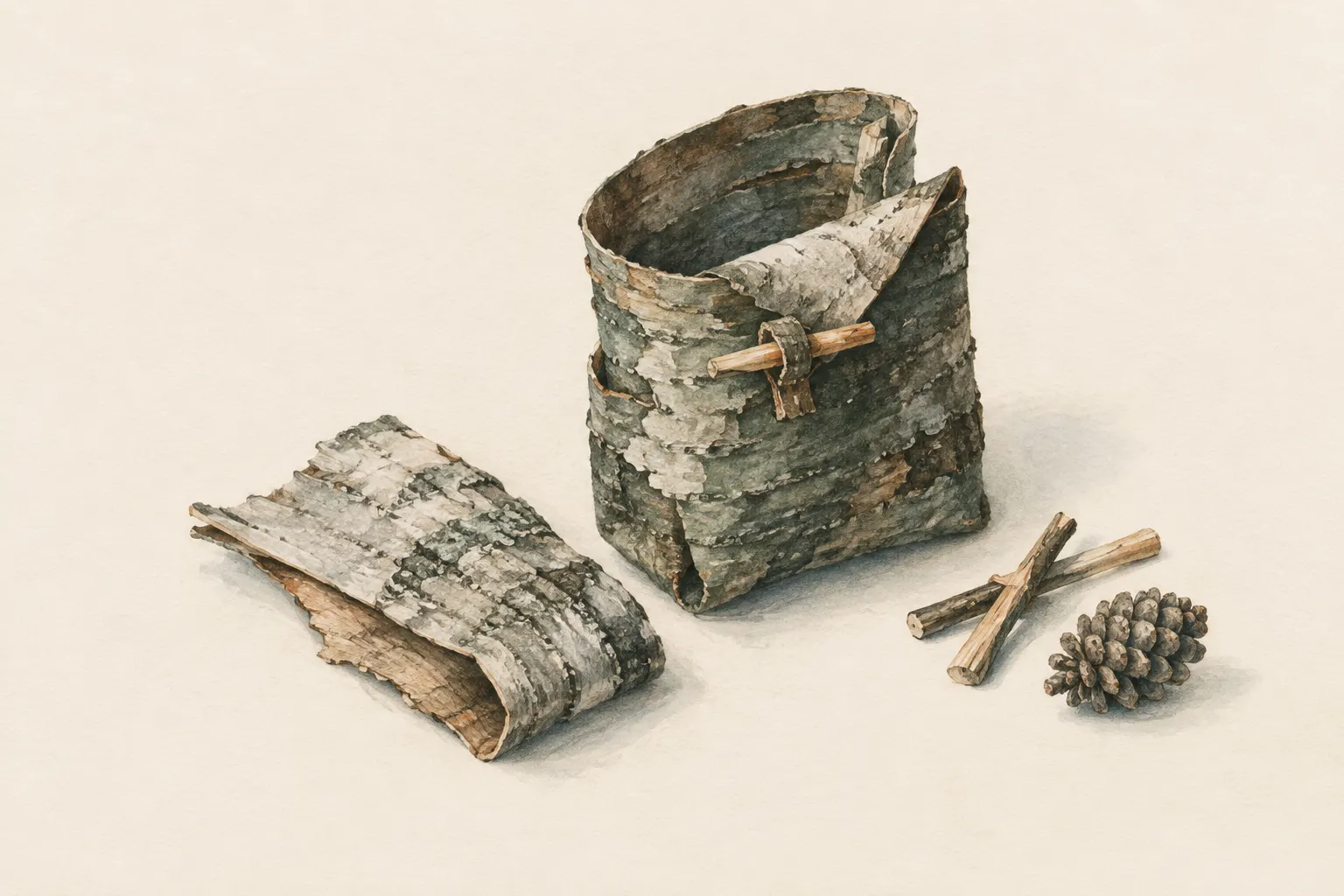
Loose, still flexible bark from fallen, dead trunks can be folded into a simple container and closed with wooden clips or cord – for tinder, collected items or small parts. Bark is never peeled from living trees. If folding does not work the bark is too brittle; then leave it where it is.
- 30–60 minutes
Explained simply
Bark is a tree's skin. On a living tree it protects the layer underneath, through which the tree moves food and water – just as your skin protects you. Peeling the bark off a living tree injures it badly. If the bark is removed all the way round, the tree can even die. So there is a firm rule here: you take bark only from trees that are already dead and lying on the ground.
On such fallen trunks the bark sometimes comes away by itself. If it is still tough and flexible, you can fold a small box from it – much like a box made of paper. The corners are folded inwards, and little split twigs hold the folds together like clothes pegs. In it you can keep dry tinder, collected cones or small things.
If the bark cracks when you bend it, it is too dry and brittle – then you leave it where it is. It is best to practise the folding with card first. And when cutting with a knife: on a firm surface and always away from your body.
How it works
The bark of some trees is tough, water-repellent and can be bent while it is damp or warmed. When it dries out it becomes stiffer and can crack. That is why dry bark is soaked in water or warmed carefully over warm air before folding – never held in the flame, because bark burns well.
You know the folding principle from paper boxes: a rectangle is creased along the base lines, the sides are folded up, and extra material appears at the corners. This is laid against the wall as a triangular fold. That way the base stays whole, without a single cut, and the container is tight. A base that has been cut into will leak later.
The clips hold the folds until the bark has dried in its new shape. For this you split thin twigs part of the way and slide them over the folds. Alternatively you wrap cord around them. After drying, the container usually holds its shape better; sometimes the clips need tightening once more.
Where the bark comes from
Peeling living trees damages them severely and is forbidden in many places. Directly beneath the bark lies the layer in which the tree grows and transports nutrients. If it is exposed, it dries out, fungi and pests get in, and if a ring is removed all round the trunk, the tree often dies. So you take nothing from standing or living trees – not even “small pieces”.
Only loose bark from fallen trunks that are already dead, which is coming away by itself and is still tough, is suitable. Such bark is rare, and it is often already too brittle. That is part of it: if you find no suitable bark, then no container gets made. Using deadwood is not allowed everywhere either – check local rules, and in protected areas everything stays as it is.
This entry does not identify tree species. Traditionally birch bark in particular was used for such containers. For the exercise, though, the species does not matter: what counts is whether a piece of bark comes from dead, fallen wood, whether it is tough and flexible – and whether you are allowed to take it.
What really matters
Cut a rectangle as large as the desired base plus the wall height all round. Score the base lines only lightly with the back of the knife so they fold cleanly without the bark tearing through. Work slowly: bark that is bent too fast is more likely to crack.
The corners are the hardest part. Fold up two opposite sides, press the extra material at the corners into a triangle and lay it flat against the outside wall. Hold it with your fingers until the clip is in place. If a corner tears, it is not the end of the world – next time soak the bark a little longer.
A bark container is good for collecting tinder and keeping it dry, or as a tray for dry small items. It does not last forever and it is not a cooking vessel. Without a lot of experience it is not suitable for food or cooking, and this entry deliberately does not describe that.
Safety: what to watch out for
Bark is smooth and slips easily when you cut it. So cut on a firm surface, such as a board or a flat piece of wood, and always guide the knife away from your body and from the holding hand. A sharp knife is safer than a blunt one, because you need less force and it does not slip as easily.
Only hold bark over warm air to warm it, never in the flame, and stay with it. For a deep cut, press firmly on the wound and, if bleeding is heavy, call the local emergency number (112 in the EU).
How to practise it
Practise the folding technique with card or thick paper first. Draw the rectangle and the base lines, fold the corners and clip them with clothes pegs. That way you learn the movements without using up precious bark. Only when this works reliably do you try it with bark.
Bark containers have a long tradition in many northern cultures, and bushcraft textbooks describe them. Traditionally bark was sometimes taken from living trees too. This atlas deliberately describes only bark from dead, fallen wood – because the harm to living trees is real and because it is forbidden in many places today.
Step by step
Find bark
Look on fallen, dead trunks for bark that is already coming away and is still tough. Take nothing from standing or living trees.
- 1
Find bark
Look on fallen, dead trunks for bark that is already coming away and is still tough. Take nothing from standing or living trees.
- 2
Cut a rectangle
Cut a rectangle from the loose bark, about the size of the desired base plus the wall height all round.
- 3
Make it pliable
Soak dry bark in water or warm it carefully over warm air until it bends – do not hold it in the flame.
- 4
Fold the corners
Lightly score the base lines with the back of the knife, fold the sides up and lay the corners as triangular folds against the wall.
- 5
Clip
Split twigs and slide them over the folds as clips, or wrap with cord.
- 6
Let it dry
Let the container dry in shape; then retighten the clips if needed.
Common mistakes
- Pulling bark off a living tree
- Folding brittle bark – it cracks
- Cutting into the base – it leaks
- Warming bark in the flame
Quick view
Materials
Knife (fixed or locking blade)
Or another fixed-blade knife
Cut away from your body.
Rules on carrying knives differ by region – check local rules.
Jute or sisal twine (bought)
Low strength, absorbs water and rots – light loads and practice only.
Sturdy sticks / poles
Thin split twigs as clips
Do not cut live wood where prohibited.
Suitable for
- Collecting tinder and keeping it dry
- A project and practice for courses
- A container for dry small items
Not suitable for
- Bark from living trees – never
- Cooking or storing food without experience
- Protected areas
Prerequisites
- Safe knife handling
- Finding a fallen, dead trunk with loose, intact bark
- Permission to use deadwood
Safety
- Peeling living trees damages them severely and is forbidden in many places. Use only loose bark from wood that is already dead and fallen, and check local rules.
- Bark slips easily when cut. Cut on a firm surface and away from the body.
How it works
The bark of some trees is tough, water-repellent and can be bent when damp or warmed. Folding the corners of a rectangle inwards produces a tight tray without cutting the base; clips hold the folds.
Advantages
- Light, little tooling needed
- Biodegradable
- Good practice project
Disadvantages
- Suitable loose bark is rare
- Limited durability
- Not permitted everywhere
Deep knowledge
Background
Bark containers, especially of birch bark, have a long tradition in many northern cultures and are described in bushcraft textbooks such as Ray Mears'.
Traditionally bark was sometimes taken from living trees too; this atlas deliberately describes only bark from dead, fallen wood.
Variants
- Practice with card
- Practise the folding technique with card or thick paper first before using bark.
Common mistakes
- Pulling bark off a living tree
- Folding brittle bark – it cracks
- Cutting into the base – it leaks
- Warming bark in the flame
Limits and risks
- No tree identification
- No instructions for cooking vessels made of bark
Material alternatives
Derived from material properties: a substitute must have all relevant properties. Observe the notes on the substitute.
- Jute or sisal twine (bought)
- Rope (Never use unknown or damaged rope for life-safety purposes.), Paracord (Not a climbing or safety rope.), Thin twine (Low breaking strength – light loads only.), Accessory cord (Use only certified cord after training for life-safety purposes.), Webbing (tubular webbing) (Inspect knotted webbing before every use.), Tree straps (Load only within the manufacturer's limits.)
Results come exclusively from structured entries. No improvised instructions are generated.
Sources
Ray Mears – Hodder & Stoughton (2002): Bushcraft
Birch bark containers
Leave No Trace Center for Outdoor Ethics: The Seven Principles of Leave No Trace (Principle 5: Minimize Campfire Impacts)
Leave what you find; do not damage live plants