Karst landscapes and sinkholes
In limestone, dolomite and gypsum areas water slowly dissolves the rock. This creates caves, dolines and disappearing streams – and occasionally sinkholes collapse suddenly. On the trail this means: keep away from the edges of hollows and shaft openings, always treat water from karst springs and only enter caves on guided tours.
- Attention on the way, reporting anything unusual
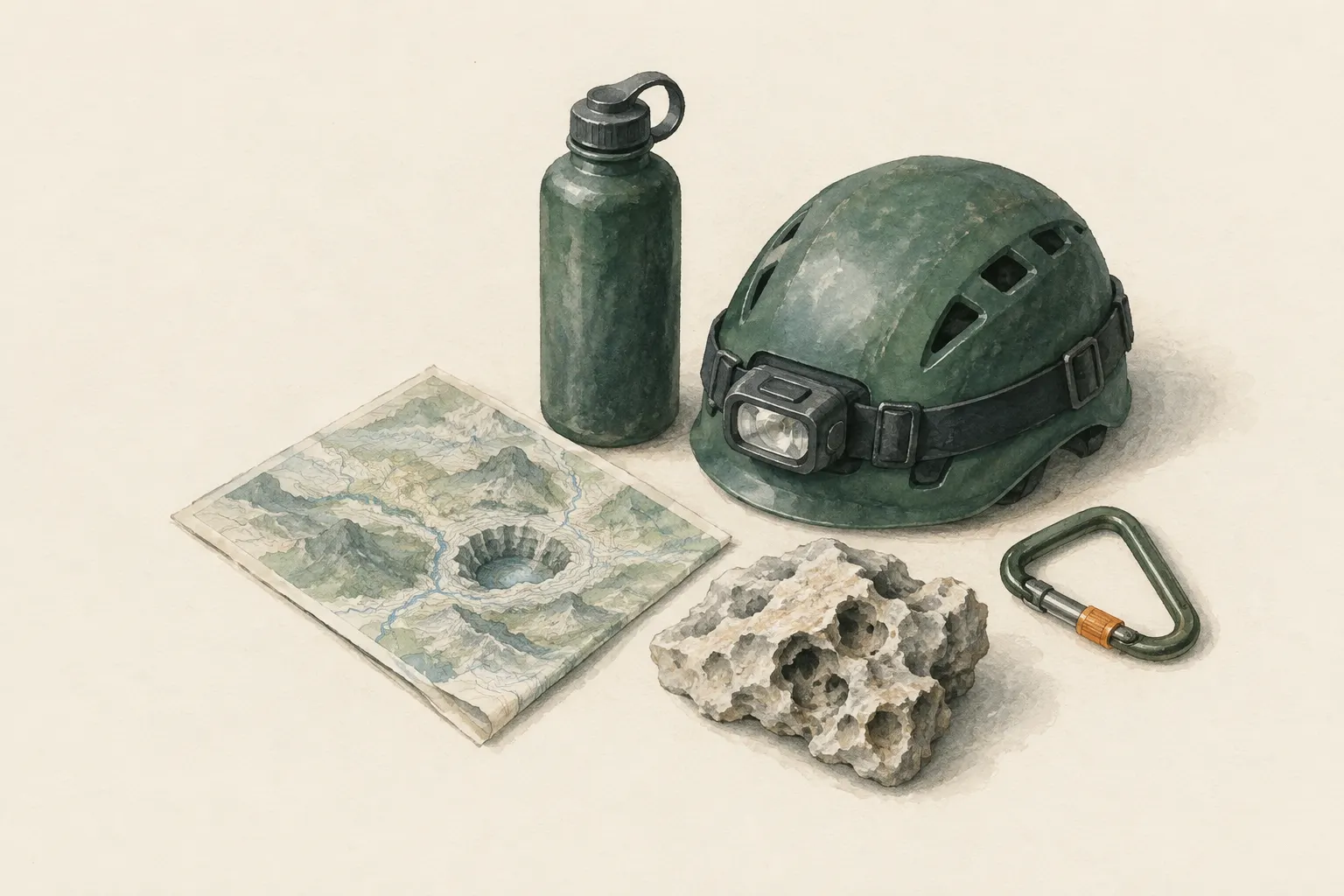
Explained simply
Some rocks, such as limestone and gypsum, dissolve very slowly in water – a bit like a sugar cube with a thin trickle of water running over it for a very long time. Over a great many years this creates cracks, tubes and caves underground. Such landscapes are called karst.
At the surface you sometimes see funnel-shaped hollows, streams that suddenly disappear into the ground, or strong springs. Rarely, the roof of a cavity collapses and a hole opens in the ground – a sinkhole.
The most important point: keep away from the edges of hollows, shaft openings and fresh collapses, because their edges can give way. Never drink even clear, cold spring water without treating it. And only go into caves with a guide.
How it works
On its way through air and soil, rainwater takes up carbon dioxide and becomes slightly acidic. This weakly acidic water dissolves limestone and dolomite along joints and bedding planes. Gypsum dissolves even more easily. Over long periods, fine cracks widen into tubes and caves through which water flows underground.
A sinkhole forms when the roof of such a cavity collapses or when loose material such as sand and clay trickles down into cracks from above. A depression or a hole then forms at the surface. Some hollows develop slowly over centuries, others collapse suddenly.
Triggers for sudden collapses can be heavy rain, long droughts or human activity, for example when groundwater is pumped out or water leaks from pipes. The US Geological Survey describes these processes in detail in its Water Science School.
Recognising karst
Typical signs are funnel-shaped hollows in meadows and forests, called dolines, streams that suddenly vanish into a hole, strong springs at the foot of slopes and bare, furrowed limestone surfaces. Dry valleys without a stream can also point to karst, because the water drains away underground.
Geological maps or information boards often tell you whether you are in a karst area. In Europe there are large karst areas, for example, in the Limestone Alps, the Dinaric mountains and parts of central Germany with gypsum karst. National geological surveys publish maps of areas where sinkholes occur.
Safety: what to watch out for
The edges of dolines, shafts and fresh collapses can give way, because there are cavities beneath them that you cannot see from above. Stay on paths, do not step to the edge of hollows or shaft openings and never cross barriers. Keep children and dogs close to you. In fog and snow extra care is needed, because openings can be hidden.
Do not investigate a fresh sinkhole, however curious you are. Have it cordoned off and report it to the local authority. Anyone living in a karst area who notices new depressions, cracks in walls or floors, tilting posts or water suddenly draining away near the house should also avoid the area and report it. In immediate danger, call the local emergency number (112 in the EU).
Caves in karst areas can fill with water quickly when it rains, even if it is only a shower outside. So only go into show caves or on guided tours with a caving club, and never when it is raining or a storm warning is in place.
Water in karst
In ordinary soil, water seeps slowly through earth, sand and gravel, and some contaminants are held back on the way. Karst is different: water flows quickly and almost unfiltered underground through cracks and tubes. Whatever gets into the ground on a pasture, by a road or in a village above can come out of a spring a short time later.
That is why clear, cold spring water can still be contaminated. Always treat water from karst springs and streams before drinking, for example by boiling it, and follow the advice of the local authorities. A filter alone does not make water safe.
Good to know
Sinkholes are rare, and there are often warning signs such as new depressions, cracks or tilting posts. Karst areas are usually well researched and mapped. If you know the signs and keep your distance, you can enjoy these landscapes with their caves, springs and rock formations safely.
This text gives no construction or survey advice and explains no caving technique. Anyone who owns or wants to buy a house in a karst area should turn to experts and the national geological survey with their questions.
Step by step
Recognise karst
Typical signs: funnel-shaped hollows, streams that suddenly disappear, strong springs, bare, furrowed limestone surfaces.
- 1
Recognise karst
Typical signs: funnel-shaped hollows, streams that suddenly disappear, strong springs, bare, furrowed limestone surfaces.
- 2
Keep your distance
Stay on paths, do not step to the edge of hollows or shaft openings, and take extra care in fog and snow – openings can be hidden.
- 3
Treat water
Treat water from karst springs and streams before drinking, even if it is clear and cold.
- 4
Caves only with guides
Caves can flood quickly when it rains. Only show caves or guided tours with a caving club.
- 5
Report anything unusual
Do not investigate new collapses or depressions, have them cordoned off and report them.
Common mistakes
- Stepping up to a fresh sinkhole to look in
- Drinking clear karst spring water untreated
- Entering a cave when it is raining
- Ignoring cracks in a house
Quick view
Materials
Topographic map
Check the publication date – paths and buildings may have changed.
Protect from wet (map case or bag).
Suitable for
- Hikes in limestone mountains and karst plateaus
- Homeowners in karst regions
Not suitable for
- Caving
- Assessing the structural safety of buildings
Prerequisites
- Knowing whether you are in a karst area (geological maps, information boards)
Safety
- In karst areas water flows quickly and almost unfiltered underground through fissures and conduits. Clear spring water can be contaminated – always treat it.
- New depressions, cracks in walls or floors, tilting posts or water suddenly draining away near a house: avoid the area and report it to the local authority. In immediate danger call the local emergency number (112 in the EU).
How it works
Rainwater takes up carbon dioxide and becomes slightly acidic. It dissolves limestone and gypsum along joints and widens them over long periods into conduits and caves. If the roof of a cavity collapses or loose material trickles in, a hollow forms at the surface. Heavy rain, drought or human activity can trigger such collapses.
Advantages
- Sinkholes are rare and often show warning signs
- Karst areas are usually well mapped
Disadvantages
- Cavities are invisible from above
- Groundwater is easily polluted
Deep knowledge
Background
The US Geological Survey explains in its Water Science School how sinkholes form in soluble rock, what triggers them and why groundwater in karst areas is particularly vulnerable.
In Europe, large karst areas are found for example in the Limestone Alps, the Dinaric mountains and parts of central Germany (gypsum karst); national geological surveys publish maps of sinkhole-prone areas.
Common mistakes
- Stepping up to a fresh sinkhole to look in
- Drinking clear karst spring water untreated
- Entering a cave when it is raining
- Ignoring cracks in a house
Limits and risks
- No construction or survey advice
- No caving technique
Sources
U.S. Geological Survey (USGS): Sinkholes (USGS Water Science School)
Formation and triggers of sinkholes, vulnerability of groundwater
World Health Organization (2022): Guidelines for drinking-water quality, fourth edition incorporating the first and second addenda
Principle: treat water from unprotected sources
European Commission: 112 – the European emergency number
European emergency number 112