Capturing small springs and trickles cleanly
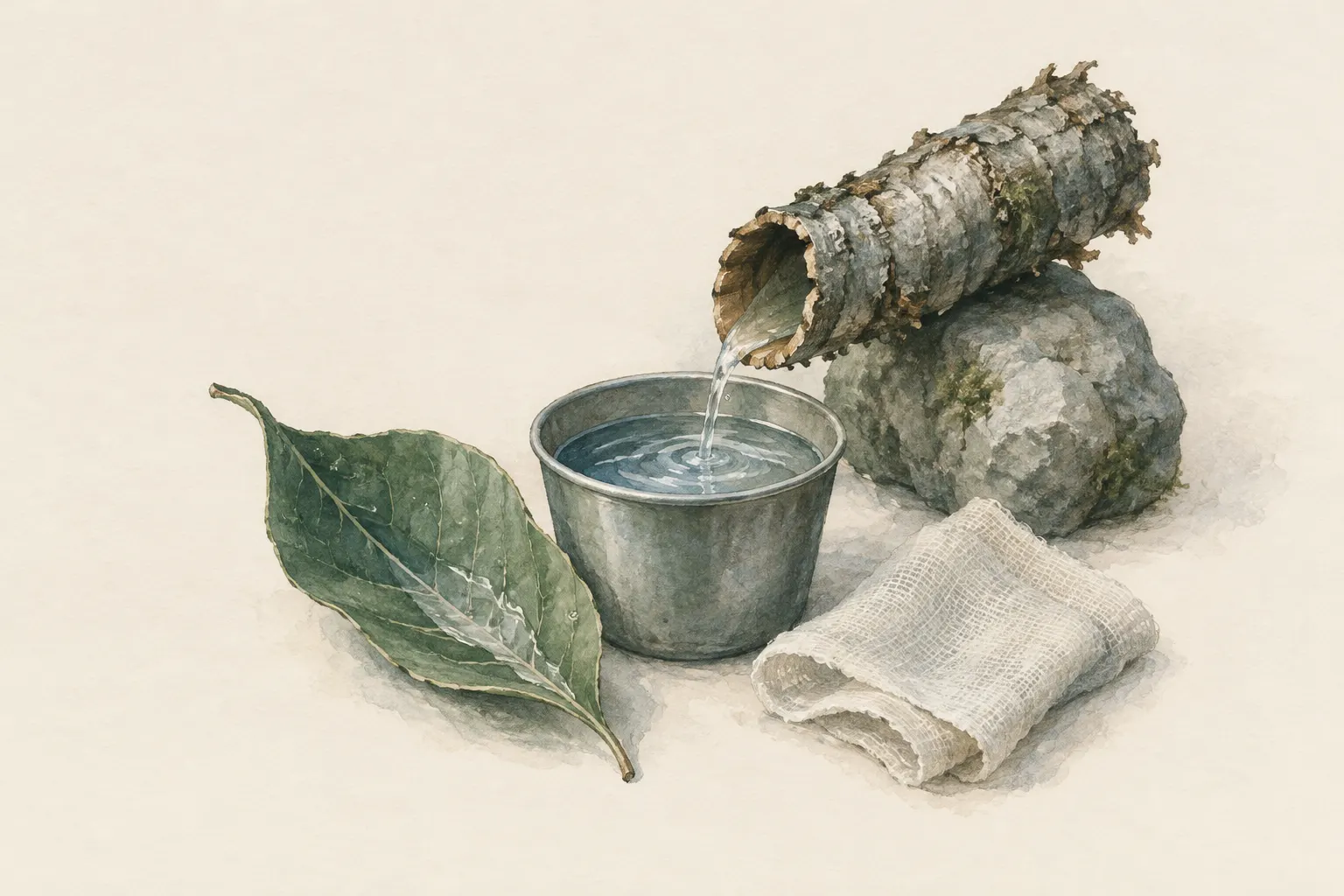
From a weak spring or trickle, a leaf, a piece of bark or a tube used as a spout lets you fill water cleanly without stirring up mud. Spring water is often clearer than stream water but not automatically safe – it is treated like any raw water.
- 5–15 minutes to set up
Explained simply
A spring is a place where water comes out of the ground. This water has been travelling underground for a while. That is why it is often clear and cold. Sometimes, though, a spring is just a thin trickle seeping over stones and leaves – you can hardly get any into a bottle without scooping up mud.
A simple trick helps: you push a large, clean leaf, a piece of bark or a tube into the outlet so that the water runs off it like from a tap. Then you hold your bottle underneath.
Important: even clear, cold spring water can contain germs, for example from animals grazing further up. That is why you boil it or disinfect it some other way before drinking it.
How it works
At a spring, groundwater emerges that has already flowed through soil and rock. Much suspended matter has stayed behind on the way, which is why spring water is often clearer than stream water. But as soon as it runs over leaves, mud and soil, it picks up dirt again. The closer to the outlet you collect it, the cleaner the collection.
With weak springs the water often flows as a thin film over a surface or seeps from a rock face. A spout gathers this film into a stream. It works like a roof gutter: the water follows the channel and drips off its end in a stream that can fill a bottle.
Whether the water itself is uncontaminated, however, cannot be seen. Surface water, animals, pastures, huts or paths above can carry in pathogens. And appearance says nothing about natural minerals or chemicals underground.
What really matters
First look at what lies above the spring: pastures, huts, paths, roads or mining. The more use above, the more important thorough treatment becomes – and with mining or roads, chemical contamination cannot be ruled out either.
Then carefully remove leaves and loose soil right at the outlet and wait until stirred-up mud has settled. Press a clean large leaf, a piece of bark or a tube into the outlet so that the water runs off it. Use only materials you know to be harmless; with plants you are often not sure – a clean tube or a piece of plastic sheet is the better choice then.
Hold the raw-water container under the stream without touching the ground or the spout with the opening. With very weak springs, a small basin lined with clean stones below the outlet can help water collect for scooping. Dismantle it afterwards where this is required.
Safety: what to watch out for
Spring water is raw water. Even if it bubbles out of the rock and is ice-cold, it can be contaminated by surface water, animals or people above. Disinfect it before drinking – for example by boiling or a suitable filter followed by chemical disinfection.
Take signs such as “not drinking water” at fountains and developed springs seriously. They are usually there because the water is not tested regularly or has been contaminated before. In protected areas, interfering with springs may be prohibited – check the local rules before you change anything.
Also watch your own footing. Springs are often on wet, slippery slopes or rock faces. Safe footing matters more than the last bottle of water.
Typical situations
In the mountains you often find small springs or seeps on rock faces where there is no stream to scoop from. Here a spout saves a lot of time and frustration, because you can fill the bottle directly. In forests, springs often emerge at the foot of slopes, frequently recognisable by damp ground and lush green growth.
If you carry a filter, clear spring water spares the filter element. It clogs more slowly, and you can filter longer before you have to backflush. Still, with hollow-fibre filters: against viruses you need additional chemical disinfection or boiling.
Good to know
Protecting springs is one of the classic measures of drinking-water hygiene. The less surface water and dirt reach the outlet, the better the starting quality. That is why developed village springs are often walled in and covered.
In the field you can only make the collection clean; you cannot test the water itself. Whether a spring is really uncontaminated can only be determined by laboratory testing. That is why even the most beautiful spring water is treated.
Step by step
Check the surroundings
Check what lies above: pastures, huts, paths, roads, mining. The more use above, the more important thorough treatment becomes.
- 1
Check the surroundings
Check what lies above: pastures, huts, paths, roads, mining. The more use above, the more important thorough treatment becomes.
- 2
Clear the outlet
Carefully remove leaves and loose soil right at the outlet. Wait until stirred-up mud has settled.
- 3
Insert a spout
Press a clean large leaf, a piece of bark or a tube into the outlet so that the water runs off it in a stream. Use only known, harmless materials.
- 4
Fill
Hold the raw-water container under the stream without touching the ground or spout with the opening.
- 5
Treat
Disinfect the water before drinking it. Leave the site as you found it.
Common mistakes
- Assuming spring water is always safe
- Stirring up mud at the outlet
- Touching the ground with the bottle neck
- Ignoring signs at fountains
Quick view
Materials
PET bottle (clear, max. 2 litres)
Mark it as the raw-water container
Do not heat or place in a fire.
Metal pot (stainless steel, aluminium, titanium)
Hot – scalding risk.
Suitable for
- Weak springs in mountains and forest
- Seeps on rock faces
- Filling bottles without a scoop
Not suitable for
- Springs below pastures, huts, roads or mining without extra caution
- Developed springs signed ‘not drinking water’
- Protected areas where interference is prohibited
Prerequisites
- A spring or trickle with a visible outlet
- A disinfection method
Safety
- Even clear, cold spring water can be contaminated by surface water, animals or people above. Disinfect before drinking.
- Take signs such as ‘not drinking water’ at fountains and springs seriously. Interfering with springs in protected areas may be prohibited – check local rules.
How it works
At a spring, groundwater emerges after already passing through soil. Taking the water right at the outlet, before it runs over leaves and mud, usually gives clearer water. A spout gathers the thin film of water into a stream that fills a bottle.
Advantages
- Often the clearest water available
- Quick and needs no tools
- Spares filters
Disadvantages
- No protection against pathogens
- Slow filling from weak springs
Deep knowledge
Background
Protecting springs is one of the classic measures of drinking-water hygiene: the less surface water and pollution reach the outlet, the better the starting quality. Developed springs in villages are therefore often enclosed and covered.
In the field only the collection itself can be made clean. Whether the water itself is uncontaminated cannot be known without testing.
Variants
- Small basin
- A small basin lined with clean stones below the outlet lets water collect for scooping. Dismantle after use where this is required.
Common mistakes
- Assuming spring water is always safe
- Stirring up mud at the outlet
- Touching the ground with the bottle neck
- Ignoring signs at fountains
Limits and risks
- Does not replace disinfection
- Says nothing about chemicals or natural mineral content
Material alternatives
Derived from material properties: a substitute must have all relevant properties. Observe the notes on the substitute.
- Metal pot (stainless steel, aluminium, titanium)
- Single-wall stainless steel bottle (Heat only single-wall bottles without paint/plastic; remove the lid before heating.)
Results come exclusively from structured entries. No improvised instructions are generated.
Sources
World Health Organization (2022): Guidelines for drinking-water quality, fourth edition incorporating the first and second addenda
Spring protection and raw-water quality
Centers for Disease Control and Prevention: Making Water Safe in an Emergency
Disinfecting water from natural sources