Seep well beside a lake or river (bank filtration)
A hole a few paces beside a muddy pond, lake or river fills with water that has seeped through the soil. It is usually much clearer than the open water – but not germ-free and not chemically cleaned. A seep well is pre-clarification, not treatment.
- 15–30 minutes of digging, then seepage and settling
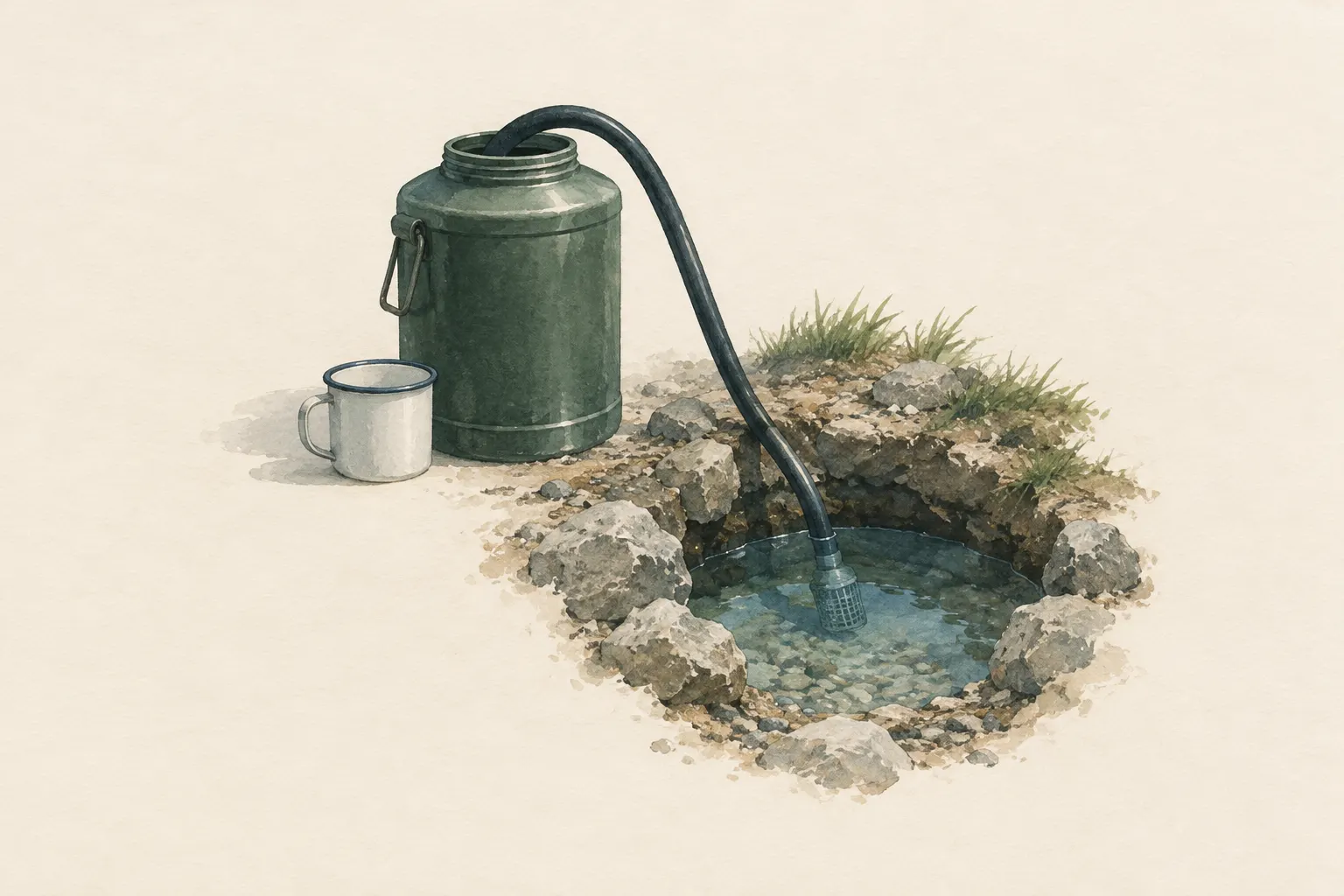
Explained simply
If a pond or river looks muddy and green, you can dig a hole a few paces beside it. After a while water runs in – it comes from the pond or river and has seeped through the ground. The sand works like a coarse sieve: mud, algae and floating particles get stuck.
That is why the water in the hole usually looks much clearer than the water in the pond. But be careful: clear does not mean clean. Tiny germs and dissolved substances can pass through the ground.
Remember: a seep well is a first step, not a finished solution. The water must still be boiled or disinfected some other way afterwards. And if the water smells of oil or lies near factories, fields or sewage, a seep well will not help either.
How it works: the ground as a pre-filter
If you dig a hole beside a body of water that goes deeper than its water level, the water pushes in through the ground from the sides and below. On this short path, larger particles such as mud, algae and part of the microorganisms get caught between the grains of sand and gravel. The result is water that is much clearer than the open water.
Large waterworks also use this principle, under the name bank filtration. There, however, the water often flows through the ground over long distances, and proper treatment still follows. A seepage path of a few metres achieves correspondingly much less.
Bacteria, viruses and dissolved substances such as chemicals or salt can pass through the ground over a short distance. That is why the seep well is pre-clarification – comparable to letting water settle and filtering through cloth – and not disinfection.
What really matters
Choose a level, sandy or gravelly spot a few paces from the bank. Sandy ground lets water through well; in dense loam or clay hardly anything seeps in. Keep away from animal trails, watering places and above all latrines, so that no faeces get into your hole.
Dig until water seeps in from below or the sides. The bottom of the pit should be lower than the water level of the pond or river. The first water is usually cloudy because you stirred up soil while digging. Scoop it out and let the pit refill. Repeat until the water runs in clearer.
Then scoop carefully without stirring up the bottom and pour the water through a cloth into a raw-water container. If you use the pit for longer, you can line the edge with stones or gravel. That stops soil sliding in and clouding the water again.
Safety: what to watch out for
Clear seep water is not ready to drink. Boil it, or use a suitable filter followed by chemical disinfection. The seep well is still very useful here: clearer water clogs filters less and makes chemical disinfection more effective.
With an oil film, foam, chemical smell, dead fish, or industry, intensive farming or sewage nearby, bank filtration does not help either. Dissolved chemicals travel through the ground with the water. Find another source in that case. Seawater or brackish water also stays salty, however far it has seeped.
Do not dig at undercut or steep bank edges. Such edges can break off, and you can fall into the water. Also avoid flood zones, because the water there is almost always heavily contaminated.
When it makes sense – and when not
A seep well is especially worthwhile with muddy or algae-rich ponds and pools and with cloudy rivers in which a filter would clog quickly. It spares filters and chemicals and needs hardly any equipment – in an emergency a stick, a flat stone or a pot lid is enough for digging.
It makes less sense when clear water is directly available or the ground is too hard to dig. Then it only costs time and energy. In such cases it is enough to let water settle and pre-filter it through a cloth before you disinfect it.
How to practise it
Try a seep well somewhere digging is allowed, for example at a campsite by a pond with a sandy bank. For comparison, fill one glass with pond water and one with water from your pit. You will see the difference in clarity – and remember that you still cannot see germs.
Notice how long it takes for the pit to fill and run clear. That gives you a feel for how much time to plan in a real situation. Afterwards fill the pit in again and leave the site as you found it.
Step by step
Choose the spot
Choose a level, sandy or gravelly spot a few paces from the water, away from animal trails and well away from latrines.
- 1
Choose the spot
Choose a level, sandy or gravelly spot a few paces from the water, away from animal trails and well away from latrines.
- 2
Dig the hole
Dig until water seeps in from below or the sides. The bottom of the pit should be below the water level of the lake or river.
- 3
Discard the first water
Scoop out the first, cloudy water and let the pit refill. Repeat until the water runs in clearer.
- 4
Scoop
Scoop without stirring up and pour through a cloth into a raw-water container.
- 5
Disinfect
Boil the water or use a filter followed by chemical disinfection.
Common mistakes
- Assuming clear seep water is ready to drink
- Digging right next to animal trails or latrines
- Drinking the first cloudy water
- Digging beside chemically suspect waters
Quick view
Materials
Small trowel
Metal pot (stainless steel, aluminium, titanium)
Hot – scalding risk.
Cotton cloth / T-shirt
Removes coarse particles only – no disinfection.
Suitable for
- Muddy or algae-rich ponds and pools
- Cloudy rivers where filters would clog quickly
- Sparing filters
Not suitable for
- Waters suspected of chemicals, oil or sewage
- Flood zones
- Seawater and brackish water – salt remains
Prerequisites
- Diggable ground beside the water
- A subsequent disinfection method
Safety
- With an oil film, foam, chemical smell, dead fish, or industry, agriculture or sewage nearby, bank filtration does not help either – find another source.
- Do not dig at undercut or steep bank edges; risk of falling in and drowning.
How it works
On the way through sand and soil, suspended matter, algae and part of the microorganisms remain in the ground. Public water supplies also use bank filtration as a preliminary stage – but over long distances and with subsequent treatment. A short seepage path of a few metres achieves correspondingly less.
Advantages
- Much clearer water
- Spares filters and chemicals
- Hardly any equipment
Disadvantages
- No disinfection
- Digging required
- No effect on dissolved substances
Deep knowledge
Background
Survival manuals recommend digging beside muddy or stagnant water instead of scooping directly. In water supply, bank filtration is an established pre-treatment process, but it is always combined with further treatment.
In the field the seep well therefore remains what settling and cloth filtering are too: the first step of the treatment chain.
Variants
- Lined with stones
- If the pit is used for longer, stones or gravel around the edge stop soil sliding in and clouding the water.
Common mistakes
- Assuming clear seep water is ready to drink
- Digging right next to animal trails or latrines
- Drinking the first cloudy water
- Digging beside chemically suspect waters
Limits and risks
- No complete protection against pathogens
- No removal of chemicals or salt
- Productive only in permeable ground
Material alternatives
Derived from material properties: a substitute must have all relevant properties. Observe the notes on the substitute.
- Metal pot (stainless steel, aluminium, titanium)
- Single-wall stainless steel bottle (Heat only single-wall bottles without paint/plastic; remove the lid before heating.)
Results come exclusively from structured entries. No improvised instructions are generated.
Sources
Headquarters, Department of the Army (USA) (2002): FM 3-05.70 Survival
Digging beside muddy or stagnant water to obtain clearer water
World Health Organization (2022): Guidelines for drinking-water quality, fourth edition incorporating the first and second addenda
Bank filtration as pre-treatment that does not replace further treatment
Centers for Disease Control and Prevention: Making Water Safe in an Emergency
Disinfecting surface water before drinking