Treatment chains: combining methods sensibly
No single field method covers everything. A chain has proven itself: first clarify, then remove or kill pathogens, then store cleanly. Typical chains are ‘settle – filter – disinfect chemically’ or ‘settle – boil’. Order matters, and even the best field chain does little against chemicals and salt.
- 30 minutes to several hours depending on the chain
Explained simply
Imagine you want to protect a football goal. A single player cannot stop everything – that is why there are defenders and a goalkeeper. It is the same with water: no single method stops all dangers. So you combine several steps into a chain.
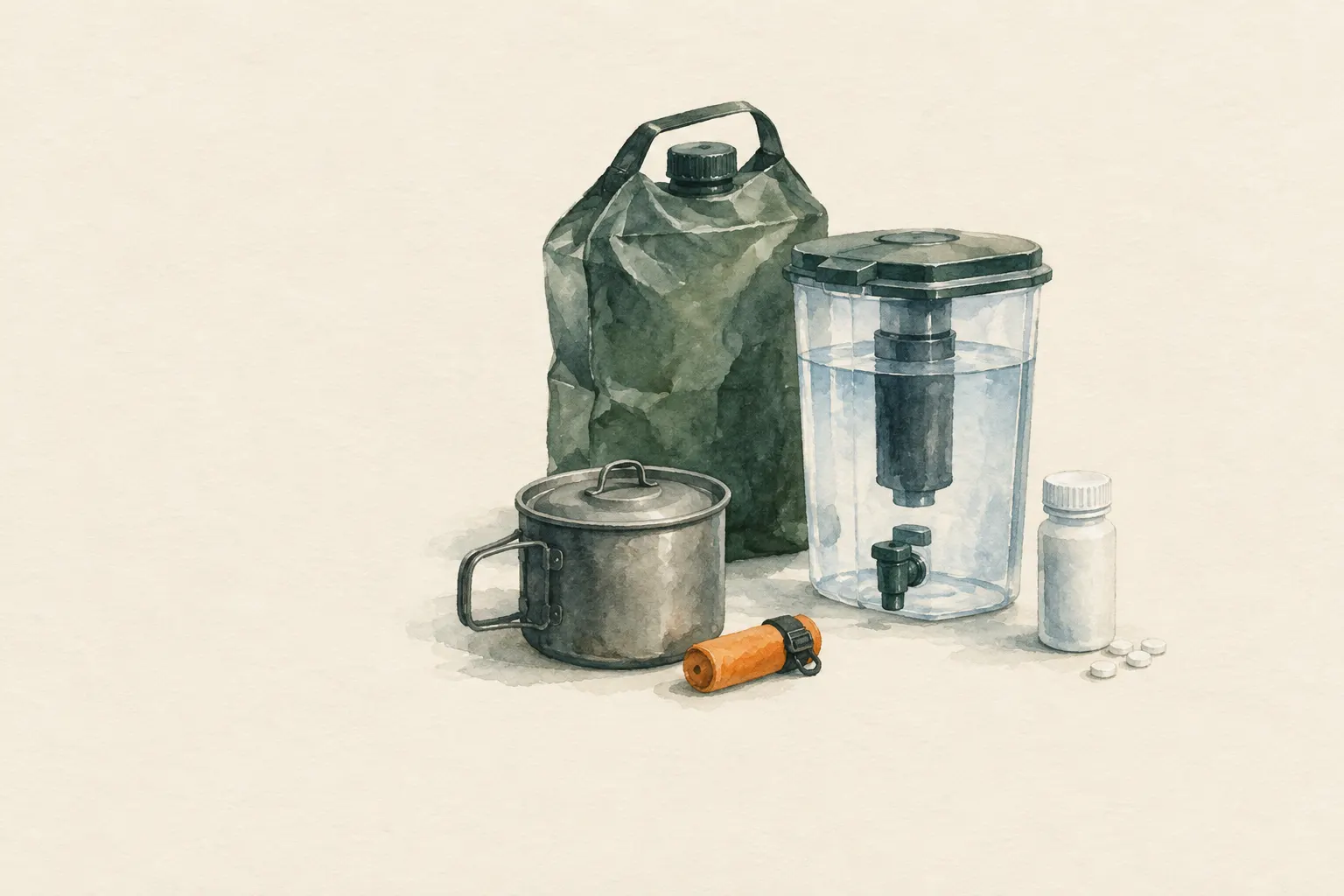
A typical chain looks like this: first you let cloudy water settle and pour it through a cloth – that is clarifying. Then you remove or kill the germs, for example by boiling or by filtering plus disinfection tablets. Finally you fill the water into a clean container.
The order matters, and one limit remains: even the best chain in the field does little against chemicals and salt. If you suspect chemicals, look for a different water source.
How it works: barriers that complement each other
Every method has strengths and gaps. Clarifying removes cloudiness but kills nothing. A filter retains protozoa and bacteria but usually lets viruses through. Chlorine catches bacteria and viruses but is weak against Cryptosporidium. Combine filter and chlorine, and each covers the other’s gap.
Clarifying plays a special role: it protects filters from clogging and makes chemical agents and UV light more effective, because fewer particles shield pathogens or use up the active ingredient. Chlorine has one more benefit: it leaves residual protection that shields stored water from new contamination for a while.
Boiling is the exception that covers all three pathogen groups on its own. But it needs fuel and time. You should still clarify cloudy water beforehand, so it tastes better and less dirt ends up in the pot.
What really matters: the right order
It always starts with assessing the source: is the water clear or cloudy? Is the source remote or close to settlements, huts or livestock? Are there signs of chemicals? This determines which chain you need – and if chemicals are suspected, you do not need a chain but a different source.
Next comes clarifying: let it settle, pour it through a cloth or coffee filter, and with muddy waters perhaps dig a seep well. After that you remove or kill the pathogens: boil, or filter and then disinfect chemically if viruses are expected. With clear water, a UV device is also possible.
Only at the very end, once disinfection is fully complete, do activated carbon or flavourings come in. If they come too early, they can interfere with disinfection. Activated carbon after chlorination also removes the residual protection – you should drink such water soon.
Typical situations
Clear stream, remote: a filter for bacteria and protozoa may be enough here. If there are huts, livestock or many people upstream, additionally disinfect chemically or boil. Cloudy and near settlements: settle – cloth – filter – disinfect chemically, or settle – cloth – boil.
Household under a boil-water notice: boil as the authority instructs. Without energy for boiling, use the chemical alternative the authority names. Without fuel on the move: filter plus chlorine or chlorine dioxide; with clear water, alternatively a UV device or SODIS, which means disinfection with sunlight in clear bottles.
In every situation the chain ends with clean storage: clean, labelled containers, covered, and water drawn only with clean cups or through a tap.
Safety: what to watch out for
No combination of clarifying, filtering, boiling and disinfecting reliably makes chemically contaminated water safe. If contamination is suspected – oily film, chemical smell, industry, mining, flood water – use another source or officially supplied water. Seawater and brackish water also stay salty; only distillation removes salt.
Mechanical filtering alone is not complete drinking-water treatment. That applies all the more to improvised sand, cloth or charcoal filters: they are clarification steps, not disinfection. Where viruses are expected, disinfection is always part of the chain.
Each stage is only as good as its application. Keep to contact times, especially with cold water, dose according to the manufacturer and keep raw and drinking water apart. A perfect chain is of no use if the water ends up in a dirty jerrycan.
Good to know
The multiple-barrier principle is the basis of WHO drinking-water hygiene. From the source to the glass, several protective stages are meant to ensure that the failure of a single stage does not lead straight to illness. Wilderness-medicine guidance applies this idea to field methods.
For your gear this means: before the trip, think about which chains you can build with your equipment and which gaps remain. A small pack of disinfection tablets to complement the filter, or a pot for boiling, often closes the most important gap.
Step by step
Assess the source
Clear or cloudy? Remote or near settlements? Signs of chemicals? The chain depends on this – if chemicals are suspected, use another source.
- 1
Assess the source
Clear or cloudy? Remote or near settlements? Signs of chemicals? The chain depends on this – if chemicals are suspected, use another source.
- 2
Clarify
Let it settle, pour it through cloth or a coffee filter, use a seep well or sand filter if appropriate.
- 3
Remove or kill pathogens
Boil – or filter and then disinfect chemically if viruses are expected. With clear water UV is also possible.
- 4
Optional: taste
Use activated carbon or flavourings only after disinfection is complete.
- 5
Store cleanly
Fill into clean, labelled containers, cover and draw with clean cups.
Common mistakes
- Thinking one filter does everything
- Chlorinating cloudy water directly
- Using carbon before disinfection and then assuming it is safe
- Adding flavourings before the end of contact time
- Filling clean water into dirty containers
Quick view
Materials
Cotton cloth / T-shirt
Removes coarse particles only – no disinfection.
Portable water filter (hollow fibre / membrane)
Do not let it freeze – fibres can be damaged without visible signs.
Chlorine tablets (NaDCC) for drinking water
Follow the manufacturer's dose and contact time.
Metal pot (stainless steel, aluminium, titanium)
Hot – scalding risk.
Food-grade water container
Only use containers that never held chemicals or fuel.
Suitable for
- Planning water equipment
- Cloudy sources or sources near settlements
- Groups and households without supply
Not suitable for
- Chemically contaminated water
- Seawater and brackish water without distillation
Prerequisites
- Basic knowledge of the individual methods
- An assessment of the source
Safety
- Activated carbon after chlorination removes the residual protection – drink such water soon. Add flavourings only after the full contact time.
- Mechanical filtering alone is not complete drinking-water treatment; where viruses are expected, disinfection is part of it.
How it works
Several barriers make up for each other's gaps: clarifying protects filters and makes chemicals and UV more effective; filters remove protozoa against which chlorine is weak; chlorine catches viruses that filters let through and protects stored water from recontamination. Boiling covers all pathogen groups but needs fuel.
Advantages
- Closes gaps of individual methods
- Spares filters and chemicals
- Adaptable to source and means
Disadvantages
- More time and effort
- More equipment
- Still no effect on chemicals and salt
Deep knowledge
Background
The multiple-barrier principle is the basis of WHO drinking-water hygiene: from source to glass, several protective stages ensure that the failure of one stage does not lead to illness. Wilderness-medicine guidance transfers this to field methods.
In practice in the field this means: clarify, disinfect, keep clean – and stay honest about where no chain helps any more.
Variants
- Clear stream, remote
- Filter for bacteria and protozoa; with huts, livestock or many people upstream, additionally disinfect chemically or boil.
- Cloudy, near settlements
- Settle – cloth – filter – disinfect chemically; or settle – cloth – boil.
- Household under a boil-water notice
- Boil as instructed by the authority; without energy, the chemical alternative named by the authority.
- Without fuel
- Filter plus chlorine or chlorine dioxide; with clear water, alternatively SODIS or a UV device.
Common mistakes
- Thinking one filter does everything
- Chlorinating cloudy water directly
- Using carbon before disinfection and then assuming it is safe
- Adding flavourings before the end of contact time
- Filling clean water into dirty containers
Limits and risks
- No reliable removal of chemicals
- Salt only by distillation
- Each stage only as good as its application
Material alternatives
Derived from material properties: a substitute must have all relevant properties. Observe the notes on the substitute.
- Chlorine tablets (NaDCC) for drinking water
- Chlorine dioxide tablets or drops (Only approved drinking-water products; follow manufacturer instructions.), Unscented household bleach (sodium hypochlorite) (Only unscented, without additives, with known concentration.), Iodine water purification tablets (Not in pregnancy, thyroid disease or iodine allergy without medical advice.)
- Metal pot (stainless steel, aluminium, titanium)
- Single-wall stainless steel bottle (Heat only single-wall bottles without paint/plastic; remove the lid before heating.)
- Food-grade water container
- Single-wall stainless steel bottle (Heat only single-wall bottles without paint/plastic; remove the lid before heating.), Double-wall insulated bottle (Never heat directly.), PET bottle (clear, max. 2 litres) (Do not heat or place in a fire.), Airtight food-grade storage container (Fill only when clean and completely dry; never use containers that previously held chemicals.), Collapsible water container or bag (Protect from sharp objects.), Food-grade water bag (Use only for drinking water, never for chemicals or fuel.), Fermentation jar or crock (Use only food-grade containers of glass, food-safe glazed stoneware or food-grade plastic – no metal containers for acidic food.), Resealable food bags (Use only bags intended for food; do not use with boiling water unless the manufacturer explicitly allows it.)
Results come exclusively from structured entries. No improvised instructions are generated.
Sources
World Health Organization (2022): Guidelines for drinking-water quality, fourth edition incorporating the first and second addenda
Multiple-barrier principle in drinking-water hygiene
Centers for Disease Control and Prevention: CDC Yellow Book: Health Information for International Travel – Water Disinfection
Combining filtration and disinfection by pathogen group
Wilderness & Environmental Medicine (Wilderness Medical Society) (2019): Wilderness Medical Society Clinical Practice Guidelines for Water Disinfection for Wilderness, International Travel, and Austere Situations: 2019 Update
Clarification before disinfection, combining methods in the field