Gravity filters for camps and groups
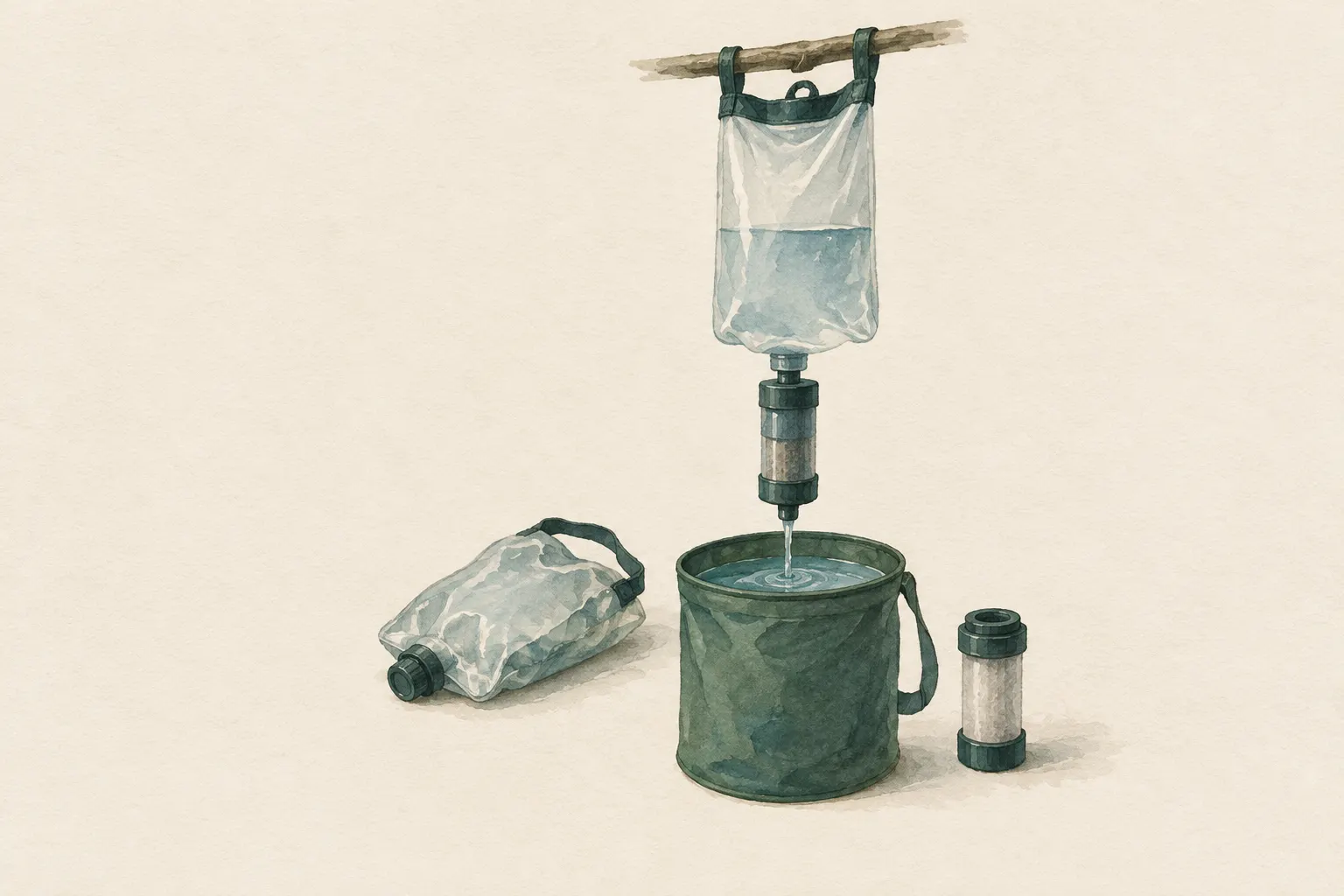
In a gravity filter a bag of raw water hangs above a filter element; the water runs into a clean container without pumping. This is convenient for groups. Like any mechanical filter it retains bacteria and protozoa depending on the element, but usually no viruses and no chemicals – mechanical filtering alone is not complete drinking-water treatment.
- Minutes to hang; flow depends on element and fouling
Explained simply
A gravity filter works like a coffee maker with a pour-over filter: the dirty water is at the top, the filter piece in the middle, and filtered water drips out at the bottom. You do not need to pump, because gravity pulls the water down by itself. To do this you hang a bag of raw water from a branch, for example.
This is very convenient, especially when many people need water. While the filter works, you can pitch tents or cook. The higher the bag hangs, the faster the water runs through.
But: the filter mainly stops bacteria and larger parasites. Viruses are usually too small and slip through. Where viruses are expected, for example near settlements, you must additionally disinfect the filtered water chemically or boil it. Against chemicals and salt the filter does not help at all.
How it works
The height difference between the raw-water bag and the outlet creates pressure. The bigger the difference, the harder the water presses through the filter element and the faster it flows. The element itself is a material with tiny pores, for example a bundle of hollow fibres or a ceramic body.
Everything larger than the pores gets stuck: suspended particles, protozoa and – depending on the element – bacteria. Anything smaller passes through the filter. This usually includes viruses and all dissolved substances such as chemicals and salt. So a filter is like a very fine sieve, but not something that kills germs.
Filter performance depends only on the element, not on whether it is used as a gravity, pump or squeeze filter. The advantage of a gravity system is convenience, not better cleaning.
What really matters
Before every trip, check the filter, hoses and seals for cracks and possible frost damage. Many manufacturers describe an integrity test you can use to check whether the element is still intact – carry it out if there is one.
Fill the raw-water bag at the clearest point of the source. Let cloudy water settle first or pour it through a cloth, or the element clogs quickly and the flow becomes very slow. Hang the bag as high as possible, lead the outlet into the clean container and open the clamp. Squeezing the bag because it hangs too low can strain the element.
The most important rule is separating the raw and clean sides. A single drop of raw water in the clean container or on the outlet hose undoes the whole filtration. Never put the outlet hose into the raw-water bag, and store both sides separately.
Safety: what to watch out for
Common hollow-fibre and ceramic elements do not reliably retain viruses. Near settlements, when many people live upstream of the source, or when travelling in regions with uncertain sanitation, additionally treat the filtered water chemically per the manufacturer’s instructions or boil it. Mechanical filtering alone is not complete drinking-water treatment.
An element that may have frozen can no longer be trusted. When water freezes in the fine fibres it can damage them without anything being visible. In frost, therefore, keep the filter protected as the manufacturer advises, for example in your sleeping bag at night.
No gravity filter helps against chemicals or salt. If chemical contamination is suspected, find another source.
Care and typical situations
After use, backflush the element according to the manufacturer. This means pushing clean water through the filter in the reverse direction to loosen stuck particles. Then empty the raw side and let all parts dry separately.
Gravity filters show their strength in a camp with several people, when several litres are needed without pumping. They are also useful at home during a supply disruption. There you often find bucket or candle filters: an upper bucket with ceramic or hollow-fibre elements in its base sits above a lower collecting container. Principle and limits are the same.
Gravity filters are less suited to quick drinking on the move, because you need a hanging point and the flow takes time.
Good to know
Gravity systems are widespread in household water treatment worldwide – from the simple ceramic pot filter to the outdoor bag. WHO sees household filters as one part of a multiple barrier, not as a solution on their own.
A common misunderstanding: filtered water often looks perfectly clear and tastes good. But that says nothing about viruses or dissolved substances. Clarity is a good sign that clarification worked, not proof of safety.
Step by step
Inspect the element
Check filter, hoses and seals for cracks and frost damage; carry out the manufacturer's integrity test if there is one.
- 1
Inspect the element
Check filter, hoses and seals for cracks and frost damage; carry out the manufacturer's integrity test if there is one.
- 2
Fill raw water
Fill the raw-water bag from the clearest part of the source. Let cloudy water settle first or pour it through a cloth.
- 3
Hang it
Hang the bag high, lead the outlet into the clean container and open the clamp.
- 4
Post-treat where needed
Where viruses are a risk, disinfect the filtered water chemically per manufacturer or boil it.
- 5
Backflush and dry
After use, backflush per manufacturer, empty the raw side and let everything dry separately.
Common mistakes
- Treating a gravity filter as complete treatment
- Putting the outlet hose into the raw-water bag
- Filling in cloudy water unclarified
- Continuing to use a frozen filter
- Hanging the bag too low and then squeezing it
Quick view
Materials
Portable water filter (hollow fibre / membrane)
Gravity kit with raw-water bag, hose and element
Do not let it freeze – fibres can be damaged without visible signs.
Collapsible water container or bag
Separate clean-water container
Protect from sharp objects.
Use only food-grade and only for water.
Chlorine tablets (NaDCC) for drinking water
For post-disinfection where viruses are a risk
Follow the manufacturer's dose and contact time.
Paracord
For hanging
Not a climbing or safety rope.
Suitable for
- Camps with several people
- Several litres without pumping
- Stationary use at home during supply disruption
Not suitable for
- Water with a virus risk without additional disinfection
- Chemically contaminated water or seawater
- Quick drinking on the move
Prerequisites
- Intact, never-frozen filter element
- Hanging point (branch, pole)
- Clear separation of raw and clean sides
Safety
- Keep the raw-water bag and the outlet hose strictly apart. Drops from the raw side in the clean container undo the filtration.
- An element that may have frozen can no longer be trusted. Protect it from frost per manufacturer instructions.
How it works
The height difference between bag and outlet creates the pressure that pushes water through the element. The element retains particles above its pore size; anything smaller – viruses, dissolved substances – passes. The higher the bag hangs, the faster the flow.
Advantages
- No pumping
- Large volumes for groups
- Works while you do other things
Disadvantages
- No removal of viruses, chemicals or salt
- Needs a hanging point
- Clogs with cloudy water
Deep knowledge
Background
Gravity systems are widespread in household water treatment worldwide, from the ceramic pot filter to the outdoor bag. Their advantage is convenience, not better filtration: only the element matters.
Because a filter usually lets viruses through, a gravity filter must always be followed by disinfection where viruses are to be expected.
Variants
- Bucket or candle filter
- At home or in camp, ceramic or hollow-fibre elements often sit in the base of an upper bucket above a lower collecting container. Principle and limits are the same.
Common mistakes
- Treating a gravity filter as complete treatment
- Putting the outlet hose into the raw-water bag
- Filling in cloudy water unclarified
- Continuing to use a frozen filter
- Hanging the bag too low and then squeezing it
Limits and risks
- Filtration only as good as the element
- Viruses usually not covered
- No effect on chemicals and salt
Material alternatives
Derived from material properties: a substitute must have all relevant properties. Observe the notes on the substitute.
- Collapsible water container or bag
- Single-wall stainless steel bottle (Heat only single-wall bottles without paint/plastic; remove the lid before heating.), Double-wall insulated bottle (Never heat directly.), PET bottle (clear, max. 2 litres) (Do not heat or place in a fire.), Food-grade water container (Only use containers that never held chemicals or fuel.), Airtight food-grade storage container (Fill only when clean and completely dry; never use containers that previously held chemicals.), Food-grade water bag (Use only for drinking water, never for chemicals or fuel.), Fermentation jar or crock (Use only food-grade containers of glass, food-safe glazed stoneware or food-grade plastic – no metal containers for acidic food.), Resealable food bags (Use only bags intended for food; do not use with boiling water unless the manufacturer explicitly allows it.)
- Chlorine tablets (NaDCC) for drinking water
- Chlorine dioxide tablets or drops (Only approved drinking-water products; follow manufacturer instructions.), Unscented household bleach (sodium hypochlorite) (Only unscented, without additives, with known concentration.), Iodine water purification tablets (Not in pregnancy, thyroid disease or iodine allergy without medical advice.)
- Paracord
- Rope (Never use unknown or damaged rope for life-safety purposes.)
Results come exclusively from structured entries. No improvised instructions are generated.
Sources
Centers for Disease Control and Prevention: CDC Yellow Book: Health Information for International Travel – Water Disinfection
Filters by pore size: bacteria and protozoa yes, viruses usually not
Wilderness & Environmental Medicine (Wilderness Medical Society) (2019): Wilderness Medical Society Clinical Practice Guidelines for Water Disinfection for Wilderness, International Travel, and Austere Situations: 2019 Update
Combining filtration and disinfection in the field
World Health Organization (2022): Guidelines for drinking-water quality, fourth edition incorporating the first and second addenda
Household filters as part of a multiple-barrier approach