Using a pump filter correctly
Pump filters draw water through a hose and push it through a ceramic, glass-fibre or hollow-fibre element. They also reach shallow trickles and holes. What they retain depends on the element; usually not viruses, chemicals or salt. Pumped water is filtered, but not drinking-ready in every situation.
- Several minutes of pumping per litre, depending on model and water
Explained simply
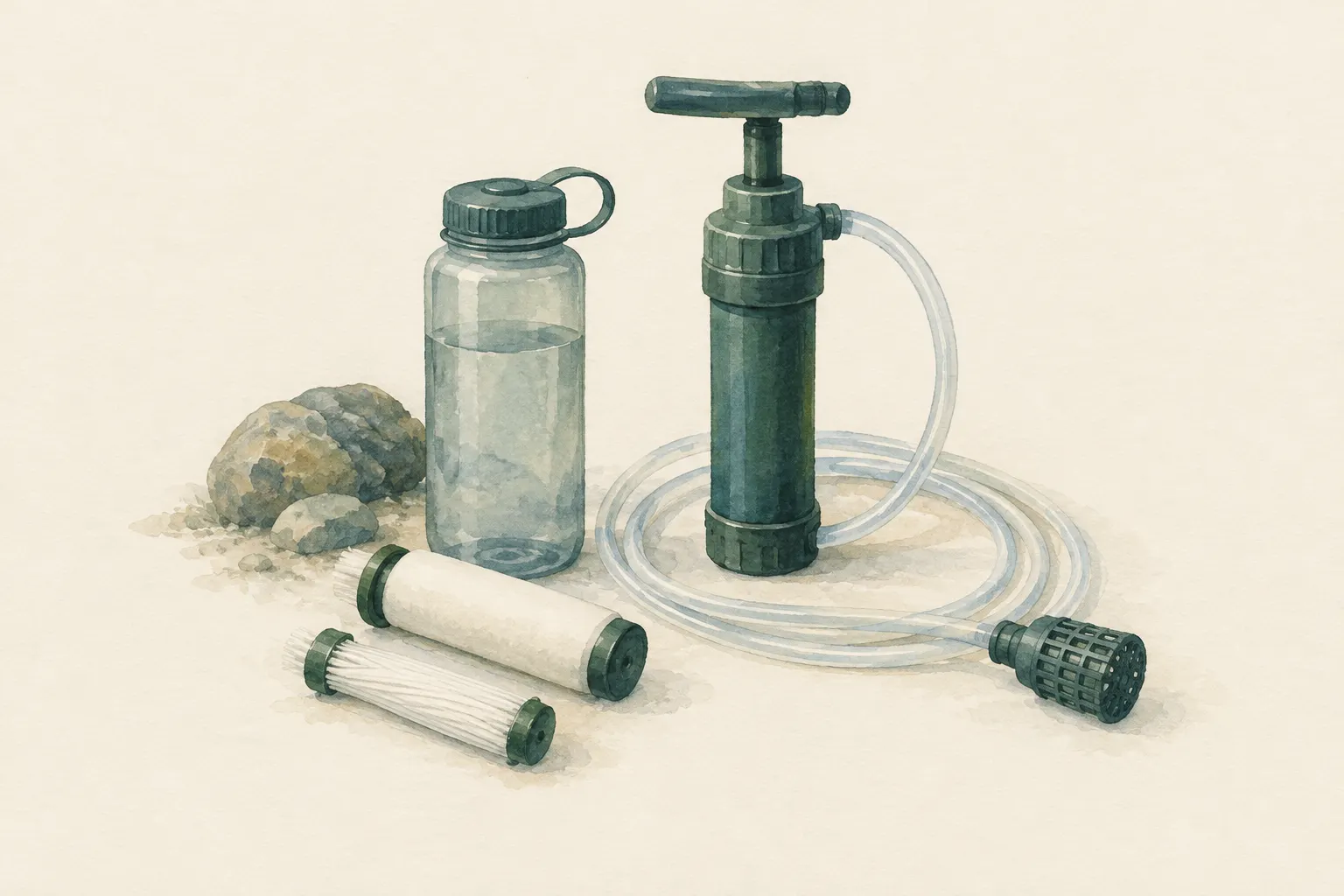
A pump filter is a small hand pump with a hose. You hold the hose in the water, then pump. The pump draws the water in and pushes it through a filter piece made of ceramic, glass fibre or fine hollow fibres. On the other side, filtered water comes out, which you let run straight into your bottle.
The big advantage: you can also reach water you cannot scoop from – such as a shallow trickle or a small puddle between stones.
But like any filter, a pump filter mainly stops bacteria and larger parasites. Usually not viruses, chemicals or salt. Where viruses are expected, you must still disinfect the water chemically or boil it after pumping – unless the manufacturer explicitly states that its model also retains viruses.
How it works
The piston in the pump alternately creates suction and pressure. When you pull up, water is drawn in through the intake hose; when you push down, it is forced through the filter element. A pre-filter at the end of the intake hose keeps out coarse particles, and a float makes sure the hose does not lie in the mud on the bottom.
Depending on the element, filtering works slightly differently. Ceramic and glass fibre hold particles back on their surface or deep within the material; ceramic can often be scrubbed when it clogs. Hollow-fibre elements are backflushed instead. Some models also have an activated-carbon core that improves taste and reduces some organic substances.
What a pump filter cannot do: kill pathogens, usually retain viruses, reliably remove dissolved chemicals, or take out salt. A carbon core does not make water chemically safe either and does not replace disinfection.
What really matters
Before pumping, check the element, seals and hoses for cracks and be clear which hose is the intake and which is the outlet. Many hoses look the same – a mark with paint or tape prevents mix-ups.
Place the intake hose in the clearest part of the water, not on the bottom. Hold the outlet in the clean container and pump calmly and evenly. If pumping becomes hard, the element is probably clogged – then clean it according to the manufacturer instead of forcing the pump.
A warning sign is the opposite: if pumping suddenly becomes very easy, the element may be cracked or damaged. Then raw water runs through unfiltered. In that case do not continue using the filter; replace the element.
Safety: what to watch out for
Most pump filters do not reliably retain viruses. Where viruses are expected – near settlements, with many people upstream or in regions with uncertain sanitation – disinfect the filtered water chemically according to the manufacturer or boil it. The only exception is models explicitly rated for viruses.
The intake hose has touched raw water. It must never come into contact with the outlet or the clean container. After use, pack the two hoses separately, for example in two different bags.
A ceramic element that has been dropped can have fine cracks you cannot see. Do not simply keep using it. Store the filter dry and frost-free, as frost can also damage elements unnoticed.
When it makes sense – and when not
A pump filter is worthwhile for shallow or awkward sources that cannot be scooped from, on multi-day trips and for small groups. The filtered water goes straight into the bottle, and ceramic elements are often cleanable and long-lasting.
It makes less sense when weight and packed size are very important, for large groups that need a lot of water, or when you do not want to pump – then a gravity filter is often more convenient. It is unsuitable for chemically contaminated water, salt water or brackish water.
Good to know
Pump filters were long the trekking standard before light hollow-fibre squeeze filters became widespread. Their advantage remains the ability to draw cleanly from shallow spots.
Travel-medicine guidance rates filters by their pore size and recommends combining them with a disinfection method where viruses are a risk. Unlike chlorine, a filter leaves no residual protection: water that is contaminated later is no longer protected.
Step by step
Inspect
Check element, seals and hoses for cracks; identify intake and outlet sides clearly.
- 1
Inspect
Check element, seals and hoses for cracks; identify intake and outlet sides clearly.
- 2
Draw without mud
Place the intake hose with pre-filter and float in the clearest part of the water, not on the bottom.
- 3
Pump steadily
Hold the outlet in the clean container and pump calmly and evenly.
- 4
Post-disinfect if needed
Where viruses are a risk, treat the filtered water chemically per manufacturer or boil it.
- 5
Clean and pack
Clean the element per manufacturer, pack hoses separately, store dry and frost-free.
Common mistakes
- Laying the intake hose on the muddy bottom
- Wetting the outlet hose with raw water
- Pumping against a clogged element
- Dropping a ceramic element and using it on
- Treating pumped water as drinking-ready in every situation
Quick view
Materials
Ceramic filter
Pump filter with ceramic element
Fragile; cracks make the filter ineffective.
Portable water filter (hollow fibre / membrane)
Pump filter with hollow-fibre element
Do not let it freeze – fibres can be damaged without visible signs.
PET bottle (clear, max. 2 litres)
Clean-water container
Do not heat or place in a fire.
Chlorine tablets (NaDCC) for drinking water
Follow the manufacturer's dose and contact time.
Suitable for
- Shallow sources that cannot be scooped from
- Small groups
- Multi-day trips
Not suitable for
- Virus risk without additional disinfection
- Chemically contaminated water
- Salt or brackish water
Prerequisites
- Undamaged element
- Pre-filter on the intake hose
- Separate storage of intake and outlet hoses
Safety
- Never let the intake hose touch the outlet or the clean container; pack them separately after use.
- If pumping suddenly becomes very easy, the element may be damaged. Do not force the pump against a clogged element – clean or replace it.
How it works
The piston creates suction and pressure: water is drawn in and forced through the element. Ceramic and glass fibre filter on their surface or in depth and can partly be scrubbed; hollow-fibre elements are backflushed. Some models additionally contain activated carbon for taste and part of organic substances.
Advantages
- Reaches shallow and awkward sources
- Filtrate usable at once
- Ceramic often cleanable and long-lasting
Disadvantages
- Pumping effort
- Mechanical parts can fail
- Viruses usually not covered
Deep knowledge
Background
Pump filters were long the trekking standard before light hollow-fibre squeeze filters spread. Their advantage remains the ability to draw cleanly from shallow spots.
Travel-medicine guidance rates filters by pore size and recommends combining them with a disinfection method where viruses are a risk.
Variants
- With activated carbon
- Models with a carbon core improve taste and reduce some organic substances – but they do not make water chemically safe and do not replace disinfection.
Common mistakes
- Laying the intake hose on the muddy bottom
- Wetting the outlet hose with raw water
- Pumping against a clogged element
- Dropping a ceramic element and using it on
- Treating pumped water as drinking-ready in every situation
Limits and risks
- Filtration depends on the element
- No removal of chemicals and salt
- No residual protection
Material alternatives
Derived from material properties: a substitute must have all relevant properties. Observe the notes on the substitute.
- Chlorine tablets (NaDCC) for drinking water
- Chlorine dioxide tablets or drops (Only approved drinking-water products; follow manufacturer instructions.), Unscented household bleach (sodium hypochlorite) (Only unscented, without additives, with known concentration.), Iodine water purification tablets (Not in pregnancy, thyroid disease or iodine allergy without medical advice.)
Results come exclusively from structured entries. No improvised instructions are generated.
Sources
Centers for Disease Control and Prevention: CDC Yellow Book: Health Information for International Travel – Water Disinfection
Filter performance by pore size, combination with disinfection
Wilderness & Environmental Medicine (Wilderness Medical Society) (2019): Wilderness Medical Society Clinical Practice Guidelines for Water Disinfection for Wilderness, International Travel, and Austere Situations: 2019 Update
Microfilters in the field and their limits with viruses