Days of rain in a temperate climate
Several days of rain at 5 to 12 degrees are often more dangerous outdoors than dry frost: clothing and sleeping bag gradually get damp, the body cools down, streams rise and slopes become unstable. People who get through a wet week well keep one dry set for the night, dry things consistently and plan alternative routes.
- Daily routine over several days
Explained simply
A single rainy day is usually not a problem: in the evening you put on dry clothes, and tomorrow the sun may shine again. But when it rains for several days in a row and is only cool, things get difficult. Everything gradually gets damp – the jacket, the socks, eventually even the sleeping bag.
Wet clothing hardly keeps you warm any more. Water pulls heat from your body much faster than air does – imagine how cold a wet T-shirt feels in the wind. That is how you can cool down dangerously even at temperatures above freezing.
The most important thing: keep one set of dry clothing just for the night, well packed, and defend it. Watch out for shivering, clumsiness and confusion – in yourself and in others. And never walk through a stream that has swollen strongly after a lot of rain.
How it works
Clothing does not keep you warm by itself; it holds still air between its fibres. This air insulates. When the fabric gets wet, water pushes out the air pockets, and because water conducts heat much better than air, body heat flows away quickly. When the water then evaporates in the wind, it cools you even more.
On a single rainy day your supply of dry clothing is enough. Over several days, however, hardly anything dries, and every layer you put on eventually gets damp too. That is why, in long wet spells, what decides things is whether you can protect one dry system for the night: sleeping bag, night clothes, socks.
At the same time the landscape changes. The ground soaks up water until it cannot take any more. Then the rain runs off over the surface, streams rise quickly and saturated slopes lose their grip. Trees stand less firmly in softened soil.
What really matters
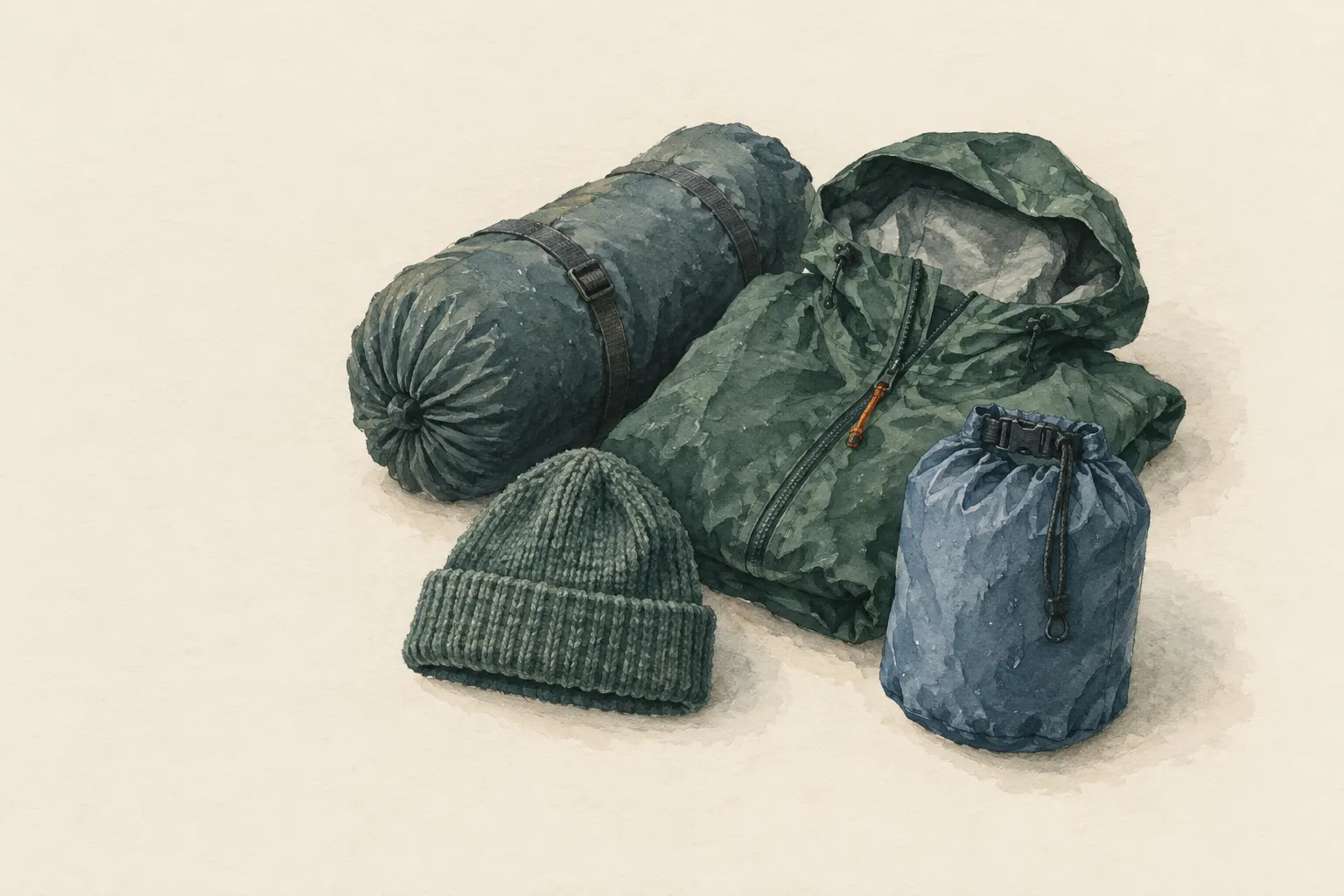
No rucksack is waterproof by itself. So pack your sleeping bag, night clothes and electronics in separate waterproof bags. The dry set is only for camp and sleep: in the evening you change, in the morning you climb back into the previous day's wet things. It feels unpleasant, but it is the only way to keep the night clothing dry.
While walking, dress slightly on the cool side. If you sweat heavily inside your rain jacket, you get wet from the inside – even the best jacket cannot let out unlimited moisture. At breaks, on the other hand, put a warm layer under the rain jacket straight away, before you cool down.
Food and warm drinks are not a side issue in prolonged rain. The body needs energy to produce heat. Cooking in the rain is a hassle, but regular warm meals make a big difference. A tarp over the cooking area helps a lot.
Safety: what to watch out for
In wet-cold weather, hypothermia often creeps in unnoticed. The first signs are shivering, cold and clumsy fingers and a bad mood. Later come stumbling, slurred speech and confusion. Take these signs seriously: get out of wind and rain, change into dry clothing, insulate, eat and drink something warm. If it gets worse, call the local emergency number (112 in the EU).
After days of rain, streams can rise quickly and strongly. You do not cross a stream in flood – you wait or turn back. The US weather service sums this up as „Turn Around Don't Drown“. Check stream crossings and slope sections when planning, and think about alternative routes.
Feet that stay wet and cold for days can be damaged. Dry them in the evening, change your socks and give them time in the air. If they go numb, very pale or painful, seek help. Do not camp below steep slopes or old trees, because in softened ground rocks, soil or trees can give way.
Camp in prolonged rain
Choose a slightly raised spot, not in a hollow and not right by the stream. Water seeks the lowest path, and a tent in a dip can turn into a puddle at night. Also watch out for deadwood above you.
Put up the tarp first. Underneath it you can set up the tent or sleeping area dry, sort your gear and cook. Wet things do not go into the inner tent but stay in the porch or under the tarp. In long wet spells it pays to plan stages so that huts or fixed accommodation can be reached for drying out.
Good to know
Many people underestimate wet-cold weather because it is „only“ a few degrees above freezing. But the Wilderness Medical Society explicitly describes that hypothermia occurs without frost when wet and wind combine. Military survival manuals even treat wet-cold conditions as a distinct and particularly treacherous form of cold.
Prolonged rain does have one advantage: water is plentiful. Even rain or stream water should be treated before you drink it, though. And with a good routine – pack dry, change, eat, have an alternative route – even a wet week can be weathered well.
Step by step
Pack waterproof
Sleeping bag, night clothes and electronics in separate waterproof bags. The rucksack itself is never waterproof.
- 1
Pack waterproof
Sleeping bag, night clothes and electronics in separate waterproof bags. The rucksack itself is never waterproof.
- 2
Adjust layers
While walking dress on the cool side so sweat does not soak your clothing from inside; at breaks immediately add a warm layer under the rain jacket.
- 3
Choose a camp site
Slightly raised, not in hollows or near streams, not under deadwood. Put up the tarp first and set up the tent or sleeping area beneath it.
- 4
Defend the dry set
Change into dry clothes in camp and back into the wet ones in the morning. This keeps the night clothes dry.
- 5
Eat and drink
Eat and drink warm food regularly – the body needs energy to produce heat.
- 6
Plan an alternative route
Check stream crossings and slope sections beforehand; if water is rising, change the plan or call off the trip.
Common mistakes
- Wearing all clothing at once and letting it all get wet
- Sweating heavily inside the rain jacket
- Camping in a hollow
- Crossing streams in flood
- Eating too little because cooking in the rain is a hassle
Quick view
Materials
Rain and wind shell
Dry bag
Dry spare clothing
For camp and sleep only
Carry it in waterproof packaging – wet clothing barely insulates.
Tarp
Suitable for
- Multi-day trips in Central and Northern Europe
- Autumn and spring trips
- Camps in bad weather
Not suitable for
- Floods in settlements (see flooding)
Prerequisites
- A waterproof packing system
- A multi-day weather forecast
Safety
- Saturated slopes can slide, rocks come loose, and trees topple more easily in soft ground. Do not camp below steep slopes or old trees.
- Feet that stay wet and cold for days can be damaged. Dry your feet in the evening, change socks, and seek help if they go numb or painful.
How it works
Water conducts heat many times better than air. Damp insulation loses its air pockets, and evaporation removes even more heat. On a single rainy day, your supply of dry clothing is enough; over several days, what matters is whether you can defend one dry system for the night. At the same time the rain saturates the ground: runoff rises and slopes lose grip.
Advantages
- Water is plentiful
- No frostbite risk above freezing
Disadvantages
- Gear barely dries
- Hypothermia creeps in
- Rising streams and slippery slopes
Deep knowledge
Background
The Wilderness Medical Society hypothermia guidelines describe how wet and wind greatly increase heat loss and how hypothermia occurs even without frost. The survival manual FM 3-05.70 treats wet-cold conditions as a distinct and particularly treacherous form of cold.
The US weather service warns with "Turn Around Don't Drown" against walking or driving through flooded paths and streams.
Variants
- Using huts and shelters
- In long wet spells, plan stages so that huts or fixed accommodation can be reached for drying out.
Common mistakes
- Wearing all clothing at once and letting it all get wet
- Sweating heavily inside the rain jacket
- Camping in a hollow
- Crossing streams in flood
- Eating too little because cooking in the rain is a hassle
Limits and risks
- No medical treatment
- No water-level or slope-stability figures
Material alternatives
Derived from material properties: a substitute must have all relevant properties. Observe the notes on the substitute.
- Rain and wind shell
- Cotton cloth / T-shirt (Removes coarse particles only – no disinfection.)
- Dry spare clothing
- Sleeping pad, Dry leaves, grass or conifer boughs (Collect only where allowed; no protected plants. Check for ticks and insects.), Backpack, Wool blanket / duvet (Keep away from candles, stoves and heaters.), Insulated cool box (Keeps cold only for a limited time; without ice packs or ice it is not a fridge.), Sleeping bag (Do not store compressed long-term; do not pack away damp.), Newspaper and cardboard (Flammable – keep away from candles, stoves, heaters and embers.), Insulated cooking box (hay box, thermal cooker) (Never put open flame or embers inside – only the hot, closed pot.)
- Tarp
- Plastic sheet / large bin bag (Tears easily; never pull over the head (suffocation risk).), Emergency blanket (Tears easily once punctured; short-term shelter only.), Document folder (waterproof) (Store securely – contains sensitive personal data.), Rain poncho (When used as a shelter, it no longer protects your body from rain.), Bivy bag (Never fully close off the face.), Tent (Do not cook or heat inside the tent (fire and carbon monoxide danger).), Heavy-duty bin bag (large) (Suffocation risk: never pull plastic bags over the head or face and keep them away from small children.), Group shelter bag (Airtight – ventilate regularly.)
Results come exclusively from structured entries. No improvised instructions are generated.
Sources
Wilderness & Environmental Medicine (Wilderness Medical Society) (2019): Wilderness Medical Society Clinical Practice Guidelines for the Out-of-Hospital Evaluation and Treatment of Accidental Hypothermia: 2019 Update
Hypothermia from wet and wind even above freezing
Headquarters, Department of the Army (USA) (2002): FM 3-05.70 Survival
Wet-cold conditions, keeping clothing dry
NOAA National Weather Service (USA): Turn Around Don't Drown
Do not cross flooded paths and streams
European Commission: 112 – the European emergency number
European emergency number 112