Staying dry in prolonged rain: wet and dry zones
Over several days of rain, routine decides whether sleeping bag and sleep clothing stay dry. Basic rule: consistently separate wet gear (vestibule, outside) from the dry sleep system (inside, packed), keep one set of clothing only for the night, and use dry bags for everything that must stay dry.
- An ongoing routine during the trip
Explained simply
When it rains for several days, almost everything outdoors gets wet: jacket, boots, backpack, tent. That is not a problem as long as one thing stays dry – your sleeping bag and your sleep clothes. Because only when they are dry do they keep you warm at night. A wet sleeping bag is like a wet jumper: it hardly warms any more and feels cold.
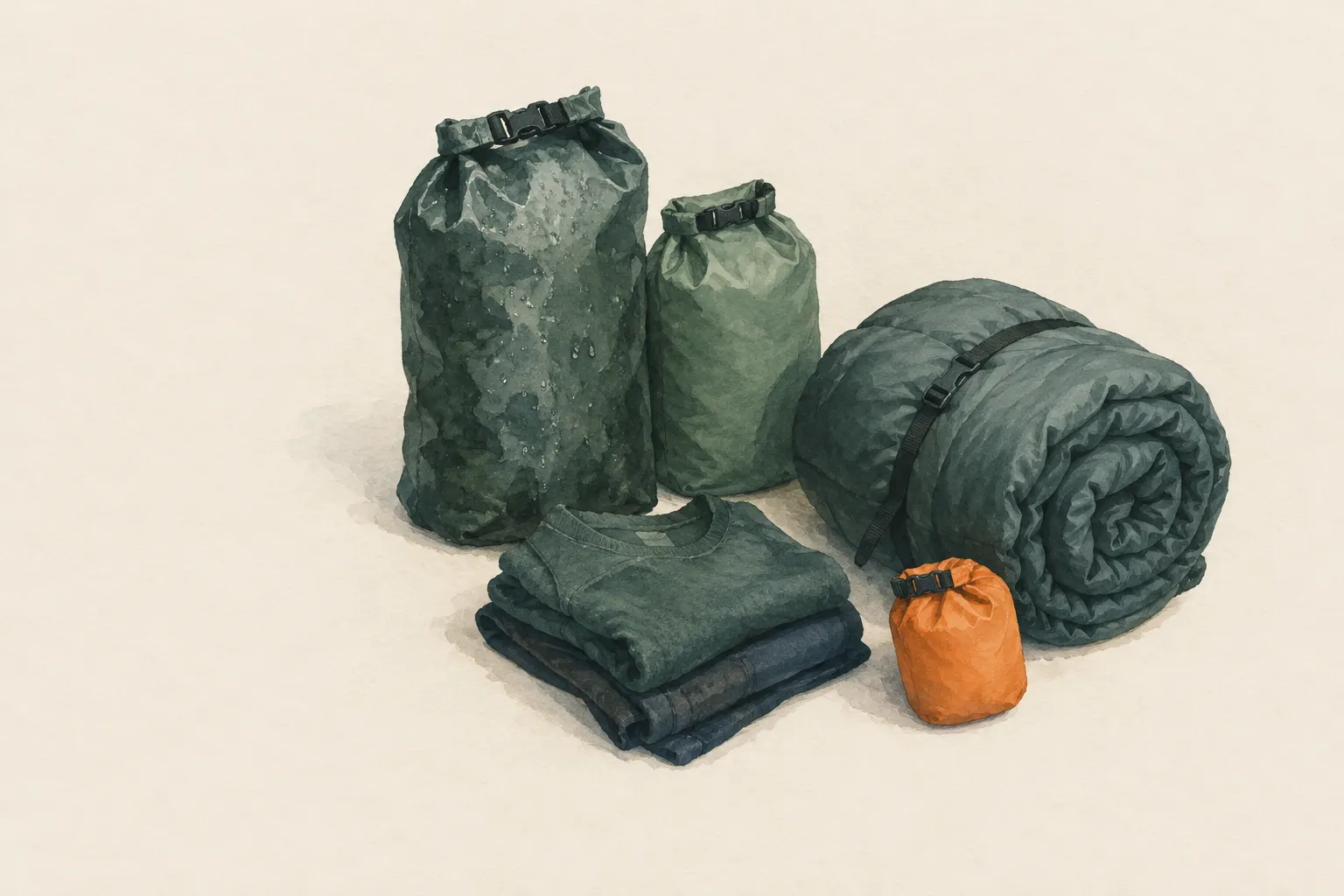
The trick is: divide your camp into two zones. Outside and in the vestibule is the wet zone – that is where the rain jacket, boots and wet backpack stay. Inside is the dry zone, and nothing wet comes in there. During the day, sleeping bag and sleep clothes live in waterproof bags.
In the evening you take off the wet things and put on your dry sleep clothes. In the morning you put the damp day clothes back on – it is unpleasant for a moment, but that way your sleep clothes stay dry for the next night. And importantly: in heavy rain streams rise quickly, so never camp in hollows or right next to water.
How it works
Clothing and sleeping bags keep you warm because they hold still air between their fibres. When the material gets wet, water fills these spaces. Water conducts heat much better than air – that is why you cool down so quickly in wet clothing, even when it is above freezing outside. Down fill collapses badly when wet; synthetic fibres keep somewhat more warmth but also get worse.
Moisture reaches your sleep system in three ways: from above as rain and drips, from inside as condensation from your breath, and from wet items you carry in. Something different helps against each of these: a tight roof, good ventilation and a strict separation of wet and dry.
The big advantage of this routine: as long as the sleeping bag is dry, you can warm up again at night even after a completely rained-out day. Your body recovers, and the next morning you start with reserves instead of already chilled.
What really matters
Packing starts at home. A backpack is almost never truly waterproof, not even with a rain cover. Sleeping bag, sleep clothes and electronics therefore belong in their own dry bags or in a large, strong liner, for example a sturdy bin bag. That way they stay dry even if the backpack is soaked.
When pitching in rain, order matters. If possible, the roof goes up first – tarp or fly – and only underneath it do you unpack. Then decide where the wet zone is: the vestibule or the edge under the tarp. That is where you take off your rain jacket and boots before crawling into the dry interior.
One set of clothing belongs to the night only. Never wear it during the day, even if it is tempting to slip into dry things in the morning. Otherwise you will have nothing dry left the next evening. Wet socks do not dry in the sleeping bag; they make it damp.
Safety: what to watch out for
Wet is one of the main causes of hypothermia, even at temperatures above freezing. Watch for persistent shivering, clumsiness, confusion or listlessness – in yourself and others. With such signs, dry clothing, protection from wind and wet, food and if necessary help via the local emergency number (112 in the EU) are what help.
In persistent rain, streams and small rivers can rise very quickly, sometimes also because of rain falling further up the valley. Do not camp in gullies, hollows, dry stream beds or right on the bank, and heed flood warnings.
It is very tempting to cook or heat inside a closed tent to dry things. That is dangerous: stoves can produce carbon monoxide, an invisible, odourless gas, and tent fabrics burn quickly. Cooking happens outdoors or under a well-ventilated tarp with plenty of distance from the fabric – and only where it is permitted.
Typical situations
In a tent, a lot of condensation often forms in rain because the air outside is already humid. Keep the vents open anyway and wipe the inside of the fly with a small cloth before the drops fall. Make sure the sleeping bag does not touch the tent wall.
In a hammock camp, rig a line for wet clothing under the tarp – but outside the lying area so nothing drips on you. Small drip lines on the suspension make rainwater drip off the rope instead of running into the hammock.
Every break in the rain is valuable. Hang sleeping bag and clothing up briefly to air, even if the sun is not shining – wind dries things too. Pack everything away again in time before the next shower comes.
When it makes sense – and when not
The wet-and-dry routine is worth it on every multi-day trip in rainy regions, whether with a tent, tarp or hammock. It costs hardly any extra weight – a few dry bags – but it demands discipline, especially when you are tired and chilled.
It does not replace retreating in floods or severe weather. Anyone who notices that the sleep system can no longer be kept dry should turn back in good time or seek out a hut rather than risk another wet, cold night.
Step by step
Pack waterproof inside
Put sleeping bag, sleep clothing and electronics in dry bags or a liner; the backpack itself is not waterproof.
- 1
Pack waterproof inside
Put sleeping bag, sleep clothing and electronics in dry bags or a liner; the backpack itself is not waterproof.
- 2
Pitch quickly and thoughtfully
If possible, pitch the tarp or fly first, then unpack underneath.
- 3
Set up zones
The vestibule or tarp edge is the wet zone (boots, rain jacket, wet backpack). Inside is the dry zone.
- 4
Change clothes
Take off wet day clothes and put on sleep clothes. In the morning, back into the (damp) day clothes – the sleep clothes stay packed and dry.
- 5
Ventilate
Keep vents open and wipe off condensation with a cloth before it drips.
- 6
Use dry spells
Use breaks in the rain and wind to air out sleeping bag and clothing.
Common mistakes
- Taking wet clothing into the inner tent
- Wearing sleep clothes during the day
- Sleeping bag in the backpack without a dry bag
- Camping in a hollow
Quick view
Materials
Dry bag
For sleeping bag and sleep clothing
Heavy-duty bin bag (large)
As a backpack liner
Suffocation risk: never pull plastic bags over the head or face and keep them away from small children.
Not breathable – sweating and condensation.
Rain and wind shell
Tarp
As an extra roof for cooking and packing outdoors
Suitable for
- Multi-day trips in rainy regions
- Tent, tarp and hammock camps
Not suitable for
- A substitute for retreating in floods or severe weather
Prerequisites
- Dry bags or a liner
- A dry set of clothing reserved for the night
Safety
- In persistent rain streams rise quickly. Do not camp in gullies, hollows or close to streams, and heed flood warnings.
How it works
Wet clothing conducts heat away much faster than dry clothing, and damp insulation loses warmth. As long as the sleep system stays dry, warmth can be regained even after a wet day. Moisture travels via condensation, drips and wet items – each of these sources must be kept separate.
Advantages
- Little extra weight
- Preserves the most important source of warmth at night
Disadvantages
- Getting into damp clothes in the morning is unpleasant
- Requires discipline
Deep knowledge
Background
Separating wet and dry things is an old rule of expedition and military practice. Damp clothing is a known factor in hypothermia, even at temperatures above freezing.
Anyone who notices that the sleep system can no longer be kept dry should turn back in good time or seek out a hut.
Variants
- In a hammock camp
- Under the tarp, rig a line for wet clothing but outside the lying area; drip lines on the suspension stop water running into the hammock.
Common mistakes
- Taking wet clothing into the inner tent
- Wearing sleep clothes during the day
- Sleeping bag in the backpack without a dry bag
- Camping in a hollow
Limits and risks
- No statements about the waterproofness of specific products
- Does not replace retreating in severe weather
Material alternatives
Derived from material properties: a substitute must have all relevant properties. Observe the notes on the substitute.
- Heavy-duty bin bag (large)
- Tarp, Plastic sheet / large bin bag (Tears easily; never pull over the head (suffocation risk).), Emergency blanket (Tears easily once punctured; short-term shelter only.), Document folder (waterproof) (Store securely – contains sensitive personal data.), Rain poncho (When used as a shelter, it no longer protects your body from rain.), Bivy bag (Never fully close off the face.), Tent (Do not cook or heat inside the tent (fire and carbon monoxide danger).), Group shelter bag (Airtight – ventilate regularly.)
- Rain and wind shell
- Cotton cloth / T-shirt (Removes coarse particles only – no disinfection.)
- Tarp
- Plastic sheet / large bin bag (Tears easily; never pull over the head (suffocation risk).), Emergency blanket (Tears easily once punctured; short-term shelter only.), Document folder (waterproof) (Store securely – contains sensitive personal data.), Rain poncho (When used as a shelter, it no longer protects your body from rain.), Bivy bag (Never fully close off the face.), Tent (Do not cook or heat inside the tent (fire and carbon monoxide danger).), Heavy-duty bin bag (large) (Suffocation risk: never pull plastic bags over the head or face and keep them away from small children.), Group shelter bag (Airtight – ventilate regularly.)
Results come exclusively from structured entries. No improvised instructions are generated.
Sources
Wilderness & Environmental Medicine (Wilderness Medical Society) (2019): Wilderness Medical Society Clinical Practice Guidelines for the Out-of-Hospital Evaluation and Treatment of Accidental Hypothermia: 2019 Update
Wind, wet and ground contact as factors in hypothermia; calling for help at signs of hypothermia
Headquarters, Department of the Army (USA) (2002): FM 3-05.70 Survival
Principles of improvised shelters, site selection and shelter construction