Packing waterproof: dry bags and pack liners
Hardly any backpack stays dry in prolonged rain, and a rain cover does not protect from behind. A waterproof liner or several roll-top dry bags are more reliable. What matters is that the sleeping bag, spare clothes, electronics and documents stay dry – even when crossing a stream or capsizing.
- 10 minutes while packing
Explained simply
Almost no backpack stays dry inside in long rain. Water creeps through seams, zips and the fabric, especially at the back. A rain cover only helps partly, because it is open at the back – exactly where your wet back and the rain get in.
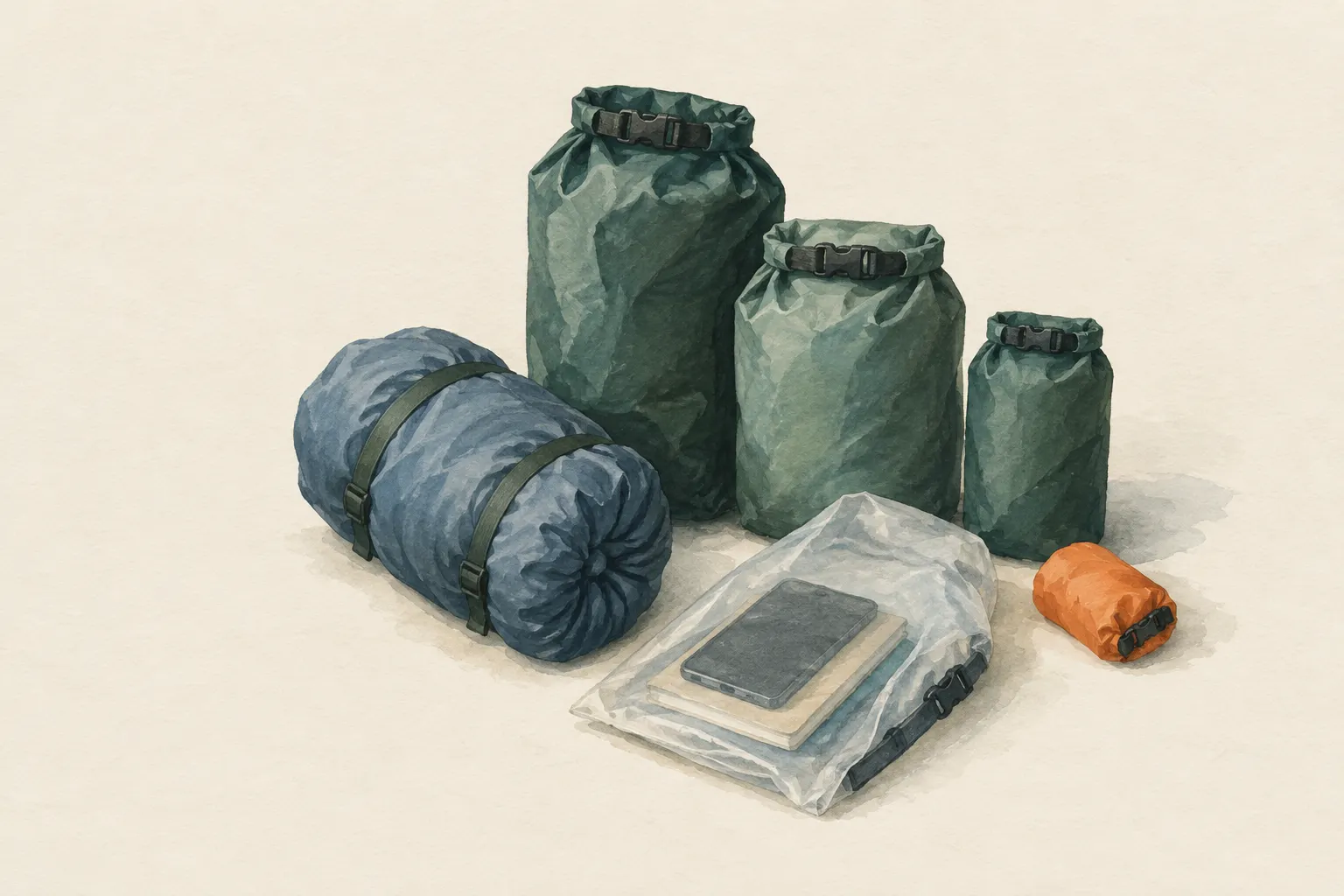
It is better to pack the things inside the pack in a waterproof way: in one big waterproof liner or in several dry bags with roll-top closures. A roll-top works like a crisp packet rolled up tightly: you roll the opening several times, and then no water gets in.
The most important point: the sleeping bag and spare clothes must be packed most securely. If they get wet, you can no longer warm up properly in the cold – and that can become dangerous.
How it works
A backpack is made of fabric, seams and zips. Even if the fabric is coated, water eventually gets in during prolonged rain: through the needle holes of the seams, through zips and at places where the coating is worn. It is worst at the back, because the rain cover is open there and water runs down from the jacket.
A roll-top dry bag seals because the opening is rolled over several times. Each roll is another barrier the water would have to get past. The entry recommends rolling tightly at least three times. Before that, press out the air and flatten the opening so that no creases or folds leave a gap. Then close the buckle so the roll does not open again.
Besides protecting against wet, dry bags keep things organised. When sleeping gear, clothing, kitchen and first aid are in their own bags, you find everything faster – even more so if you use different colours. And you keep wet things apart from dry ones.
What really matters
The simplest and most reliable solution is one large liner that lines the whole pack. This can be a purpose-made waterproof bag or a heavy-duty bin bag. You put it into the pack and pack everything into it. At the top you twist or roll it closed.
Whatever matters most you protect twice: the sleeping bag, spare clothing, documents and electronics also go into their own dry bags or sealed pouches. The sleeping bag and warm clothing are your warmth reserve – they must stay dry even when everything else is wet.
Wet things never go into the dry section. Put a wet tent or wet clothing on the outside of the pack or in a bag of its own. Sharp objects such as stove parts, tent pegs or a knife should not rest directly against a dry bag, because they can wear through it.
Safety: what to watch out for
A wet sleeping bag and wet spare clothing can become dangerous in the cold, because you then have no way to warm up after a wet day. So the rule is: the warmth reserve is always packed most securely, even if that means a few grams more weight.
Most dry bags are only splash-proof or can survive brief submersion, but not lying underwater for a long time. What your dry bag can really do is stated in the manufacturer's information. On canoe and boat trips where capsizing is possible, you should know this beforehand and protect important items additionally.
When crossing a stream, the pack can end up in the water if you slip. Well-packed things then stay dry. Whether a stream crossing is safe at all is a quite separate question, though – if in doubt, look for another spot or turn back.
Checking and care
Dry bags wear out over time, especially at creases where they are folded again and again. A small hole is enough to let water in. So check them before a trip and now and then in between.
The test is simple: fill the dry bag with air, roll it closed as usual, close the buckle and squeeze it. If air escapes anywhere you will hear or feel it – there is a hole or a leaking seam there. Small holes can often be repaired with a suitable patch; a badly worn bag is better replaced.
After a wet trip, let dry bags dry open before you put them away. Otherwise mould can form inside. A bin bag as a liner is cheap but more fragile; take a second one as a spare just in case.
Typical situations
On a rainy hike, the liner is often enough on its own, combined with a separate dry bag for the sleeping bag and spare clothing. On snow trips the same method protects against meltwater that gets into the pack when you set it down in the snow.
Paddlers have long used roll-top dry bags because on the water you must always expect spray and sometimes a capsize. In a go bag too, documents, medication and electronics are well kept in a sealed pouch – for example during an evacuation in rain or floods.
Mountaineering handbooks recommend protecting pack contents from wet with liners or plastic bags. The method is simple, cheap and one of the most effective safety measures you can take when packing.
Step by step
Insert a liner
Put a waterproof liner or heavy-duty bin bag into the pack and pack the contents into it.
- 1
Insert a liner
Put a waterproof liner or heavy-duty bin bag into the pack and pack the contents into it.
- 2
Double-protect critical items
Put the sleeping bag, spare clothing, documents and electronics into their own dry bags or pouches as well.
- 3
Close properly
Press out the air, flatten the opening and roll it at least three times, then close the buckle.
- 4
Keep wet items separate
Put a wet tent and wet clothing outside or in their own bag, never in the dry section.
- 5
Check
Occasionally fill with air, close and squeeze – escaping air shows holes.
Common mistakes
- Relying only on the rain cover
- Rolling the roll-top only once
- Wet tent in the main compartment
- Sharp objects directly against the dry bag
Quick view
Materials
Dry bag
Heavy-duty bin bag (large)
Suffocation risk: never pull plastic bags over the head or face and keep them away from small children.
Not breathable – sweating and condensation.
Backpack
Suitable for
- Rain and snow trips
- Canoe and boat trips
- Go bags
- Documents and electronics
Not suitable for
- Prolonged submersion – most dry bags are only splash-proof or briefly submersible; check manufacturer information
Prerequisites
- Dry bags without holes – check before the trip
Safety
- A wet sleeping bag and wet spare clothing can become dangerous in the cold. Always pack the warmth reserve most securely.
How it works
Water gets through the seams, zips and fabric of a pack, especially at the back where the rain cover is open. A roll-top seals when the opening is rolled tightly at least three times. Separate dry bags also keep dry items apart from wet ones and keep things organised.
Advantages
- Reliably dry warmth reserve
- Organised pack
Disadvantages
- A little more weight
- Dry bags wear at creases
Deep knowledge
Background
Mountaineering handbooks recommend protecting pack contents from wet with liners or plastic bags. Paddlers have long used roll-top dry bags.
How watertight a dry bag is depends on material, seams and closure; manufacturer information on this is decisive.
Variants
- Colour codes
- Different colours for sleeping, clothing, kitchen and first aid speed up finding things, especially in the dark.
Common mistakes
- Relying only on the rain cover
- Rolling the roll-top only once
- Wet tent in the main compartment
- Sharp objects directly against the dry bag
Limits and risks
- No statements on the submersibility of individual products
Material alternatives
Derived from material properties: a substitute must have all relevant properties. Observe the notes on the substitute.
- Heavy-duty bin bag (large)
- Tarp, Plastic sheet / large bin bag (Tears easily; never pull over the head (suffocation risk).), Emergency blanket (Tears easily once punctured; short-term shelter only.), Document folder (waterproof) (Store securely – contains sensitive personal data.), Rain poncho (When used as a shelter, it no longer protects your body from rain.), Bivy bag (Never fully close off the face.), Tent (Do not cook or heat inside the tent (fire and carbon monoxide danger).), Group shelter bag (Airtight – ventilate regularly.)
- Backpack
- Sleeping pad, Dry leaves, grass or conifer boughs (Collect only where allowed; no protected plants. Check for ticks and insects.), Dry spare clothing (Carry it in waterproof packaging – wet clothing barely insulates.), Wool blanket / duvet (Keep away from candles, stoves and heaters.), Insulated cool box (Keeps cold only for a limited time; without ice packs or ice it is not a fridge.), Sleeping bag (Do not store compressed long-term; do not pack away damp.), Newspaper and cardboard (Flammable – keep away from candles, stoves, heaters and embers.), Insulated cooking box (hay box, thermal cooker) (Never put open flame or embers inside – only the hot, closed pot.)
Results come exclusively from structured entries. No improvised instructions are generated.
Sources
The Mountaineers Books (2017): Mountaineering: The Freedom of the Hills, 9th edition
Protecting pack contents from wet