Emergency poncho from a bin bag
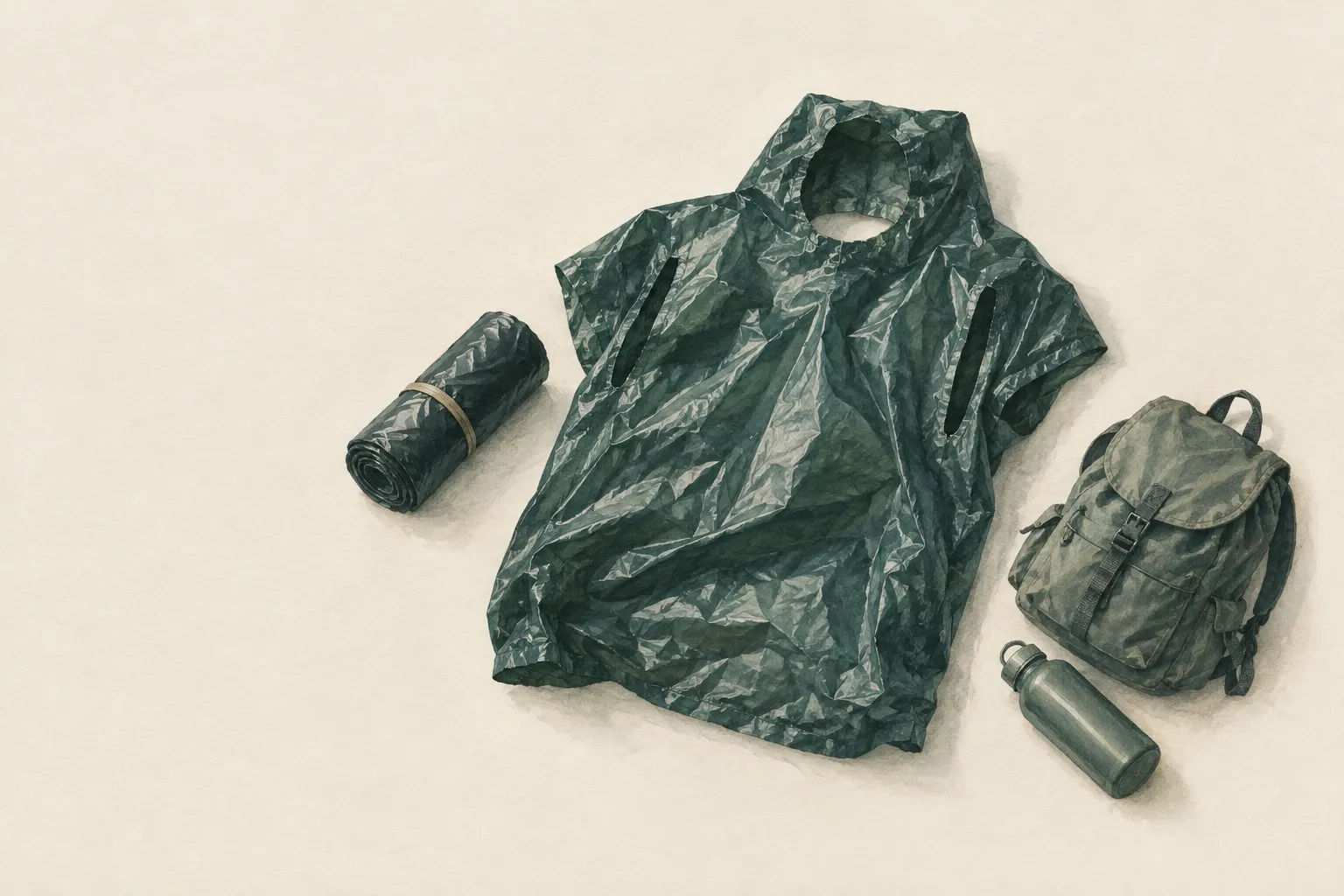
A large, heavy-duty bin bag becomes rain protection for the upper body in seconds with a face hole and arm slits. Important: the hole is for the face; the bag is never pulled over the head. The bag is not breathable and no substitute for rain gear, but it can slow cooling through wetness.
- Under a minute
Explained simply
A large, thick bin bag is really a waterproof shell. If you are caught in the rain unexpectedly and have no rain jacket, you can turn it into an emergency poncho in a minute: cut a hole for your face near the closed end, slip the bag on like a hood with a cape and cut slits at the sides for your arms.
The most important rule is very simple: the hole is for the face. Mouth and nose must always be free, and the bag is never pulled over the head. Small children get no plastic bags at all, because they can suffocate in them.
Plastic keeps rain out, but it does not let sweat out either. Underneath it gets damp if you move a lot. So the bin bag is an emergency solution for a short time, not a replacement for a proper rain jacket.
How it works
Plastic sheeting is waterproof and airtight. Rain runs off and wind cannot blow through your clothing. That is exactly what makes it valuable in the cold: wet clothing conducts heat away from the body much faster than dry clothing, and wind strengthens this effect. A bin bag over your clothes can therefore noticeably slow cooling from wet and wind.
The downside: your body constantly gives off moisture, and a lot of it when walking. Breathable rain gear lets some of it escape. Plastic cannot. The water vapour condenses on the inside of the plastic and makes clothing damp from within. A loose fit that lets air in at the bottom and the arms eases this a little.
A bin bag is not insulation – it does not warm you by itself. It only holds on better to the warmth already in your clothes, because wind and rain no longer carry it away.
What really matters
Take a large, heavy-duty bag. Thin bags tear while you put them on or on the first branch. Hold it with the closed bottom up and, a little below the bottom, cut an oval hole the size of your face on one side. The bottom then sits on your head like a hood and your face looks out freely. Without a knife the hole can also be carefully torn.
Cut arm slits at the sides at about shoulder height. If you are only waiting, your arms can stay inside – that keeps you warmer. A cord tied loosely around your waist keeps the bag against your body so the wind does not puff it up like a balloon or blow it into your face.
During breaks and in the cold a dry layer under the bag helps. If you notice you are sweating underneath, slow down or open the bag briefly. And think of your backpack: a second bag inside the pack keeps your sleeping bag and spare clothes dry – often that is even more important than the poncho itself.
Safety: what to watch out for
Plastic bags can cause suffocation. So without exception: the bag is never pulled over the head, mouth and nose always stay free, and the face hole is big enough. Small children get no plastic bags, not even to play with. Older children only wear an emergency poncho under supervision, with a large face opening and the head free.
Wet clothing under the plastic increases the risk of hypothermia, especially when you stop after exertion. Watch for warning signs such as intense shivering, clumsiness or confusion. Then: find shelter, put on dry clothing, insulate from the ground and, with serious signs, call the local emergency number (112 in the EU).
In strong wind and in brush a bin bag is quickly shredded. Flapping plastic can also block your view. So belt it and make sure nothing blows across your face.
When it makes sense – and when not
The emergency poncho makes sense in unexpected rain, while waiting outdoors – at a bus stop or for help, say – and as an extra wind layer in an emergency. A bin bag weighs almost nothing, fits in any pocket and can also be a pack liner, a sit mat or a rubbish bag.
It is less suitable for long hikes with a lot of exertion, because you sweat through underneath. In dense brush it tears, and in a storm it flaps. For small children it is off-limits. Anyone who goes out regularly carries proper rain gear and keeps the bin bag as an extra reserve.
Good to know
Bin bags appear on many emergency and hiking lists because they are so versatile. Military survival manuals have long described how ponchos and plastic sheeting can be used as rain protection, groundsheet or roof.
A light or brightly coloured bag is easier to see in the landscape than a black one – that can be useful if you want to be found. Try the emergency poncho once at home with an old bag: then you know where the hole goes and how big it needs to be.
Step by step
Cut a face hole
Hold the bag with the closed bottom up. A little below the bottom, cut an oval hole the size of a face on one side.
- 1
Cut a face hole
Hold the bag with the closed bottom up. A little below the bottom, cut an oval hole the size of a face on one side.
- 2
Put on as a hood
Slip the bag on so that the bottom sits like a hood over the head and the face is fully out through the hole. The airways must be free.
Mouth and nose must never be covered.
- 3
Arm slits
Cut slits at the sides for the arms, or keep the arms inside if you are only waiting.
- 4
Belt it
Belt it loosely with a cord so the wind does not balloon the bag.
Common mistakes
- Pulling the bag over the head without a free face
- Too thin a bag that tears immediately
- Wearing it during exertion and soaking through with sweat
Quick view
Materials
Heavy-duty bin bag (large)
Suffocation risk: never pull plastic bags over the head or face and keep them away from small children.
Not breathable – sweating and condensation.
Knife (fixed or locking blade)
Or scissors; holes can also be torn
Cut away from your body.
Rules on carrying knives differ by region – check local rules.
Suitable for
- Unexpected rain without a rain jacket
- Protecting a backpack
- An extra wind layer in emergencies
Not suitable for
- Small children
- Long physical exertion – heavy sweating
- Strong wind, brush
Prerequisites
- A large, undamaged bag
- Awareness of the suffocation risk
Safety
- Sweat collects under plastic. In breaks and cold wear a dry layer underneath; wet clothing increases the risk of hypothermia.
How it works
Plastic keeps out rain and wind because it is waterproof and airtight. For exactly that reason water vapour from the body cannot escape. A loose fit lets some air circulate; a cord belt stops flapping.
Advantages
- Light, cheap, available everywhere
- Quick to make
- Multiple uses
Disadvantages
- Not breathable
- Tears in brush
- Suffocation risk if misused
Deep knowledge
Background
Bin bags are part of many emergency and hiking lists because they can be rain protection, pack liner, mat and rubbish bag at once. Military survival manuals describe the versatile use of plastic sheeting and ponchos.
As weather protection the bag is an emergency solution. Anyone who goes out regularly carries proper rain gear.
Variants
- Pack liner
- A second bag inside the backpack keeps the sleeping bag and spare clothes dry – often more effective than a poncho.
- Sit mat
- Folded as a mat the bag stops wet ground from soaking clothing.
Common mistakes
- Pulling the bag over the head without a free face
- Too thin a bag that tears immediately
- Wearing it during exertion and soaking through with sweat
Limits and risks
- No insulation
- Not for children without supervision
Material alternatives
Derived from material properties: a substitute must have all relevant properties. Observe the notes on the substitute.
- Heavy-duty bin bag (large)
- Tarp, Plastic sheet / large bin bag (Tears easily; never pull over the head (suffocation risk).), Emergency blanket (Tears easily once punctured; short-term shelter only.), Document folder (waterproof) (Store securely – contains sensitive personal data.), Rain poncho (When used as a shelter, it no longer protects your body from rain.), Bivy bag (Never fully close off the face.), Tent (Do not cook or heat inside the tent (fire and carbon monoxide danger).), Group shelter bag (Airtight – ventilate regularly.)
Results come exclusively from structured entries. No improvised instructions are generated.
Sources
Headquarters, Department of the Army (USA) (2002): FM 3-05.70 Survival
Using ponchos and plastic sheeting as weather protection
Wilderness & Environmental Medicine (Wilderness Medical Society) (2019): Wilderness Medical Society Clinical Practice Guidelines for the Out-of-Hospital Evaluation and Treatment of Accidental Hypothermia: 2019 Update
Wetness and wind as factors in cooling