Poncho as an emergency shelter
A rain poncho with grommets can be pitched as a small lean-to or mini A-frame. It is an emergency solution for one person that keeps off rain – but the poncho is then no longer available as rainwear, and the area is small.
- About 10–15 minutes
Explained simply
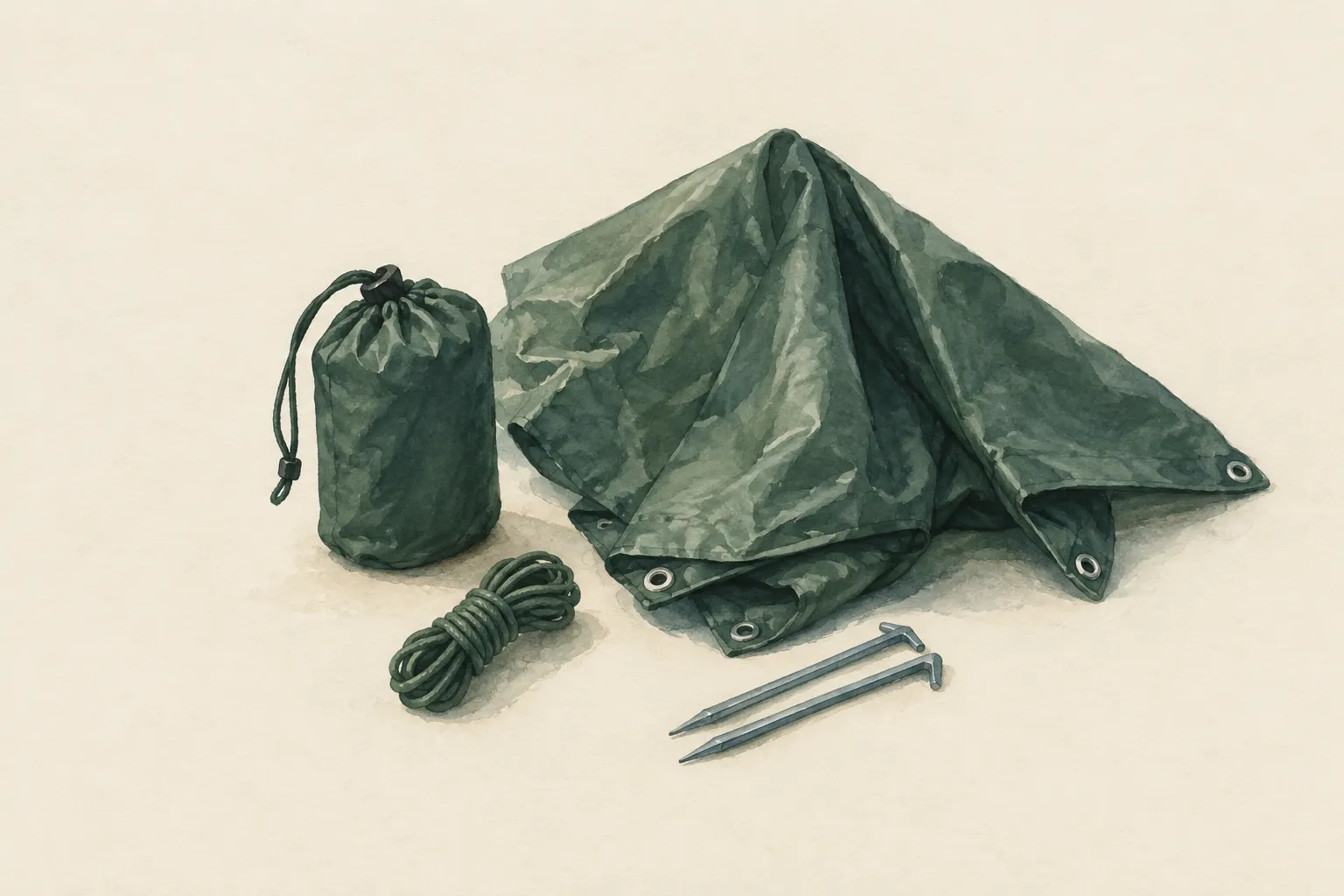
A rain poncho is a cape that keeps you dry while walking. Many ponchos have grommets at the corners – small reinforced holes. You can tie cords to them and in an emergency stretch the poncho out like a small roof.
The roof is small, just enough for one person. It keeps off rain, but it does not keep you warm. Imagine standing under an umbrella in the snow: you stay dry, but it is still cold. So underneath you need something warm between you and the ground, such as a sleeping pad or your backpack.
If someone is very cold, shivering, confused or extremely tired, call the local emergency number (112 in the EU).
How it works
A poncho is basically a small waterproof sheet with a hole for the head. When you stretch it out you can build two shapes: a lean-to, with one edge high on a line and the other on the ground on the weather side, or a mini A-frame over a line, which protects you on both sides but is very low.
Because the area is so small, the spot matters a lot. A rock, a terrain edge or dense bushes take over part of the wind protection that the poncho cannot provide on its own. The smaller the sheet, the more important a naturally sheltered spot.
The head opening is a leak. Pull the hood tight and tie it off inwards or upwards, otherwise water runs straight through it.
Safety: what to watch out for
The poncho does not insulate. It only protects from wet. In the cold you lose warmth mainly to the ground and through wind. Insulation underneath is therefore decisive: a sleeping pad, your backpack, or where permitted a thick layer of dry plant material. Dry clothing and a hat help as well.
Watch for signs of hypothermia: strong shivering, clumsiness, slurred speech, confusion or great tiredness. Then call the local emergency number (112 in the EU), get the person out of wind and wet as far as possible and insulate them from the ground.
Look up before you pitch: dead branches and trees can fall in wind or under snow load. A poncho gives no protection against that.
What really matters
The open side faces away from the wind. If the low edge is on the weather side and well secured, rain runs off and the wind passes over you. If the poncho faces the wrong way, it becomes a sail and tugs at its tie-outs.
Many civilian ponchos lack sturdy grommets. A trick helps: wrap a small pebble into a corner and tie the cord around the resulting knob. That way the fabric tears out less easily than at a hole.
Treat the poncho with care and take it with you again. It is your rain protection for the way onwards – and while it is pitched as a roof, it is not available to you as rainwear.
When it makes sense – and when not
The poncho shelter is an emergency solution for one person: to wait out a shower, take a break in the dry or get through an unplanned night when nothing else is available. It is quick to set up and needs only a little cord and a few sticks or stakes.
It is not enough for several people, strong wind or longer stays. And if you have to keep moving, for example because you want to descend or reach help, you need the poncho as clothing. Then it is often wiser to keep it on and use a naturally sheltered spot for a short rest.
Good to know
Military survival manuals such as FM 3-05.70 describe the poncho lean-to and poncho tent as standard solutions for soldiers who carry a poncho. But the principle applies to any small waterproof sheet, such as a sturdy plastic sheet or a small groundsheet.
If you carry a poncho, you can try out at home whether it can be pitched and how much room is left underneath. A length of cord and two or three light stakes in your pack turn the rain protection into a roof more quickly in an emergency.
Step by step
Find shelter from the wind
Choose a spot behind rocks, terrain or dense vegetation; check overhead for dead branches.
- 1
Find shelter from the wind
Choose a spot behind rocks, terrain or dense vegetation; check overhead for dead branches.
- 2
Close the hood
Pull the hood tight and tie it off so no water runs through.
- 3
Attach the high edge
For a lean-to, attach one long edge to a line between two trees or sticks.
- 4
Stake the low edge
Fix the opposite edge to the ground on the weather side.
- 5
Insulate the ground
Put a sleeping pad, backpack or dry plant material underneath.
Common mistakes
- Leaving the hood open
- Open side facing the wind
- Lying without ground insulation
- Damaging or leaving the poncho behind
Quick view
Materials
Rain poncho
When used as a shelter, it no longer protects your body from rain.
Paracord
Several pieces for the ridge and corners
Not a climbing or safety rope.
Sturdy sticks / poles
As stakes or a support
Do not cut live wood where prohibited.
Sleeping pad
Suitable for
- An unexpected night on a day hike
- A rain break for one person
Not suitable for
- Several people
- Strong wind
- Situations in which you must keep moving
Prerequisites
- A poncho with corner grommets
- Cord
Safety
- The hood opening is a leak: pull the hood tight and tie it inwards or upwards.
How it works
The poncho is a small waterproof sheet. As a lean-to it protects from above and from the weather side; as a mini A-frame over a line it protects on both sides but is very low. The smaller the sheet, the more important a spot in natural shelter from the wind.
Advantages
- Gear you often carry anyway
- Light and fast
- Can be combined with an emergency blanket
Disadvantages
- Very small area
- Poncho no longer available as rainwear
- Little wind protection
Deep knowledge
Background
Military survival manuals such as FM 3-05.70 describe the poncho lean-to and poncho tent as standard solutions for soldiers who carry a poncho. The principle applies to any small waterproof sheet.
Many civilian ponchos lack sturdy grommets; then a small pebble wrapped into a corner and tied around with cord serves as an improvised tie-out.
Variants
- Mini A-frame
- Line along the middle (over the hood line), both edges staked to the ground. Protects on both sides but is very low.
- Joining two ponchos
- With two people, two ponchos can be joined at the grommets for a larger area.
Common mistakes
- Leaving the hood open
- Open side facing the wind
- Lying without ground insulation
- Damaging or leaving the poncho behind
Limits and risks
- Only for one person
- Not suitable for longer stays
Material alternatives
Derived from material properties: a substitute must have all relevant properties. Observe the notes on the substitute.
- Rain poncho
- Tarp, Plastic sheet / large bin bag (Tears easily; never pull over the head (suffocation risk).), Emergency blanket (Tears easily once punctured; short-term shelter only.), Document folder (waterproof) (Store securely – contains sensitive personal data.), Bivy bag (Never fully close off the face.), Tent (Do not cook or heat inside the tent (fire and carbon monoxide danger).), Heavy-duty bin bag (large) (Suffocation risk: never pull plastic bags over the head or face and keep them away from small children.), Group shelter bag (Airtight – ventilate regularly.)
- Paracord
- Rope (Never use unknown or damaged rope for life-safety purposes.)
- Sleeping pad
- Dry leaves, grass or conifer boughs (Collect only where allowed; no protected plants. Check for ticks and insects.), Backpack, Dry spare clothing (Carry it in waterproof packaging – wet clothing barely insulates.), Wool blanket / duvet (Keep away from candles, stoves and heaters.), Insulated cool box (Keeps cold only for a limited time; without ice packs or ice it is not a fridge.), Sleeping bag (Do not store compressed long-term; do not pack away damp.), Newspaper and cardboard (Flammable – keep away from candles, stoves, heaters and embers.), Insulated cooking box (hay box, thermal cooker) (Never put open flame or embers inside – only the hot, closed pot.)
Results come exclusively from structured entries. No improvised instructions are generated.
Sources
Headquarters, Department of the Army (USA) (2002): FM 3-05.70 Survival
Poncho lean-to and poncho tent
Wilderness & Environmental Medicine (Wilderness Medical Society) (2019): Wilderness Medical Society Clinical Practice Guidelines for the Out-of-Hospital Evaluation and Treatment of Accidental Hypothermia: 2019 Update
Wind, wet and ground contact as factors in hypothermia