Rain gear: waterproof, breathable, reproofed
Rain jackets keep water out and are meant to let water vapour out from inside. No membrane manages this completely during hard exertion – vents and pace help. An intact outer water-repellent finish (DWR) matters; otherwise the face fabric wets out and breathability collapses.
- 10 minutes reading, care as needed
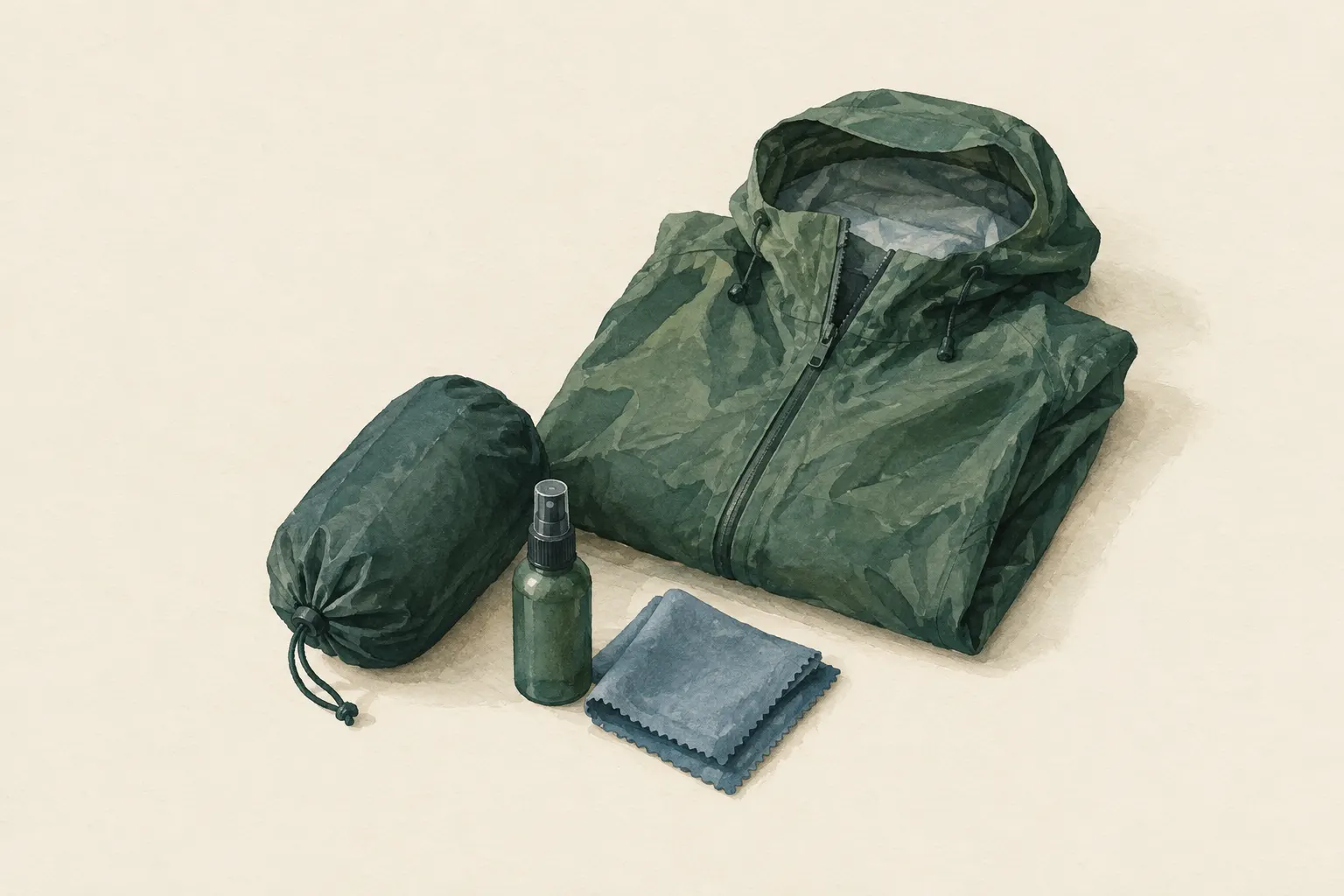
Explained simply
A rain jacket has to do two things at once that do not really go together: keep rain out and let your sweat out. Many jackets have a special layer for this, a membrane. Some membranes have tiny holes – too small for raindrops but big enough for water vapour. Others let the vapour travel slowly through in a different way.
But this only works up to a point. When you walk uphill fast and sweat a lot, more vapour comes out than the jacket can let through. Then you get damp on the inside too – that does not mean the jacket is broken. What helps then: walk more slowly and open the zips.
On the outside a good jacket has a water-repellent finish that makes water bead up and roll off like water off a duck's back. If it is worn out, the fabric soaks up water and the jacket barely “breathes” any more. Important for safety: wet and wind together chill you fast – put on dry layers in time.
How it works
A rain jacket usually consists of several layers: a face fabric outside, a waterproof layer – a membrane or a coating – and often a lining or protective layer inside. The waterproof layer stops liquid water but lets water vapour through. For that to work, it has to be warmer and more humid inside than outside. The vapour then moves from the “full” area to the “empty” one, roughly the way a smell spreads through a room.
The smaller that difference, the less vapour escapes. On a cold, dry day a breathable jacket therefore works well. On a warm, muggy rainy day, when there is almost as much moisture in the air outside as inside, only a little vapour gets out.
The face fabric has a water-repellent finish, often called DWR (durable water repellent). It makes rain bead up. When it wears off, the face fabric soaks up water. Then a film of water forms on the outside that slows the vapour further. The jacket is usually still waterproof, but it feels cold and clammy inside.
Why you can still get wet
No material stays completely dry inside during hard exertion. When you work hard or walk uphill fast, you produce more sweat than any membrane can release. In the cold, the vapour can also condense on the inside of the jacket, much like condensation on a window. Many people take this for a leak, even though the jacket is waterproof.
There are real leaks too, of course: at seams whose sealing tape has come loose, at cuffs where water runs in, or at a hood that does not close well. Water can also wick upwards through clothing from below if the jacket is too short or your trousers get wet.
Good to know: a poncho or an umbrella lets plenty of air circulate and is often more pleasant than a closed jacket on paths in warm rain. In wind, though, both are unsuitable.
What really matters
When buying, the details count more than lab values: a hood with a peak that can be adjusted and turns with your head (and fits over a helmet if needed); vent zips under the arms or at the sides; taped seams; a length that reaches below the hips; cuffs that can be closed. Think about what you need the jacket for: short showers in daily life, long rainy days in the mountains or wind on the coast make different demands.
On the way, you decide a lot about the result yourself. Adjust your pace, open zips before you are soaked with sweat and do not wear more under the jacket than necessary. Layers underneath that are too warm almost always lead to sweat. At breaks you then put a warm layer under or over the jacket.
In the layering system, the rain jacket is the outermost protective layer. It works together with the base and mid layers. Rain trousers complete it in long rain and wind.
Washing and reproofing
Many people never wash their rain jacket for fear of damaging the membrane. Often the opposite is right: dirt, sunscreen and skin oils weaken the water-repellent finish and can reduce breathability. So wash the jacket when it is dirty, exactly as the manufacturer instructs and with a suitable detergent.
Fabric softener is off-limits: it can leave deposits on the fabric and membrane and weaken the finish. Some manufacturers also mention heat, for example in a tumble dryer, as a way to reactivate the water repellency – but only if the care label allows it.
If water no longer beads up after washing but soaks into the face fabric, it is time to reproof. There are wash-in and spray-on products for this. Use them according to the manufacturer's instructions, and use sprays only outdoors or with good ventilation. The manufacturer's care instructions always take precedence.
Safety: what to watch out for
Wetness from outside or sweat from inside makes clothing insulate less well. Add wind and cold, and the risk of hypothermia rises – even in summer in the mountains. Watch for feeling cold, intense shivering, clumsy hands or confusion. Put on dry layers in time, find shelter from wind and rain and with serious signs get help via the local emergency number (112 in the EU).
In rain you see less well and are seen less well. Bright or conspicuous colours help you be noticed on roads or in open country. A hood also limits hearing and side vision – look around deliberately when crossing roads.
Step by step
Clarify the need
Short showers in daily life, long rainy days in the mountains or wind at the coast make different demands.
- 1
Clarify the need
Short showers in daily life, long rainy days in the mountains or wind at the coast make different demands.
- 2
Check features
Hood with a peak, adjustable and helmet-compatible if needed; pit or side zips for venting; taped seams; length below the hips.
- 3
Pace and venting
Adjust pace, open zips and wear little under the jacket so you do not soak with sweat.
- 4
Wash and reproof
Wash as the manufacturer instructs with a suitable detergent; dirt and skin oils weaken the water repellency. When water no longer beads, reproof.
Common mistakes
- Never washing the jacket for fear of damaging the membrane
- Layers underneath that are too warm
- Using fabric softener
- Overestimating breathability during exertion
Quick view
Materials
Rain and wind shell
Rain poncho
When used as a shelter, it no longer protects your body from rain.
Suitable for
- Buying a rain jacket
- A jacket that no longer performs
- Planning wet trips
Not suitable for
- Product comparisons by lab values
Prerequisites
- The layering principle
Safety
- Wetness from outside or sweat from inside makes clothing insulate less well. In wind and cold the risk of hypothermia rises – put on dry layers and find shelter in time.
How it works
Waterproof, breathable materials let water vapour diffuse outwards when it is warmer and more humid inside than outside. The smaller that difference – for example in warm, humid weather – the less vapour escapes. If the face fabric soaks with water, a film forms that slows diffusion further.
Advantages
- Realistic expectations of materials
- Longer life through care
Disadvantages
- No material stays dry inside during exertion
Deep knowledge
Background
Mountaineering handbooks explain waterproof-breathable materials, their limits and the importance of venting. The layering principle places the rain jacket as the outermost protective layer.
Wet clothing is a known factor in hypothermia – so it is not only protection from outside that counts but also avoiding sweat.
Variants
- Poncho and umbrella
- A poncho or umbrella lets plenty of air circulate and is often more pleasant on trails in warm rain; unsuitable in wind.
Common mistakes
- Never washing the jacket for fear of damaging the membrane
- Layers underneath that are too warm
- Using fabric softener
- Overestimating breathability during exertion
Limits and risks
- No lab values or product comparisons
- Manufacturer care instructions take precedence
Material alternatives
Derived from material properties: a substitute must have all relevant properties. Observe the notes on the substitute.
- Rain and wind shell
- Cotton cloth / T-shirt (Removes coarse particles only – no disinfection.)
- Rain poncho
- Tarp, Plastic sheet / large bin bag (Tears easily; never pull over the head (suffocation risk).), Emergency blanket (Tears easily once punctured; short-term shelter only.), Document folder (waterproof) (Store securely – contains sensitive personal data.), Bivy bag (Never fully close off the face.), Tent (Do not cook or heat inside the tent (fire and carbon monoxide danger).), Heavy-duty bin bag (large) (Suffocation risk: never pull plastic bags over the head or face and keep them away from small children.), Group shelter bag (Airtight – ventilate regularly.)
Results come exclusively from structured entries. No improvised instructions are generated.
Sources
The Mountaineers Books (2017): Mountaineering: The Freedom of the Hills, 9th edition
Waterproof-breathable clothing and layering
Wilderness & Environmental Medicine (Wilderness Medical Society) (2019): Wilderness Medical Society Clinical Practice Guidelines for the Out-of-Hospital Evaluation and Treatment of Accidental Hypothermia: 2019 Update
Wetness as a factor in cooling