Emergency planning with people with disabilities
People with disabilities are the experts on their own needs. An emergency plan is therefore made together with them: how do warnings reach the person, which aids and assistance do they need, how do they get out of the building, and who belongs to their personal support network?
- One thorough conversation; regular review
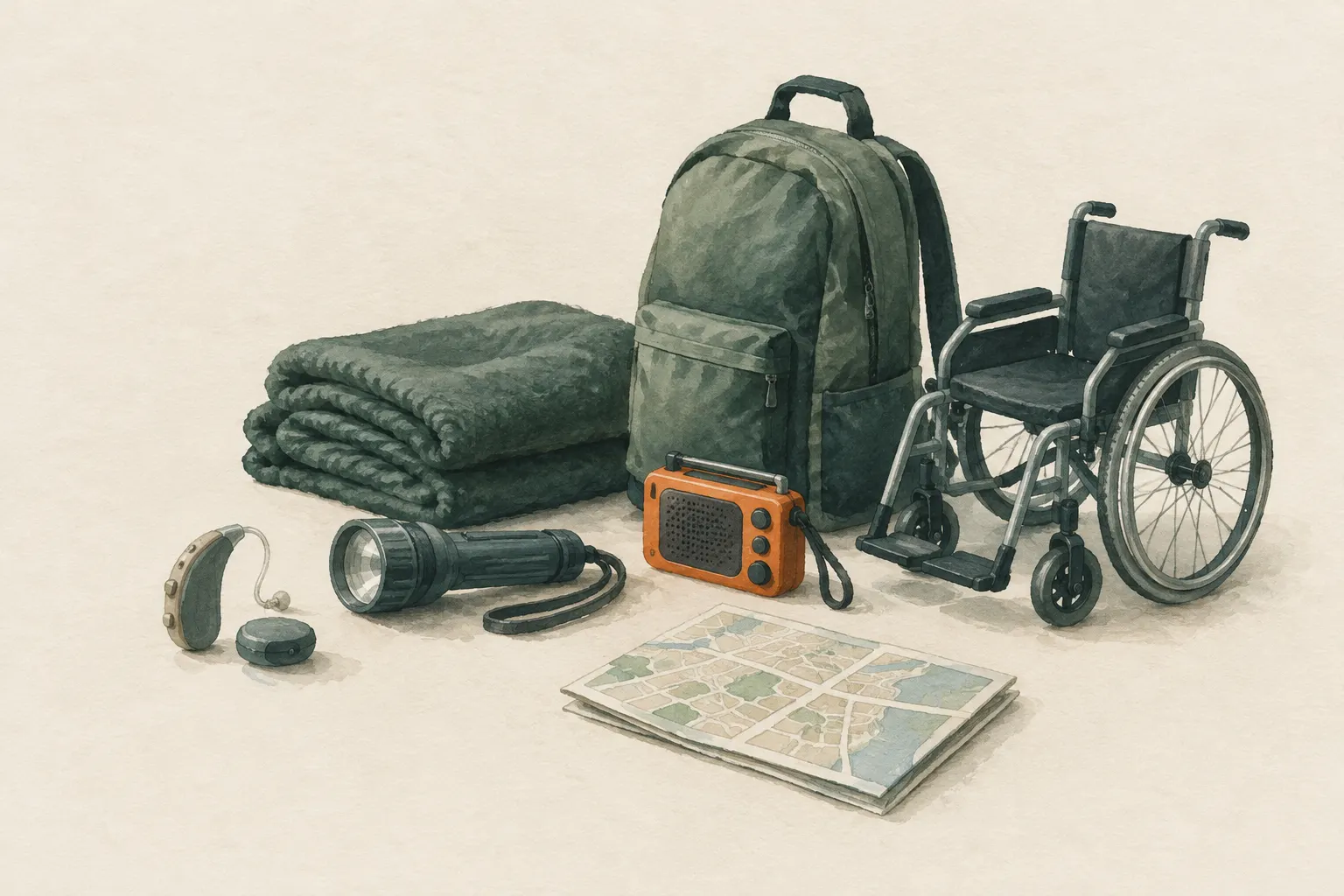
Explained simply
People with disabilities know best themselves what they need. That is why the emergency plan is made together with them. Someone who uses a wheelchair may need help on the stairs. Someone who cannot hear will not notice a siren. Someone who cannot see cannot read a text warning on the phone unless the phone reads it aloud.
So a good plan says: how does a warning reach me? Which aids do I need? How do I get out of the building? And who are the people who help me? It is like a net with several knots: if one knot breaks, the net still holds.
The most important thing: leave early when a warning comes, because with support you need more time. In danger, call the emergency number (112 in the EU) and say straight away what help you need.
How it works
“Nothing about us without us” is a principle of the disability rights movement, and it fits emergency planning exactly. The person knows what helps them, what they can do themselves and where they need support. A plan made over their head often misses reality – and also violates their self-determination.
A good plan describes needs rather than diagnoses. For helpers, “I need help on stairs and cannot stand for long” is far more useful than a medical term. The plan also takes into account that in an emergency, precisely the usual support may fail: assistance cannot get through, transport services do not run, power for aids is missing and the lift stands still.
What really matters
The personal support network is the heart of it. At least three people in different places – home, work, neighbourhood – are advisable, who know the plan, know how to get into the home and check in an emergency. Several people matter because in a crisis any one of them may be affected or unreachable.
Warnings must arrive. Not everyone can hear sirens, not everyone can read text warnings. Helpful options are warning apps with vibration or light signals, smoke alarms with a strobe light or vibrating pad, and a firm agreement that someone will let you know. Ask your municipality which accessible warning channels exist – accessible warning is still being developed in many countries.
A short information card for rescuers saves time in an emergency: how do you communicate with me? Which aids are essential? Which medication do I take, whom should you call? It goes in the wallet and in the emergency bag. Add backups for aids where possible: spare glasses, chargers, spare batteries where the manufacturer provides for this, and sometimes a manual alternative to an electric aid. For assistance animals, plan food, water and documents.
Safety: what to watch out for
Anyone who needs support to leave the building should set off early when evacuation warnings come, rather than waiting to see whether it gets serious. In danger, call the local emergency number (112 in the EU) and say straight away what support is needed, for example: “I use a wheelchair and I am on the third floor.” That way responders can send the right equipment and enough people.
Lifts cannot be used in a fire or power cut. So clarify escape routes and help on stairs in advance, not during the emergency – together with building management, neighbours, employer or school. The local fire service often advises on special situations such as flats on upper floors. Rescue techniques from windows or via ladders are a matter for professionals, not neighbours.
How to practise it
Try the route out of the home with your own aids – also without the lift and also in the dark. That shows where things get stuck: a heavy fire door, a step without a handrail, a corridor blocked with bicycles. Some of this can easily be changed with building management.
For cognitive impairments, plain language, picture cards showing the next steps and regular practice help. What has been practised often can still be recalled under stress. Review the plan together regularly, because aids, living situation and support people change.
Good to know
Ready.gov explicitly advises people with disabilities to build a personal support network, include aids and communication needs in the plan and keep information ready for rescuers. The BBK also points to special preparedness for people needing support.
Whether your region has registers, special support services or accessible emergency shelters varies a great deal. Ask your municipality, disability organisations or advice centres. Medical and legal questions are for the relevant professionals.
Step by step
Describe needs
Record together: what do I need daily (aids, medication, assistance, diet)? What stops working in a power outage? How do I communicate best?
- 1
Describe needs
Record together: what do I need daily (aids, medication, assistance, diet)? What stops working in a power outage? How do I communicate best?
- 2
Personal support network
At least three people in different places (home, work, neighbourhood) who know the plan, arrange access to the home and check in an emergency.
- 3
Adapt warning channels
Warning apps with vibration or light signals, smoke alarms with strobe or vibrating pad, an agreement that someone will let you know. Ask the municipality which accessible warning channels exist.
- 4
Information card
A short card for rescuers: how to communicate with me, which aids are essential, important contacts and medication. In the wallet and in the emergency bag.
- 5
Practise the escape and evacuation route
Try the way out of the home with aids, also without the lift and in the dark. Involve building management, employer or school where needed.
- 6
Backup for aids
Spare glasses, chargers, if possible a manual backup for electric aids. For assistance animals plan food, water and documents.
Common mistakes
- Planning for rather than with the person
- Having only one support person
- Assuming the lift or assistance will be available in an emergency
- Warnings via one channel only
- Not including aids in the go bag
Quick view
Materials
Document folder (waterproof)
Communication and health information
Store securely – contains sensitive personal data.
Medication supply
Agree any stock of prescription medication with a doctor or pharmacist; observe storage instructions and expiry dates.
Spare batteries
For aids, where the manufacturer provides for this
Store cool and dry, observe the expiry date; keep button cells out of children's reach.
Signal whistle
To attract attention
Carry within easy reach, not deep in the pack.
Do not blow right next to other people's ears.
Suitable for
- People with mobility, visual, hearing, cognitive or mental-health impairments
- Families, shared households and assistance teams
- Employers and schools in dialogue with those affected
Not suitable for
- Plans made without the person's participation
- A substitute for professional assistance or medical care
Prerequisites
- The person decides what goes into the plan
- Knowledge of aids, assistance and communication channels
Safety
- Lifts cannot be used in a fire or power outage. Clarify escape routes and help on stairs in advance, not during the emergency.
- Warnings do not reach everyone in the same way: not everyone can hear sirens, not everyone can read text warnings. Plan several channels and a contact person.
How it works
Nothing about us without us: the person knows best what they need and what helps them. A good plan describes needs rather than diagnoses, spreads tasks across a network of several people and takes into account that usual support such as assistance, transport services, power or lifts may fail in an emergency.
Advantages
- Preserves self-determination and dignity
- Makes help in an emergency faster and more suitable
- Benefits helpers too
Disadvantages
- Requires time and coordination with several people
- Backup aids can be expensive
Deep knowledge
Background
Ready.gov advises people with disabilities to build a personal support network, include aids and communication needs in the plan and keep information ready for rescuers. The BBK points to special preparedness for people needing support.
Accessible warning is still being developed in many countries. Those who cannot rely on public systems depend on a reliable personal network.
Variants
- Cognitive impairments
- Plain language, picture cards with the next steps and regular practice help people stay able to act under stress.
Common mistakes
- Planning for rather than with the person
- Having only one support person
- Assuming the lift or assistance will be available in an emergency
- Warnings via one channel only
- Not including aids in the go bag
Limits and risks
- No medical or legal information
- Services and registers differ by region – ask the municipality
Material alternatives
Derived from material properties: a substitute must have all relevant properties. Observe the notes on the substitute.
- Document folder (waterproof)
- Tarp, Plastic sheet / large bin bag (Tears easily; never pull over the head (suffocation risk).), Emergency blanket (Tears easily once punctured; short-term shelter only.), Rain poncho (When used as a shelter, it no longer protects your body from rain.), Bivy bag (Never fully close off the face.), Tent (Do not cook or heat inside the tent (fire and carbon monoxide danger).), Heavy-duty bin bag (large) (Suffocation risk: never pull plastic bags over the head or face and keep them away from small children.), Group shelter bag (Airtight – ventilate regularly.)
Results come exclusively from structured entries. No improvised instructions are generated.
Sources
Ready.gov – U.S. Federal Emergency Management Agency (FEMA): People with Disabilities
Support network, aids, communication and information for responders
Bundesamt für Bevölkerungsschutz und Katastrophenhilfe (BBK), Deutschland: Ratgeber für Notfallvorsorge und richtiges Handeln in Notsituationen
Preparedness for people needing support