Powered medical devices: an outage plan
Anyone using ventilation, oxygen, home dialysis, suction devices, an electric care bed or medication that must be kept cold at home needs their own outage plan – agreed with their doctor, care service and device supplier. The core: know the battery run time, organise backup, know where to go in good time.
- One appointment with the doctor or supplier; yearly review
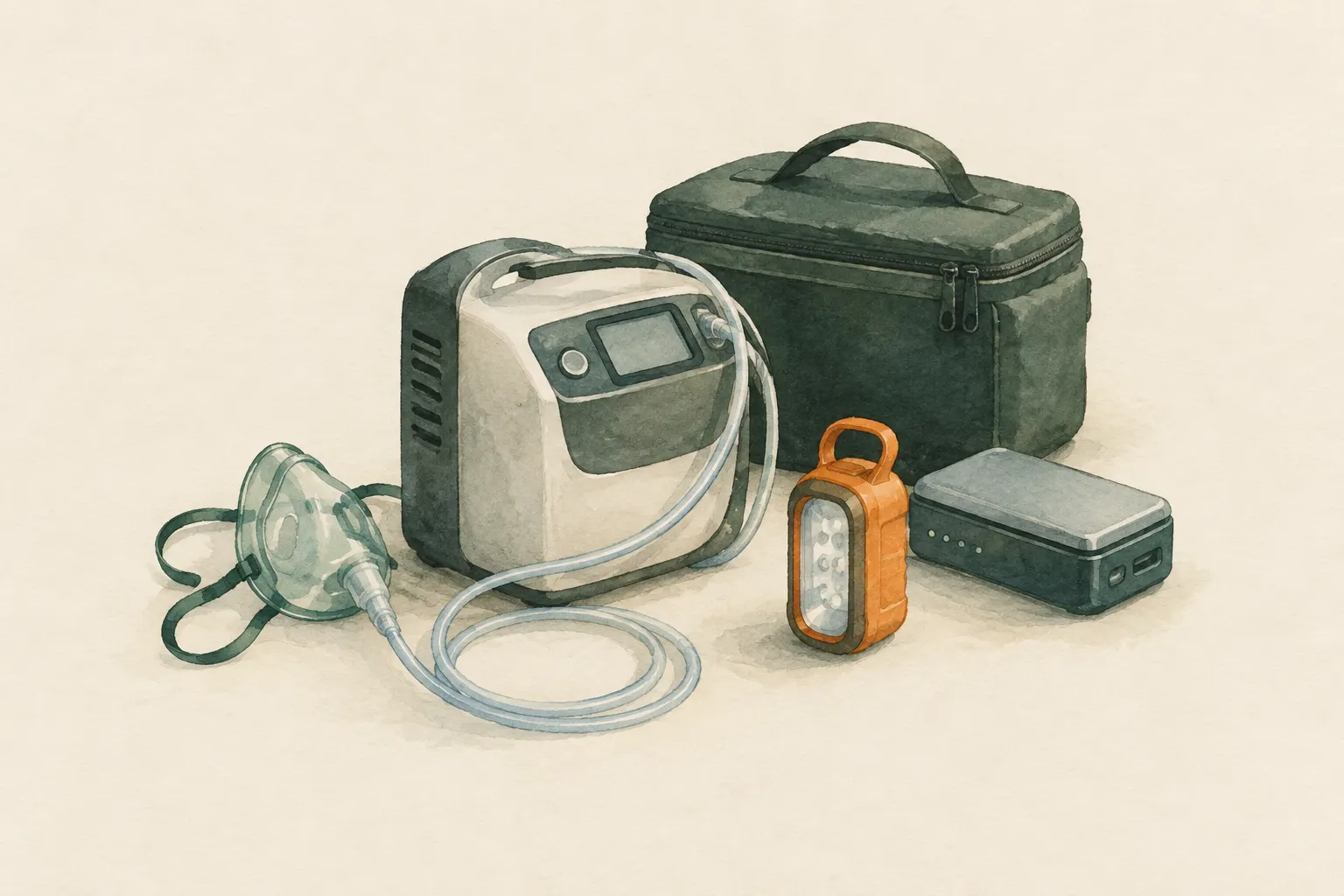
Explained simply
Some people need devices at home that run on electricity and help them breathe, with treatment or with care – for example a ventilator or a device that supplies oxygen. Some medicines, such as insulin, also have to stay cool. When the power goes out, this quickly becomes serious.
That is why these people need their own plan, which they discuss beforehand with their doctor, the care service and the company that supplies the device. The plan says, for example: how long does the device's battery last? Is there a spare battery? And from what point do you go to hospital or to relatives who have power?
The most important rule: do not wait until the last minute. If a life-sustaining device is about to fail, call the emergency number in good time (112 in the EU) or act as agreed in the plan.
How it works
With powered therapies the crucial question is not whether an outage will come at some point, but how long your own reserve lasts. Many devices have a built-in battery, some also spare batteries. How long these really last depends on the device, its settings and the age of the battery – this figure must come from the supplier, not from a guess.
A written plan sets out beforehand which measure applies from which point: first the device battery, then a spare battery or spare device, then support from the supplier, and finally moving to relatives who have power or to a hospital. If this has been clarified in advance, nobody has to improvise during the outage – not under stress and not in the dark.
What really matters
Write down every power-dependent device: manufacturer, model, battery run time according to the supplier, and the hotline. Add all medication that must be kept cold. Take this list to the doctor, care service and device supplier and clarify: are there spare batteries or a spare device? May the device be connected to a power station or generator? Where to go if the power is off for longer? How is medication stored without a fridge?
Set a trigger point: the remaining run time at which you get help or move. Choose it early enough that transport is still possible even when roads are congested and the phone network has failed.
At least two people nearby should know the plan, know where the documents are and drop by on their own initiative during an outage – even if the phone does not work. Some grid operators, municipalities or care services keep lists of people with power-dependent devices. Ask whether this exists where you live; it is no guarantee of priority help, though.
Safety: what to watch out for
Oxygen makes fire burn much more fiercely. Anyone receiving oxygen therapy has no candles, no naked flames and no smoking nearby. Battery light is the only sensible lighting here.
Connect devices to a power station, inverter or generator only as the manufacturer expressly permits. A generator always runs outdoors only, well away from windows and doors, because of carbon monoxide; it is never fed into a house socket.
Whether medication is still usable after refrigeration was interrupted is for the pharmacy or doctor to decide – not appearance or guesswork. Never change therapy, dosage or device settings on your own.
Typical situations
A short outage of an hour is usually bridged by the device battery. An outage whose end nobody knows is harder. Then the plan helps: you look at the remaining run time, compare it with your trigger point and act in good time instead of waiting and hoping.
The plan is just as important for relatives and carers. They then know where the device list is, whom to call, where to take the person and which medication has to come along. So keep a folder with the device list, contacts, medication plan and procedure in a fixed place.
Good to know
Ready.gov explicitly advises people with powered medical devices to make a power-outage plan with their medical provider. The BBK also emphasises special preparedness for people in need of care.
In widespread outages, emergency services and hospitals are under heavy strain. Acting early and according to plan protects you and relieves the system. Review the plan at least once a year and whenever the device, therapy or living situation changes. This entry does not replace medical advice.
Step by step
List devices and medication
Note every power-dependent device with manufacturer, model, battery run time according to the supplier and hotline, plus all medication that must be kept cold.
- 1
List devices and medication
Note every power-dependent device with manufacturer, model, battery run time according to the supplier and hotline, plus all medication that must be kept cold.
- 2
Talk to professionals
Clarify with the doctor, care service and device supplier: are there spare batteries or a spare device? May the device be connected to a power station or generator? Where to go if the power is off for longer? How is medication stored without a fridge?
- 3
Register where possible
Some grid operators, municipalities or care services keep lists of people with power-dependent devices. Ask whether this exists in your region – it is no guarantee of priority help.
- 4
Keep batteries charged
Always keep device batteries and approved spare batteries charged and check them regularly according to the manufacturer's instructions.
- 5
Set a trigger point
Set down in writing at which remaining run time you get help or move – early enough that transport is still possible despite traffic chaos and network failure.
- 6
Involve supporters
At least two people nearby know the plan, know where the documents are and drop by during an outage, even if the phone does not work.
Common mistakes
- Not knowing the actual battery run time
- Waiting too long before getting help
- Connecting devices to a generator or inverter without approval
- Candles near oxygen
- The plan existing only in one person's head
Quick view
Materials
Medication supply
As prescribed
Agree any stock of prescription medication with a doctor or pharmacist; observe storage instructions and expiry dates.
Insulated cool box
Only after checking with the pharmacy for medication that must be kept cold
Keeps cold only for a limited time; without ice packs or ice it is not a fridge.
Document folder (waterproof)
Device list, contacts, plan
Store securely – contains sensitive personal data.
Power bank
Only for devices the manufacturer approves for this
Do not use damaged or swollen batteries; do not charge while covered.
Suitable for
- People with powered assistive or therapy devices
- Relatives and carers
- Households with medication that must be kept cold
Not suitable for
- Changing therapy, dosage or device on your own
- Improvised power from a generator without the manufacturer's approval
Prerequisites
- Device name, manufacturer and hotline noted down
- A conversation with the doctor, care service or device supplier
Safety
- Whether medication is still usable after refrigeration was interrupted is for the pharmacy or doctor to decide – not appearance or guesswork.
How it works
With powered therapies the question is not whether an outage will come but how long your own reserve lasts. A written plan sets out beforehand at which point which measure applies: battery, spare device, support from the supplier, moving to relatives or hospital. Then nobody has to improvise during the outage.
Advantages
- Prevents dangerous improvisation
- Clarifies responsibilities beforehand
- Gives relatives confidence
Disadvantages
- Requires appointments and coordination
- Spare devices and batteries can be expensive
Deep knowledge
Background
Ready.gov explicitly advises people with powered medical devices to make a power-outage plan with their medical provider and mentions medication that must be refrigerated. The BBK also emphasises special preparedness for people in need of care.
In widespread outages emergency services and hospitals are under heavy strain. Acting early and according to plan relieves the system and avoids an emergency under time pressure.
Common mistakes
- Not knowing the actual battery run time
- Waiting too long before getting help
- Connecting devices to a generator or inverter without approval
- Candles near oxygen
- The plan existing only in one person's head
Limits and risks
- No medical instructions – therapy and medication only as directed by a doctor
- No device or product recommendations
Material alternatives
Derived from material properties: a substitute must have all relevant properties. Observe the notes on the substitute.
- Insulated cool box
- Sleeping pad, Dry leaves, grass or conifer boughs (Collect only where allowed; no protected plants. Check for ticks and insects.), Backpack, Dry spare clothing (Carry it in waterproof packaging – wet clothing barely insulates.), Wool blanket / duvet (Keep away from candles, stoves and heaters.), Sleeping bag (Do not store compressed long-term; do not pack away damp.), Newspaper and cardboard (Flammable – keep away from candles, stoves, heaters and embers.), Insulated cooking box (hay box, thermal cooker) (Never put open flame or embers inside – only the hot, closed pot.)
- Document folder (waterproof)
- Tarp, Plastic sheet / large bin bag (Tears easily; never pull over the head (suffocation risk).), Emergency blanket (Tears easily once punctured; short-term shelter only.), Rain poncho (When used as a shelter, it no longer protects your body from rain.), Bivy bag (Never fully close off the face.), Tent (Do not cook or heat inside the tent (fire and carbon monoxide danger).), Heavy-duty bin bag (large) (Suffocation risk: never pull plastic bags over the head or face and keep them away from small children.), Group shelter bag (Airtight – ventilate regularly.)
Results come exclusively from structured entries. No improvised instructions are generated.
Sources
Ready.gov – U.S. Federal Emergency Management Agency (FEMA): Power Outages
Plan with the medical provider for powered devices and refrigerated medication
Bundesamt für Bevölkerungsschutz und Katastrophenhilfe (BBK), Deutschland: Ratgeber für Notfallvorsorge und richtiges Handeln in Notsituationen
Preparedness for people in need of care
Centers for Disease Control and Prevention: Carbon Monoxide Poisoning – Prevention guidance
Generators outdoors only