Keeping phones charged during a power outage
During a power outage the phone is torch, warning receiver and link to the family – and its battery is limited. If you charge power banks beforehand, switch to power-saving straight away and use the car as a charging station only outdoors, you stay reachable much longer.
- About 15 minutes of preparation; ongoing upkeep of power banks
Explained simply
During a power outage your phone is very valuable: it is torch, warning receiver and link to your family. But its battery is like a water bottle on a long hike. What you drink now, you will miss later. So you share out the energy wisely.
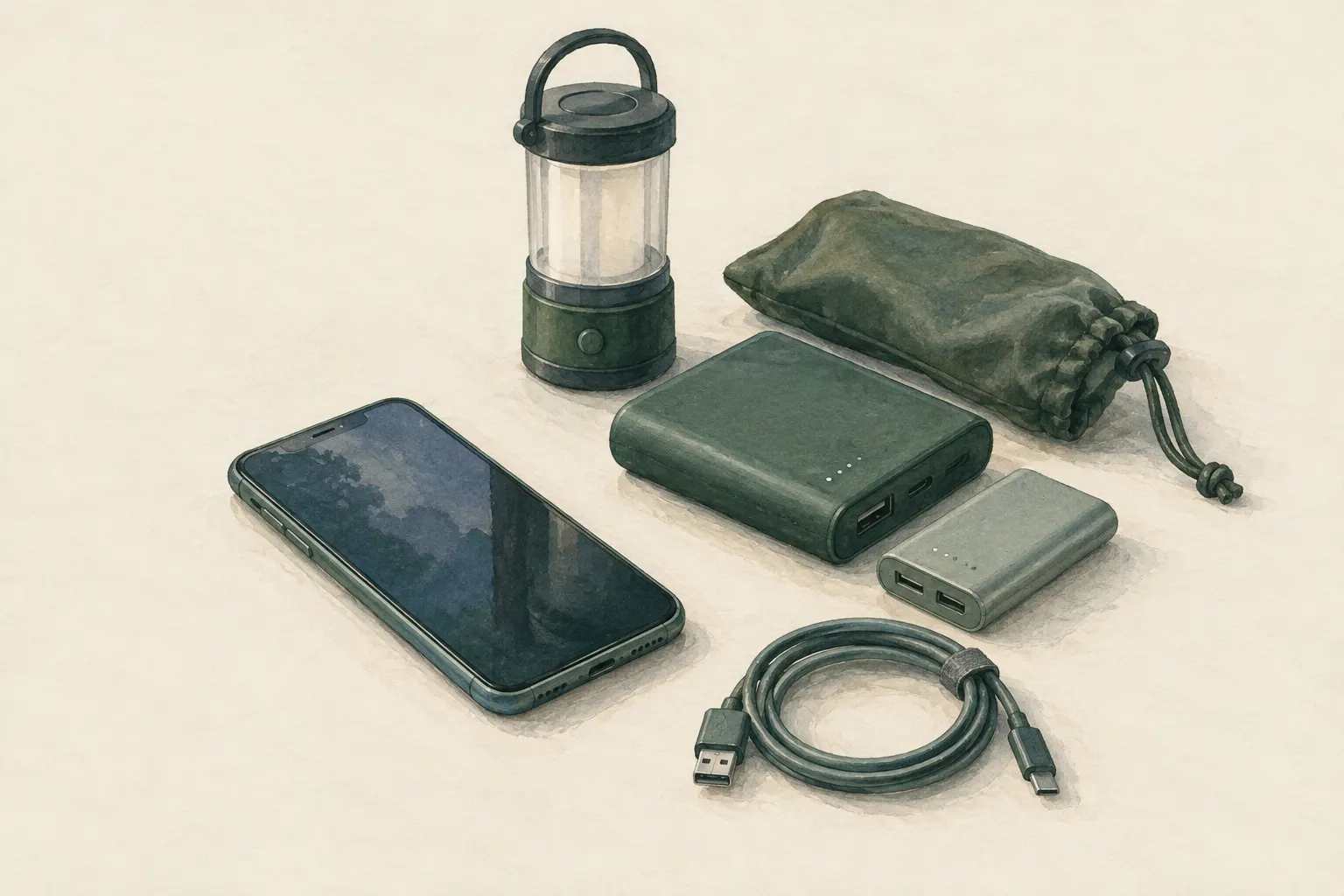
A power bank is an extra battery that you charge at home beforehand. During the outage you use it to fill up your phone again. Add saving: turn the screen down, close unnecessary apps and switch on power-saving mode. Listen to the news on a battery radio instead.
Very important: if you charge your phone in a car, only run the engine outdoors – never in a garage, not even with the door open. Car exhaust contains carbon monoxide, an invisible gas that can kill without warning.
How it works
A phone uses energy mainly for three things: the screen, the radio connections and apps running in the background. Searching for a network is especially sneaky. When there is little or no reception, the phone transmits harder and keeps looking for a mast – and that drains the battery fast. So when the network is down, it can make sense to switch on flight mode and only check briefly at fixed intervals whether there is a connection again.
Energy during an outage is therefore a stock. You combine three things: stored energy (charged power banks), saving (screen, radio, apps) and – only where safe – recharging from other sources, such as the car or a solar panel.
Cold matters too. Batteries deliver less energy at low temperatures and then seem to go “flat” sooner. If you carry the phone and power bank in an inside pocket close to your body, they stay warm and last longer.
What really matters
Preparation is what counts. Charge power banks fully and check them regularly, for example when the clocks change, because even unused batteries slowly lose charge. When severe weather is forecast, charge all phones, power banks and rechargeable lights as a precaution. Keep the right cable for each device at hand.
In a household, dividing roles helps: one phone stays on for emergency calls and warnings, the others are switched off and kept as a reserve. If everyone uses their phone at once, they are all flat in the end. Videos and constantly refreshing news apps use a particularly large amount of energy.
In longer outages, municipalities often set up contact points with backup power where you can charge devices. You usually hear about them on the radio or from notices. Bring your own cable and a multi-port USB plug.
Safety: what to watch out for
The car can charge devices through a USB adapter. The danger here is not the charging but the running engine. The vehicle stands outdoors, the exhaust is clear – in winter also of snow –, nobody sleeps in it and it does not run unattended. With the engine off, avoid draining the starter battery, or the car may not start later.
Do not keep charging or using swollen, damaged or very hot batteries. Do not charge power banks under blankets or pillows, because the heat cannot escape there.
Always keep some battery in reserve for emergency calls. If the mobile network has failed completely, the municipality's contact points are the way to call for help. The emergency number is the local emergency number (112 in the EU).
When it makes sense – and when not
Charged phones help in short and multi-day outages and also on the road after an evacuation. But they are useless if the mobile network itself fails. That is why the phone does not replace a battery or crank radio as the main source of information.
Larger battery packs, so-called power stations, can also run lamps and small devices. Crank devices with a USB output, by contrast, usually deliver only a little energy – enough for a short call, not for normal use. For medical devices: only a solution agreed with the doctor or supplier.
Good to know
How long a battery or power bank lasts cannot be stated across the board. It depends on the device, the age of the battery and the temperature. Power banks also lose capacity over the years. The most honest approach is your own test: charge your phone once completely from a full power bank and see how many times that works.
Mobile masts usually have only limited backup power. That is why Ready.gov and the BBK also recommend phone numbers on paper and a battery-powered radio.
Step by step
Beforehand: keep power banks full
Charge power banks fully and check them regularly, for example when the clocks change. When severe weather is forecast, charge all phones, power banks and rechargeable lights as a precaution.
- 1
Beforehand: keep power banks full
Charge power banks fully and check them regularly, for example when the clocks change. When severe weather is forecast, charge all phones, power banks and rechargeable lights as a precaution.
- 2
Save power at once
Switch on power-saving mode, turn down brightness, switch off Wi-Fi and Bluetooth, close unneeded apps. If the network is gone anyway, constant searching for a signal uses a lot of battery – then use flight mode for a while and switch it off briefly at fixed intervals.
- 3
Divide phones in the household
Do not use all devices at once: one phone stays on for emergency calls and warnings, others are switched off and kept as a reserve. Follow news on the radio rather than on the phone.
- 4
Keep the battery warm
Cold reduces usable battery capacity. Carry the phone and power bank in an inside pocket close to the body, do not leave them on a cold windowsill.
- 5
Car as a charging station – outdoors only
With a USB adapter the car can charge devices. For this the vehicle stands outdoors with a clear exhaust, nobody sleeps in it, and it is not left running unattended. With the engine off, do not drain the starter battery.
Never run it in a garage or enclosed space.
- 6
Use public charging points
In longer outages municipalities often set up contact points with backup power. Information comes via radio and notices. Bring your own cable and a multi-port USB plug.
Common mistakes
- Leaving power banks unused and empty in a cupboard for years
- Watching videos or constantly refreshing news apps during an outage
- Running the car in the garage to charge the phone
- Using all phones at the same time until all are flat
- No matching cable at hand
Quick view
Materials
Power bank
Store charged, top up every few months
Do not use damaged or swollen batteries; do not charge while covered.
Mobile phone
The battery drains quickly in cold and with continuous screen and GPS use.
Do not plan on it as your only means of navigation or emergency calls.
Battery or crank radio
Saves the phone battery for news
Check batteries regularly and keep spares.
Folding solar charger
Supplement for longer outages
Do not let phones and power banks overheat in direct sun while charging.
Output depends strongly on sun, orientation and season.
Suitable for
- Short and multi-day power outages
- Households that rely on warning apps and messengers
- On the road after an evacuation
Not suitable for
- Charging in a running car in a garage, a walled carport or with a snow-blocked exhaust
- A substitute for a battery or crank radio as the main source of information
Prerequisites
- Matching charging cables for all devices in the household
- Knowing where power-saving mode is set on your own phone
Safety
- Do not keep charging or using swollen, damaged or very hot batteries; do not charge power banks under blankets or pillows.
- Keep some battery in reserve for emergency calls. If the mobile network is down, use the municipality's emergency contact points; the emergency number is the local emergency number (112 in the EU).
How it works
Energy during an outage is a stock that has to be rationed: what is not used does not have to be recharged. That is why you combine stored energy (power banks), saving (screen brightness, radio connections, background apps) and – only where safe – recharging from other sources such as the car or a solar panel.
Advantages
- Keeps contact with family and authorities
- Low cost
- Also useful on the road and after an evacuation
Disadvantages
- Of no use if the mobile network fails
- Power banks lose capacity over time
Deep knowledge
Background
Mobile phone masts usually have only limited backup power; in long, widespread outages the network can therefore fail or become overloaded after a while. Ready.gov and the BBK therefore also recommend a battery-powered radio, phone numbers on paper and backup power for phones.
The danger of charging in the car is not the charging but the running engine: carbon monoxide poisoning from vehicles in garages is a known cause of death during power outages and storms.
Variants
- Portable power station
- Larger battery packs with a socket can also power lamps or small devices. They also have to be kept charged and do not replace a solution agreed with a doctor or supplier for medical devices.
- Crank and dynamo devices
- Some emergency radios have a crank with a USB output. Usually only a little energy can be gained this way – enough for a short emergency call, not for normal use.
Common mistakes
- Leaving power banks unused and empty in a cupboard for years
- Watching videos or constantly refreshing news apps during an outage
- Running the car in the garage to charge the phone
- Using all phones at the same time until all are flat
- No matching cable at hand
Limits and risks
- No run-time figures – they depend on device, battery age and temperature
- No product recommendations
Material alternatives
Derived from material properties: a substitute must have all relevant properties. Observe the notes on the substitute.
- Mobile phone
- Headlamp / flashlight, Battery lantern / LED light
Results come exclusively from structured entries. No improvised instructions are generated.
Sources
Ready.gov – U.S. Federal Emergency Management Agency (FEMA): Power Outages
Backup power for phones, carbon monoxide danger from engines
Centers for Disease Control and Prevention: Carbon Monoxide Poisoning – Prevention guidance
No running engines in garages, even with the door open
Bundesamt für Bevölkerungsschutz und Katastrophenhilfe (BBK), Deutschland: Ratgeber für Notfallvorsorge und richtiges Handeln in Notsituationen
Battery radio and backup power for communication