Solar chargers: realistic expectations
A small solar panel can keep phones, lights and radios running during longer outages – but much more slowly and less reliably than the figures on the packaging suggest. It works best to charge a power bank during the day and the devices from it at night.
- About 10 minutes to set up; re-aim several times a day
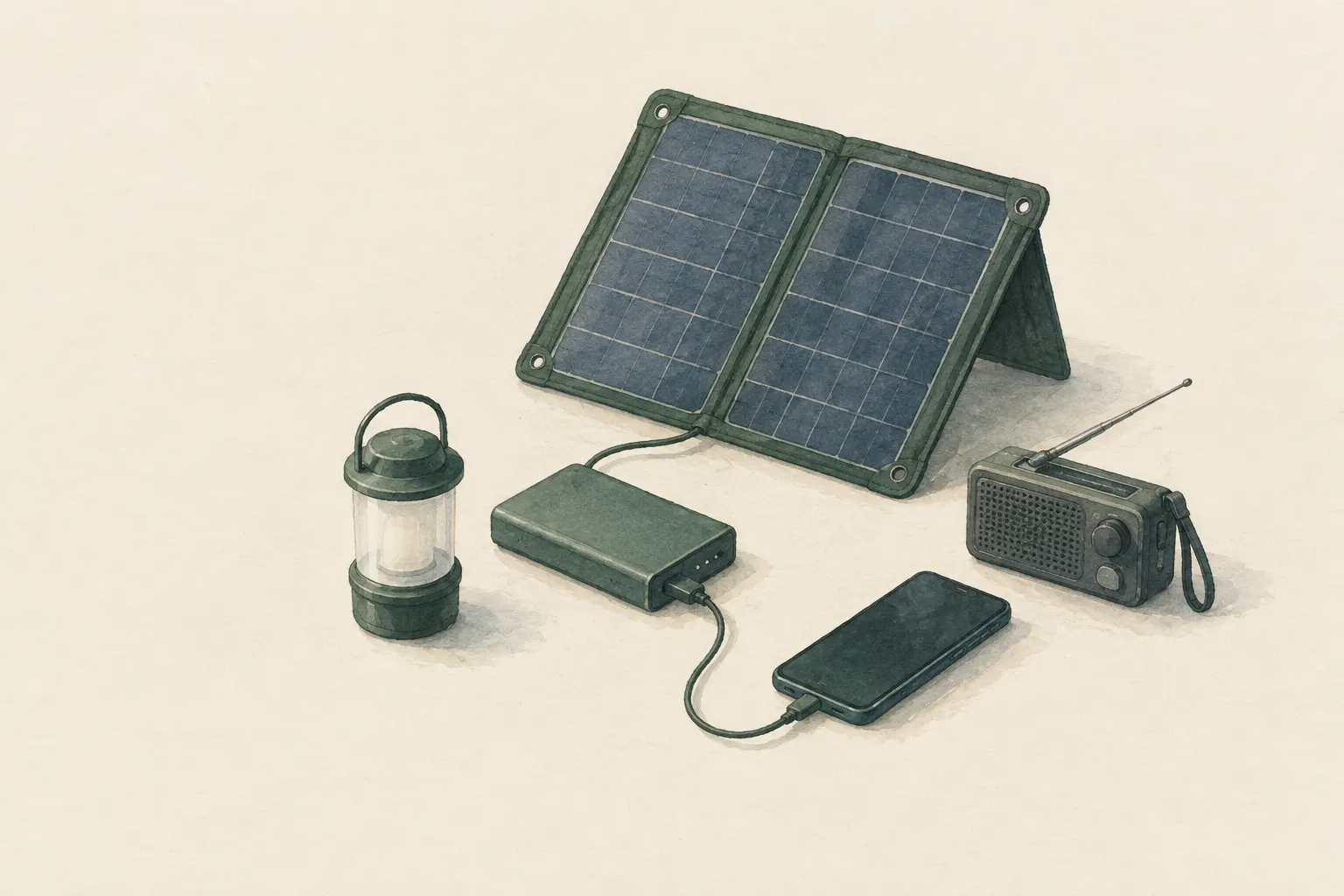
Explained simply
A solar panel is a flat plate that turns sunlight into electricity. During an outage you can use it to charge small devices such as a phone, headlamp or radio. That sounds great – but it goes much more slowly than many people think, especially when there are clouds in the sky or in winter.
Think of the panel like a bucket in the rain: the more sun shines directly onto it, the faster it fills. Shade, clouds or a window pane make the “rain” much weaker. So the panel belongs in full sun, and you turn it to follow the sun.
A good trick: during the day the panel charges a power bank, and in the evening you charge the phone from it. Keep the phone and power bank in the shade while doing this – only the panel needs the sun. Batteries do not like heat.
How it works
Solar cells produce electricity when light falls on them. They deliver most when the sun shines as squarely as possible onto the surface. When the sun is low, clouds pass, dirt lies on the surface or the light comes through window glass, output drops sharply. Even shade on a small part of the surface can noticeably reduce the output of the whole panel, because the cells are connected to each other.
The wattage on the label is measured under ideal laboratory conditions. In everyday use – on a balcony, in changing weather – a panel usually delivers considerably less. Anyone who calculates with the printed figure will be disappointed.
Because the output keeps fluctuating, a buffer battery makes sense. Many phones stop charging when a cloud passes briefly. A power bank usually copes better with fluctuating current and later passes it on evenly to the phone.
What really matters
Place the panel in direct sunlight without shade, outdoors rather than behind a pane if possible, and point it towards the sun. The sun moves across the sky, so re-aim the panel every one to two hours when you are at home.
Allocate the energy. What the panel delivers goes first to light, radio and one emergency phone – not to entertainment. That way the important things stay supplied even on dull days.
Most important of all is a test before an emergency. Try out on a sunny day and on a cloudy day how long your panel takes to charge a power bank noticeably. Then you know what is realistic and do not unpack the panel for the first time in an emergency.
Safety: what to watch out for
Only the panel belongs in the sun. Keep the phone and power bank in the shade while charging. In direct sun, batteries can overheat and be permanently damaged; a hot battery also charges less well.
Fasten panels on the balcony or in the garden so the wind cannot blow them down – a falling panel can injure people. Do not climb onto roofs to set up a panel.
When it makes sense – and when not
A small solar panel is a good supplement in multi-day outages, especially in the summer half of the year, and for small devices such as a phone, headlamp and radio. It is quiet, needs no fuel and produces no exhaust.
It is not a reliable solution for life-sustaining medical devices. Nor are small panels enough for heating, cooking or a fridge. In winter the sun in central Europe is much weaker and shines for a shorter time – exactly when an outage is most stressful because of the cold. So plan for the worst case.
Plug-in balcony solar systems normally feed into the household grid and switch off automatically when the grid fails. Without their own storage and suitable technology, they therefore provide no power during an outage. Whether and how that can be changed is for a qualified installer or the manufacturer to clarify – not a DIY solution.
Good to know
Small folding panels were originally developed for hiking and camping. They are practical there because you are outdoors during the day anyway. At home during an outage they need more attention: someone has to aim the panel and keep an eye on it.
Devices with a built-in mini panel, such as solar radios or solar lights, usually charge only slowly. They are a nice extra, but no replacement for a stock of charged power banks and batteries.
Step by step
Test beforehand
Check on a sunny and on a cloudy day how long your panel takes to charge a power bank noticeably. Then you know what is realistic in an emergency.
- 1
Test beforehand
Check on a sunny and on a cloudy day how long your panel takes to charge a power bank noticeably. Then you know what is realistic in an emergency.
- 2
Position correctly
Place the panel in direct sunlight without shade, outdoors rather than behind glass if possible, and face it towards the sun. Even shade on part of the surface can greatly reduce output.
- 3
Charge the power bank first
Many phones stop charging when a cloud passes. A power bank usually copes better with fluctuating current; the phone is then charged from the power bank later.
- 4
Re-aim
The sun moves. Re-aim the panel every one to two hours when you are at home.
- 5
Allocate energy
Use what the panel delivers first for light, radio and one emergency phone – not for entertainment.
Common mistakes
- Calculating with the wattage printed on the label
- Leaving the panel behind a window or in partial shade
- Charging the phone in direct sun
- Unpacking the panel only in an emergency without ever testing it
Quick view
Materials
Folding solar charger
Do not let phones and power banks overheat in direct sun while charging.
Output depends strongly on sun, orientation and season.
Power bank
As a buffer
Do not use damaged or swollen batteries; do not charge while covered.
Cable ties
To fasten the panel
Never put around body parts – they cannot be released without a tool.
Suitable for
- Multi-day outages in the summer half of the year
- Small devices: phone, headlamp, radio
- A supplement to power banks
Not suitable for
- Life-sustaining medical devices
- Heating, cooking or fridges with small panels
- Reliable supply in winter or during persistent cloud
Prerequisites
- Panel tried once in sunshine before it is needed
- A place with direct sun (balcony, garden, windowsill facing the sunny side)
Safety
- Put the phone and power bank in the shade while charging (only the panel in the sun). Overheated batteries can be permanently damaged.
- Fasten panels securely on a balcony or roof so the wind does not blow them down. Do not climb onto roofs.
How it works
The output of a solar module depends on how much sunlight falls perpendicularly on the cells. Clouds, shade, a low sun, dirt and window glass reduce it greatly. The rated output on the label is measured under laboratory conditions; in everyday use a panel usually delivers considerably less. A buffer battery smooths out fluctuations.
Advantages
- Independent of fuel
- Quiet and emission-free
- Usable for weeks as long as the sun shines
Disadvantages
- Strongly dependent on weather and season
- Slow
- Needs attention to keep it aimed
Deep knowledge
Background
Small folding panels are designed for hiking and camping and can be a useful supplement during an outage. They replace neither a stock of charged power banks nor a battery radio.
In central Europe solar radiation in winter is much lower than in summer – exactly when outages are most stressful because of the cold. Plans should therefore assume the worst case.
Variants
- Solar radio and solar light
- Devices with a small built-in panel are handy but usually charge slowly. Useful as a supplement, not as the only solution.
- Plug-in balcony solar system
- Plug-in solar systems normally feed into the household grid and switch off when the grid fails. Without their own storage and suitable technology they provide no power during an outage – ask a qualified installer or the manufacturer.
Common mistakes
- Calculating with the wattage printed on the label
- Leaving the panel behind a window or in partial shade
- Charging the phone in direct sun
- Unpacking the panel only in an emergency without ever testing it
Limits and risks
- No output or charging-time figures – they depend on model, place and weather
- No guidance on permanently installed solar systems (qualified installer)
Sources
Bundesamt für Bevölkerungsschutz und Katastrophenhilfe (BBK), Deutschland: Ratgeber für Notfallvorsorge und richtiges Handeln in Notsituationen
Supplementary off-grid energy sources such as solar and crank devices in preparedness