Eating and drinking in the cold
In the cold the body uses more energy – through shivering, heavy clothing and harder walking. Regular meals and snacks, hot drinks and enough fluid help you stay warm and capable. Alcohol does not warm you; it promotes heat loss.
- Planning before a trip or when the heating fails
Explained simply
Your body is like a small power station that is always making heat. When it is cold outside, it has to heat more – just as a heating system uses more in winter than in summer. On top of that, every step is harder in thick clothes and in snow. That is why you need more food than usual in the cold.
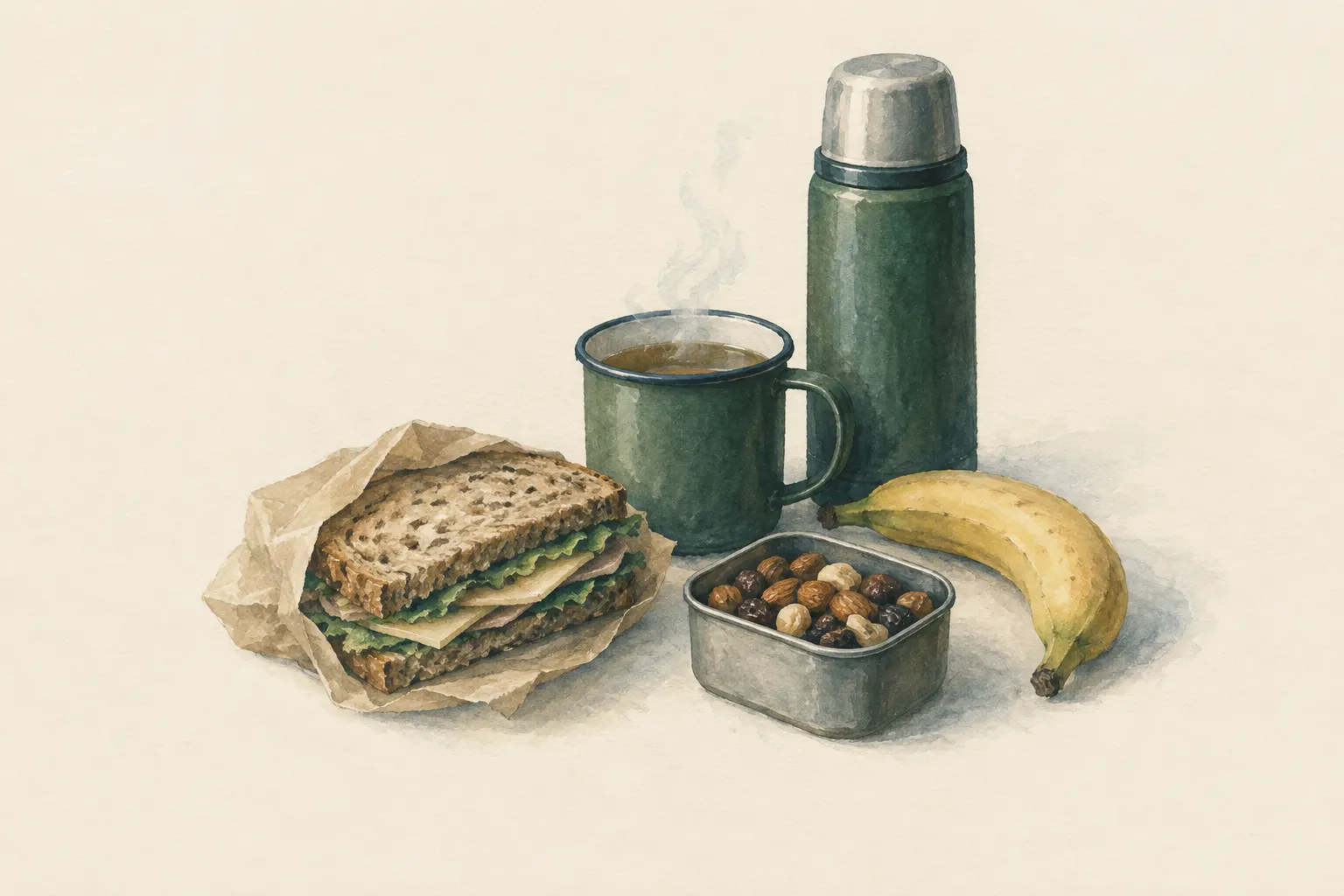
It is best to eat small portions regularly rather than going a long time without eating. Nuts, bread, cheese, oats or dried fruit are good companions. And do not forget to drink: in the cold you feel less thirsty, but you still need water. A warm tea from a vacuum flask does you good.
An important misconception: alcohol does not warm you. It only makes you feel warmer for a short time, but in reality it makes the body lose heat faster. And drinks are never heated with a stove or grill inside a tent or home – because of the poisonous gas carbon monoxide.
How it works
The body produces heat through its metabolism and through muscle work. In the cold the demand rises: shivering is nothing other than rapid muscle work that produces heat and uses energy to do so. Heavy clothing, a backpack and hard walking in snow or slush cost extra strength. Food supplies the fuel for all of this.
Carbohydrates such as bread, oats or dried fruit provide energy the body can use quickly. Fat, for example in nuts and cheese, provides more energy per gram and is used more slowly. A mix of both in small, frequent portions keeps the energy flow steady – like a stove you feed regularly rather than throwing in one huge pile at once.
Hot drinks warm you only a little directly, but they help against dehydration. That is easily overlooked in the cold: you feel less thirsty, but you lose moisture with every breath into the dry, cold air and still sweat under your clothes. A warm drink simply makes drinking more pleasant.
What really matters
Plan more food than usual for cold days, especially easy-to-eat, energy-dense food that tastes fine without cooking: nuts, dried fruit, bread, cheese, oats. Do not rely only on hot meals – if the stove fails or the weather turns, you still need to be able to eat.
A good rhythm: breakfast before setting off, a snack every one to two hours on the way, a hot meal in the evening and something to eat before sleeping. Drink regularly, even without thirst. Pale urine is a simple sign that you are drinking enough.
Cold makes eating and drinking awkward: chocolate and bars go rock-hard, water can freeze. Carry snacks close to your body in an inside pocket and drinks in an insulated bottle. Store bottles upside down – ice usually forms at the top first, so the opening stays clear for longer.
Safety: what to watch out for
No alcohol to warm up. It widens the blood vessels in the skin so that you feel warm for a short time – in reality more warm blood flows to the surface and the body loses heat faster. Alcohol also impairs judgement, precisely when good decisions matter.
Severe shivering, confusion or apathy can be signs of hypothermia. Then get the person to a warm, sheltered place and call for help on the local emergency number (112 in the EU). Hypothermia is a medical emergency; food and drink do not replace treatment.
Drinks and food are never heated with a stove or grill inside a tent, porch or home. Carbon monoxide is invisible and odourless and can cause unconsciousness without warning in enclosed spaces.
Typical situations
On a winter trip, pack more food than for a summer trip and distribute it so that you can reach it on the way without unpacking. A break to eat and drink every one to two hours keeps you warm and capable – and is a good moment to check how everyone is doing.
If the heating fails at home in winter, the same applies: eat regularly, drink warm drinks, wear several layers of clothing and keep one room warm together. Hot drinks in an insulated bottle, heated once outdoors or on an approved cooker, stay warm for hours.
Pay special attention to others. Children, older people and exhausted people often eat and drink too little in the cold because they lack appetite or unpacking is a hassle. Actively offer them something instead of waiting until they ask.
Good to know
According to the FAO/WHO/UNU report on human energy requirements, needs depend on body, age and activity. Military survival manuals such as FM 3-05.70 treat food and fluids in the cold as an integral part of cold protection – not as a side issue.
This entry deliberately gives no fixed calorie figures for the cold, because they depend strongly on weather, clothing, exertion and the person. The simple rule of thumb is: pack more, eat more often, drink regularly – and take one break too many rather than one too few.
Step by step
Plan more
Plan more food than usual for cold days, especially easy-to-eat, energy-dense food such as nuts, dried fruit, bread, cheese, oats.
- 1
Plan more
Plan more food than usual for cold days, especially easy-to-eat, energy-dense food such as nuts, dried fruit, bread, cheese, oats.
- 2
Eat regularly
Breakfast before setting off, a snack every one to two hours on the way, a hot meal in the evening. Eat something before sleeping.
- 3
Do not forget to drink
Carry warm drinks in an insulated bottle and drink regularly, even without thirst. Pale urine is a simple guide.
- 4
Prevent freezing
Carry snacks and water close to the body or insulated; store bottles upside down. Chocolate and bars go hard in the cold.
- 5
Watch out for others
Children, older people and exhausted people often eat and drink too little in the cold – actively offer food and drink.
Common mistakes
- Going into the cold on an empty stomach
- Relying only on hot meals
- Drinking too little
- Alcohol to warm up
Quick view
Materials
Double-wall insulated bottle
Never heat directly.
Non-perishable food
Prefer food that can be eaten without cooking; consider allergies and dietary needs; do not forget a can opener.
Stove
Never operate inside a tent, shelter or enclosed room – carbon monoxide and fire risk.
Suitable for
- Winter trips
- Heating failure in winter
- Long periods outdoors in the cold
Not suitable for
- Treating hypothermia – that is a medical emergency
Prerequisites
- Energy-dense food that can be eaten without cooking
- Insulated bottle
Safety
- No alcohol to warm up: it dilates skin blood vessels, increases heat loss and impairs judgement.
How it works
The body produces heat through metabolism and muscle work. In the cold the demand rises, and food supplies the fuel. Small, frequent meals keep the energy flow steady. Hot drinks warm only a little directly, but help against dehydration, which is easily overlooked in the cold because thirst is reduced.
Advantages
- More warmth and capacity
- Better mood
Disadvantages
- More weight to carry
- Larger stock needed
Deep knowledge
Background
According to the FAO/WHO/UNU report on human energy requirements, energy needs depend on body, age and activity. Military survival manuals such as FM 3-05.70 treat food and fluids in the cold as part of cold protection.
Fixed calorie figures for cold conditions are deliberately not given here because they depend strongly on the situation.
Common mistakes
- Going into the cold on an empty stomach
- Relying only on hot meals
- Drinking too little
- Alcohol to warm up
Limits and risks
- No calorie figures
- No dietary advice for medical conditions
Material alternatives
Derived from material properties: a substitute must have all relevant properties. Observe the notes on the substitute.
- Double-wall insulated bottle
- Single-wall stainless steel bottle (Heat only single-wall bottles without paint/plastic; remove the lid before heating.), PET bottle (clear, max. 2 litres) (Do not heat or place in a fire.), Food-grade water container (Only use containers that never held chemicals or fuel.), Airtight food-grade storage container (Fill only when clean and completely dry; never use containers that previously held chemicals.), Collapsible water container or bag (Protect from sharp objects.), Food-grade water bag (Use only for drinking water, never for chemicals or fuel.), Fermentation jar or crock (Use only food-grade containers of glass, food-safe glazed stoneware or food-grade plastic – no metal containers for acidic food.), Resealable food bags (Use only bags intended for food; do not use with boiling water unless the manufacturer explicitly allows it.)
Results come exclusively from structured entries. No improvised instructions are generated.
Sources
Food and Agriculture Organization of the United Nations (FAO) (2004): Human energy requirements – Report of a Joint FAO/WHO/UNU Expert Consultation
Energy needs depend on body, age and activity
Headquarters, Department of the Army (USA) (2002): FM 3-05.70 Survival
Food and fluids in the cold
Wilderness & Environmental Medicine (Wilderness Medical Society) (2019): Wilderness Medical Society Clinical Practice Guidelines for the Out-of-Hospital Evaluation and Treatment of Accidental Hypothermia: 2019 Update
Hypothermia as an emergency