Choosing a compass: baseplate, mirror and sighting compass
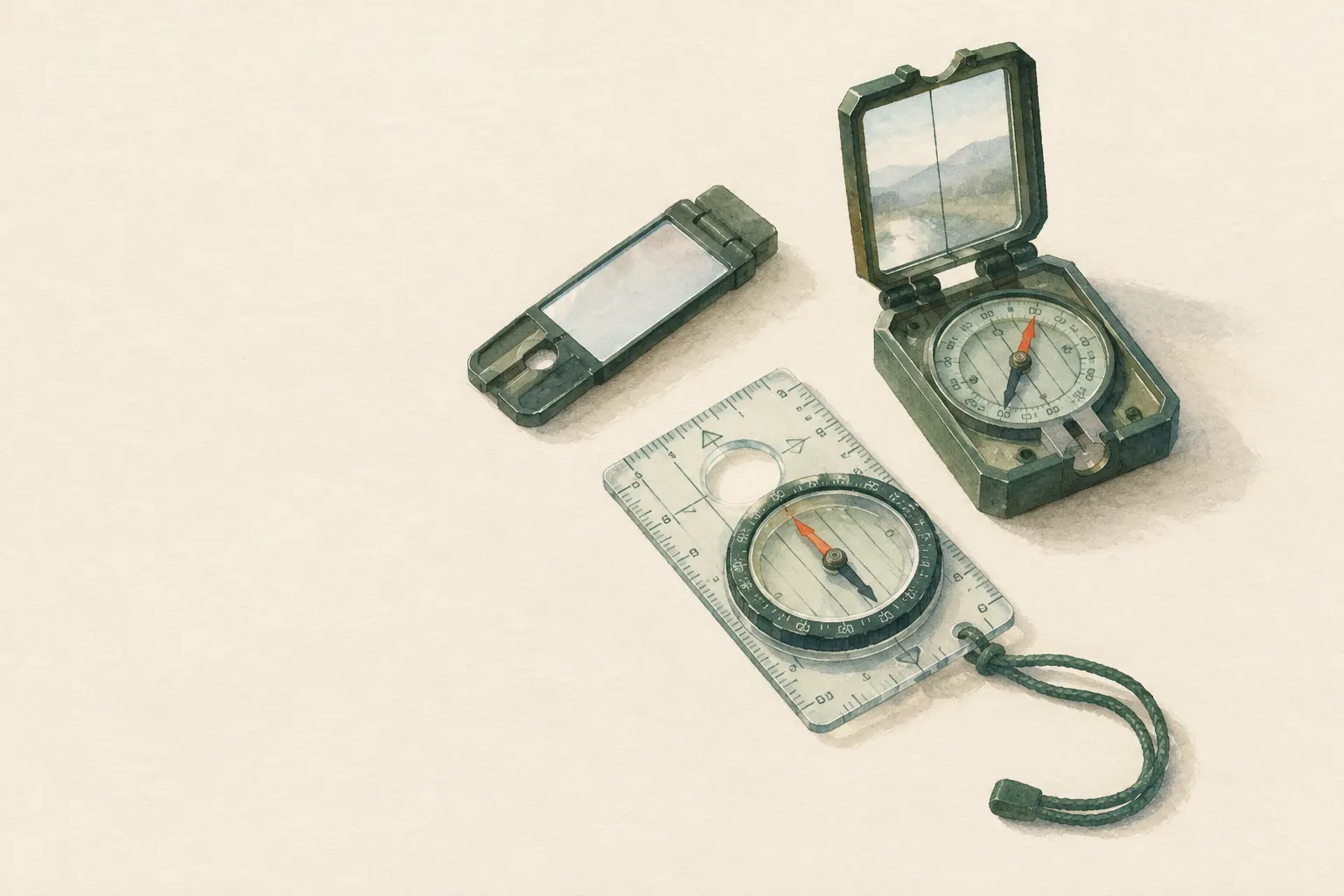
For map work a baseplate compass with rotating housing, rulers and a liquid-damped needle is the basic tool. Mirror and sighting compasses allow more precise bearings to distant targets. Important are a scale in degrees, rulers matching your map scales, adjustable declination if needed and a needle balanced for your part of the world.
- 10 minutes reading
Explained simply
The Earth is like a giant, weak magnet. A compass needle is a small magnet that can turn freely. That is why it always points in the same direction, roughly north – no matter how you hold the compass. With it you can work out which way you need to go.
For hikes with a map a baseplate compass is the most practical. It is a transparent plate with rulers and a rotating housing in which the needle floats. Because the plate is see-through, you can lay it directly on the map and transfer directions from the map to the terrain. Mirror and sighting compasses also have a sighting device that lets you aim at distant points more precisely.
Important: metal, magnets and phones can deflect the needle. Keep away from them when taking a bearing. And a compass only helps if you have practised with map and compass.
How it works
The compass needle is magnetised and aligns itself with the Earth's magnetic field. It points to the magnetic north pole, which does not exactly match the geographic north pole. The angle between the two directions is called declination (or magnetic variation). It differs from place to place and changes slowly over time. National agencies offer calculators to find the current declination for your location.
The Earth's magnetic field is not horizontal everywhere. Towards the poles it tilts more and more towards the ground. A simple needle would therefore hang at an angle in some regions and scrape against the housing. Manufacturers compensate for this by balancing the needle for particular regions of the world. So-called global needles are built to work worldwide.
The housing is filled with liquid. It damps the needle's movement so that it doesn't swing back and forth for long but settles quickly. This makes reading faster and more accurate, especially when you hold the compass in your hand.
The three types
The baseplate compass is the basic tool for most hikers. It consists of a transparent plate with a direction-of-travel arrow, a rotating housing with a degree scale, orienting lines in the bottom of the housing and rulers along the edge. With it you can measure a direction on the map and then follow it in the terrain, or the other way round.
The mirror compass is basically a baseplate compass with a folding lid that holds a mirror and a sighting notch. When you raise the compass to eye level, you see the target through the notch and the needle in the mirror at the same time. This makes bearings to distant targets more precise. The lid also protects the housing.
The sighting or lensatic compass has a sight for aiming and a small magnifying lens for reading the scale. It is robust and common in military use; a US field manual describes it in detail. For map work it is somewhat more awkward without a transparent baseplate, because you cannot transfer directions directly.
What matters when buying
Look for a clearly readable scale. Usually it is divided into degrees; a full circle has 360 degrees. Some compasses are divided into mils, which are mainly common in military use. Which unit you choose matters less than that map, compass and everyone in your group use the same one.
The rulers on the edge should match the scales of your maps so you can measure distances directly. Adjustable declination is handy if declination is large in your area – you set it once and then don't have to calculate every time. Luminous markings help at dusk.
The needle matters too. If you travel abroad, check whether your needle is balanced for that region, or take a compass with a global needle. Toy or keyring compasses are not suitable for serious navigation; they are often inaccurate and not damped.
Safety: recognising interference
Metal, magnets, phones, speakers and some magnetic clasps on jackets or bags deflect the needle. Even a phone in your chest pocket can distort the reading. Keep away from such things when taking a bearing, including cars, fences and power lines. Also don't store the compass right next to electronics or strong magnets, because in unfavourable cases these can weaken the needle's magnetisation.
Test a compass before you rely on it. Reasons to replace it are bubbles in the housing, a sluggish or sticking needle and a reading that differs clearly from a second compass. Such a comparison is easy: lay both compasses side by side, a little apart, and see whether they point in the same direction.
Don't rely only on the compass in your phone. It needs power, can be inaccurate if not calibrated and fails along with the phone. A real compass works without a battery and is a good backup – also in a go bag.
How to practise it
A compass is only as useful as the practice you have with it. Start in a familiar area: lay the compass on the map, orient the map to north and compare what you see with what the map shows. Then take a bearing on a church tower or a summit and find it on the map.
The actual navigation – taking a bearing, allowing for declination, holding a course – is explained in detail in the navigation world. This entry only helps you choose the tool. Many clubs and adult education centres offer courses where you learn map and compass together with others.
Step by step
Baseplate compass
Transparent plate with direction-of-travel arrow, rotating housing with degree scale, orienting lines and rulers. Sufficient for most hikers.
- 1
Baseplate compass
Transparent plate with direction-of-travel arrow, rotating housing with degree scale, orienting lines and rulers. Sufficient for most hikers.
- 2
Mirror compass
With a folding mirror and sighting notch: see target and needle at the same time for more precise bearings. The lid protects the housing.
- 3
Lensatic or sighting compass
With sight and magnifying lens, robust and common in military use. Somewhat more awkward for map work without a baseplate.
- 4
Check features
Degree scale (or the division used in your region), rulers matching your maps, declination adjustment if needed, a needle for your zone or a global needle, readable in the dark.
- 5
Test
Bubbles in the housing, a sluggish or sticking needle and readings that differ from a second compass are reasons to replace it.
Common mistakes
- Using the phone compass as the only tool
- Carrying the compass next to magnetic clasps
- Using a needle from another region abroad without checking
Quick view
Materials
Baseplate compass
Metal, magnets and electronics nearby deflect the needle.
Bubbles in the capsule or a sluggish needle indicate a defect.
Topographic map
Check the publication date – paths and buildings may have changed.
Protect from wet (map case or bag).
Suitable for
- Buying a first compass
- Backup for phone and GPS
- Go bags
Not suitable for
- Toy and keyring compasses for serious navigation
Prerequisites
- Basics of map reading
Safety
- Metal, magnets, phones and speakers deflect the needle. Do not store the compass next to electronics and keep away from them when taking a bearing.
How it works
The compass needle aligns with the Earth's magnetic field. A baseplate compass combines the needle with a protractor and rulers so directions can be transferred directly between map and terrain. Because the magnetic field is not horizontal everywhere, needles are balanced for particular zones; so-called global needles work worldwide.
Advantages
- Works without power
- Robust and light
Disadvantages
- Only useful with a map and practice
- Susceptible to metal and magnets
Deep knowledge
Background
The US field manual FM 3-25.26 describes the lensatic compass in detail; mountaineering handbooks cover baseplate and mirror compasses and setting declination.
Calculators from national agencies give the declination for your location; it changes over time.
Variants
- Mils instead of degrees
- Some compasses are divided in mils. What matters is that map, compass and group use the same unit.
Common mistakes
- Using the phone compass as the only tool
- Carrying the compass next to magnetic clasps
- Using a needle from another region abroad without checking
Limits and risks
- No product recommendations
- No navigation instructions – see the navigation world
Sources
Headquarters, Department of the Army (USA) (2001): FM 3-25.26 Map Reading and Land Navigation
Design and use of the lensatic compass
The Mountaineers Books (2017): Mountaineering: The Freedom of the Hills, 9th edition
Baseplate and mirror compasses, setting declination