Cookware on the move: material, size, care
Titanium is light, aluminium conducts heat well and stainless steel is robust and affordable. A pot with a lid saves fuel, a handle must sit securely and the size depends on the number of people and the meal. Do not overheat coatings, and store everything clean and dry.
- 10 minutes reading
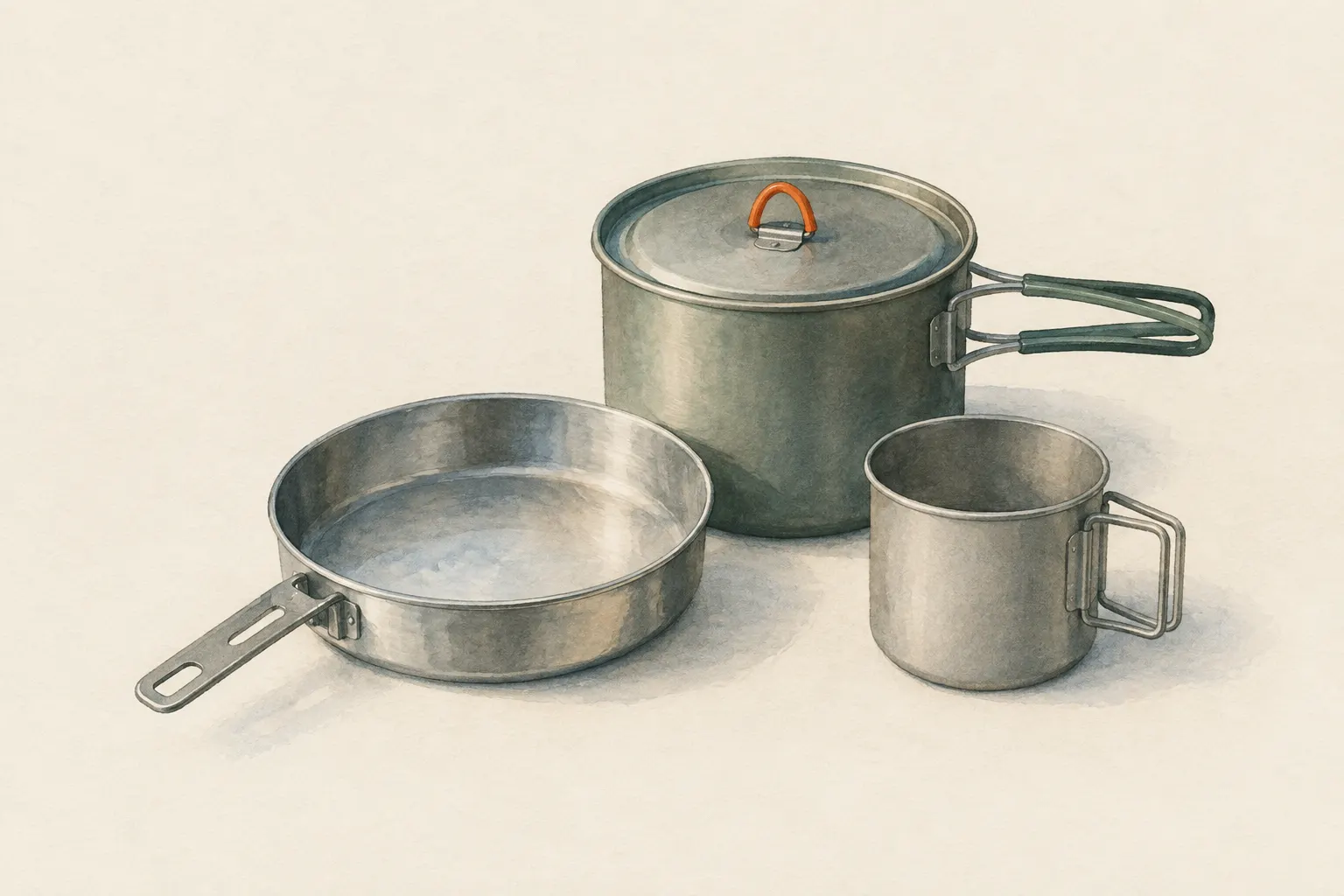
Explained simply
Cookware for the outdoors comes in different metals. Titanium is feather-light, aluminium spreads heat well, and stainless steel is especially tough. Which is best depends on what you want to cook: only water for tea and ready meals? Or proper meals for a whole family?
A lid is a small trick with a big effect. It keeps the heat in the pot, just as a hat keeps the heat in your head. The water boils faster, and you need less fuel.
Important for your safety: thin pots and metal handles get very hot. Only touch them with a pot grip or glove, and always set the pot centred and firm on the stove. Plastic tableware never goes over a flame.
How it works
How fast a pot heats water depends on three things: how well the material conducts heat, how wide the pot is and whether there is a lid on it. A wide, low pot catches more of the flame than a narrow, tall one. A lid stops hot steam, and with it a lot of heat, from simply escaping. Without a lid you are partly heating the air above the pot.
Heat conduction decides how evenly the heat spreads across the base. Aluminium conducts heat very well. The heat of the flame spreads quickly across the whole base, and food burns less easily. Titanium and stainless steel conduct heat much less well. Over a small, concentrated stove flame a hot spot then forms in the middle, where food quickly burns.
For simply boiling water this hardly matters, because the water moves and spreads the heat itself. For meals that need stirring and simmering, however, even heat distribution is a real advantage.
Materials compared
Titanium is very light and highly resistant to corrosion, but expensive. It is ideal for boiling water and for simple meals that you just add water to. It is unsuitable for frying, because it spreads heat poorly.
Aluminium is light, spreads heat well and is therefore suited to real cooking. Outdoor pots made of aluminium are often anodised, meaning they have a hard protective surface layer. Some also have a non-stick coating. Never heat it empty and do not scratch it with metal utensils. Follow the manufacturer's guidance here.
Stainless steel is heavier but very robust and usually affordable. It copes well with knocks, scratches and an open fire, provided the handles are suitable. For group and family trips by car or over an open fire it is often the most practical choice. There is no best material for everything – it depends on the trip, the group and the stove.
Size and details
For one person a small pot is often enough. For groups you need several medium pots or one large pot that suits the stove. A pot that is too small means cooking several times in a row – that costs time and fuel, and the food gets cold before everyone has eaten.
Practical details are a lid with a strainer, a scale inside for measuring water, a firm handle that does not wobble, and enough room for the stove or canister to be stowed inside the pot for transport. For open fires, sturdy pots with bail handles work well. It is best to pack the soot away in a separate bag.
Make sure pot and stove go together. A very large pot on a small stove stands unsteadily. A windscreen improves efficiency but must never enclose a gas canister, because it can overheat – follow the stove manufacturer's instructions.
Hygiene and care
Hygiene when cooking follows the same principles on the way as at home. The WHO sums them up in five keys: keep clean, separate raw and cooked food, cook thoroughly, keep food at safe temperatures, and use safe water and raw materials. Wash your hands before cooking as well as you can.
After eating, clean the cookware with hot water while the leftovers are still soft. Scatter the washing-up water away from streams and lakes so that food scraps and detergent do not get into the water. Then let everything dry before packing it – cookware packed damp soon smells and can grow mould.
Without refrigeration on the way, avoid keeping cooked leftovers for long. Whatever is left over should be eaten soon or disposed of properly.
Safety: what to watch out for
Thin-walled pots and metal handles get very hot. Use a pot grip or glove and set the pot centred and stable on the stove. Stir carefully and hold the pot while stirring so it does not slide off the stove. Children keep their distance from stove and pot – hot water quickly causes serious scalds.
Plastic tableware never goes over a flame or into embers. Cooking happens outside, never in the tent. Cool small burns or scalds with cool running water; for larger burns, burns to the face or burns in children, call the local emergency number (112 in the EU) or seek medical help.
Step by step
Size
For one person a small pot is often enough; for groups several medium pots or one large pot that suits the stove.
- 1
Size
For one person a small pot is often enough; for groups several medium pots or one large pot that suits the stove.
- 2
Material
Titanium: very light, expensive, ideal for boiling water. Aluminium (often anodised): good heat distribution for cooking. Stainless steel: heavy, very robust, also suits fires.
- 3
Details
Lid with a strainer, scale inside, a firm handle, and whether the stove or canister nests inside.
- 4
Clean
Clean with hot water after eating, scatter grey water away from water sources and store dry.
Common mistakes
- Pot too small for the group
- Cooking without a lid
- Using titanium for frying
- Packing it wet
Quick view
Materials
Metal pot (stainless steel, aluminium, titanium)
Hot – scalding risk.
Stove
Never operate inside a tent, shelter or enclosed room – carbon monoxide and fire risk.
Suitable for
- Buying new
- Saving weight
- Family and group trips
Not suitable for
- Plastic tableware over flame or embers
Prerequisites
- Stove type and typical meals known
Safety
- Thin-walled pots and metal handles get very hot; use a pot grip or glove. Keep the pot centred and stable on the stove.
- Do not heat non-stick coatings empty or scratch them with metal; follow the manufacturer's guidance.
How it works
How fast a pot heats water depends on heat conduction, width and lid. Wide, low pots use the flame better, and a lid prevents heat loss through evaporation. Thin titanium spreads heat sideways poorly, so food burns more easily in it.
Advantages
- Suitable cookware saves fuel and weight
Disadvantages
- Light materials are more expensive or more delicate
Deep knowledge
Background
Mountaineering handbooks cover cookware together with stoves and food on trips. Hygiene when cooking and washing up follows the same principles as at home.
Which material is right depends on trip, group and stove – there is no best material for everything.
Variants
- Over an open fire
- For fires, sturdy pots with bail handles work well; soot can be kept in a separate bag.
Common mistakes
- Pot too small for the group
- Cooking without a lid
- Using titanium for frying
- Packing it wet
Limits and risks
- No product recommendations
Material alternatives
Derived from material properties: a substitute must have all relevant properties. Observe the notes on the substitute.
- Metal pot (stainless steel, aluminium, titanium)
- Single-wall stainless steel bottle (Heat only single-wall bottles without paint/plastic; remove the lid before heating.)
Results come exclusively from structured entries. No improvised instructions are generated.
Sources
The Mountaineers Books (2017): Mountaineering: The Freedom of the Hills, 9th edition
Cookware, stoves and food on trips
World Health Organization (WHO) (2006): Five Keys to Safer Food Manual
Principles of food hygiene