Emergency kits compared: home, car, go bag
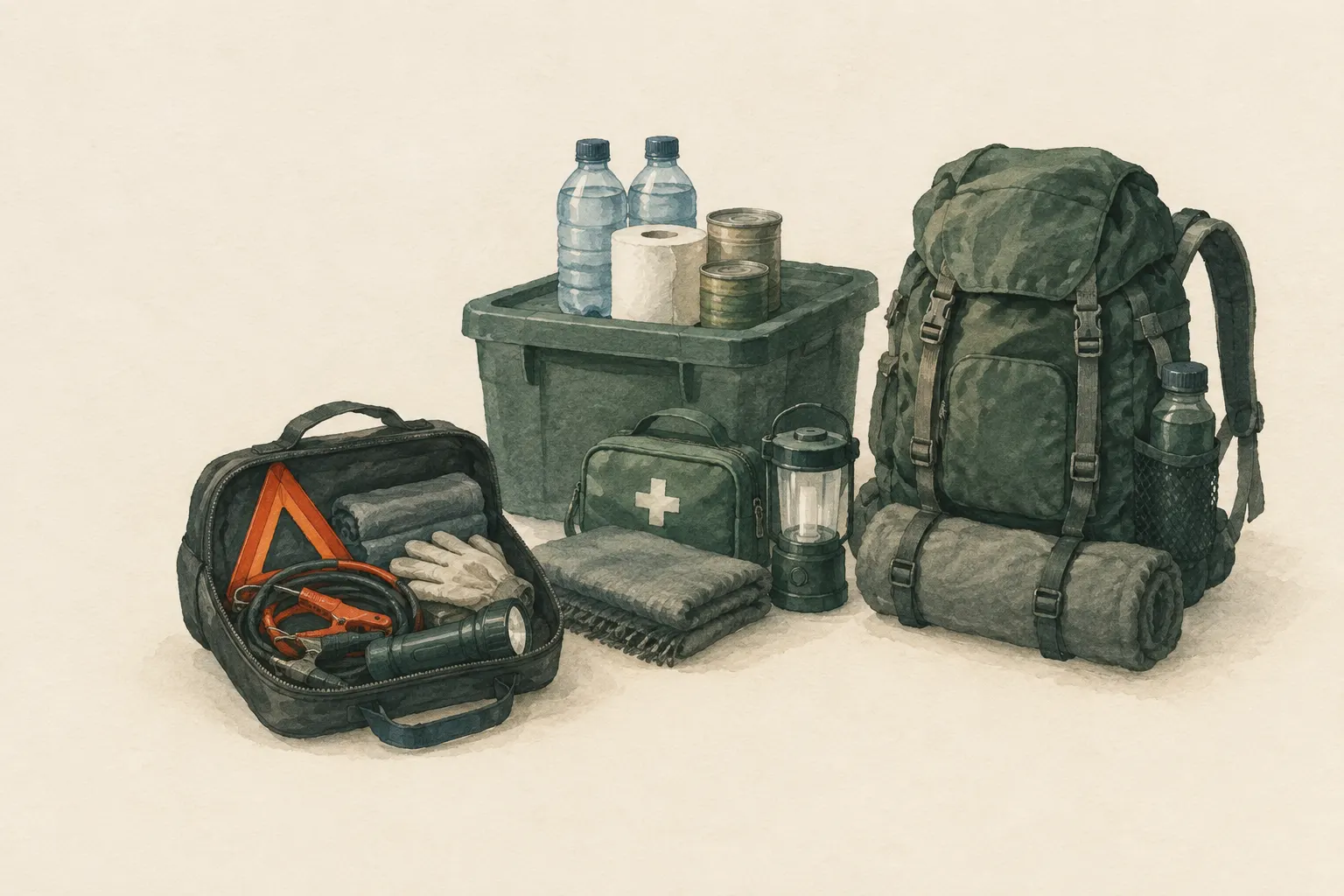
The three emergency kits do different jobs: home supplies bridge days without services, the car kit helps with a breakdown or traffic jam, and the go bag accompanies a quick evacuation. Much overlaps – light, water, first aid, communication – but quantity, weight and focus differ.
- Planning 1–2 hours, assembling step by step
Explained simply
Imagine three bags that are all meant for emergencies, but for very different moments. The supplies at home are like a well-stocked pantry: they can be big and heavy because nobody has to carry them. The car kit is like an umbrella in the boot: it helps when you break down or get stuck in a long traffic jam. The go bag is like a school bag packed for an emergency: you grab it and leave straight away.
All three bags hold similar things: light, water, some first-aid supplies and a way to get news. But how much of it is inside and what matters most depends on where you are. At home quantity counts, in the go bag weight counts, and in the car warmth and being seen.
The most important point: medicine that someone needs every day belongs in every kit. And if anyone is in danger, call the emergency number (112 in the EU) and follow the authorities' instructions.
How it works: three situations, three kits
The basic idea is simple: each kit answers a different question. Home supplies answer: “How do I manage for a few days if power, water or shops fail but I can stay at home?” The car kit answers: “What helps me if I am stuck somewhere with the vehicle?” The go bag answers: “What do I need if I have to leave my home quickly?”
The differences follow almost by themselves from these questions. At home there is space, so there can be more water, more food and a way to cook outdoors. In the car there is some space, but heat and cold take their toll on the contents, and what matters is warm clothing, visibility and help for the waiting time. In the go bag every gram counts, because it may have to be carried a long way.
Official bodies such as the German Federal Office of Civil Protection and Disaster Assistance (BBK) or Ready.gov in the USA publish preparedness lists. Their quantities differ between publishers. This overview only sorts the lists by situation – for exact amounts it is best to look at the list for your region.
What really matters
Some things matter everywhere: light (a headlamp keeps your hands free), first-aid supplies, charging cables and a way to hear news, such as a battery radio. Instead of constantly moving these items from one kit to another, it is worth having them several times. Otherwise the lamp is missing from the car exactly when it happens to be in the go bag.
With the go bag, weight is the biggest trap. Many people pack too much out of worry and end up with a bag they can hardly carry. Better is one bag per person that this person can actually carry for a while. It holds copies of important documents, medication, a change of clothes, water and food for about three days, light, a power bank and hygiene items.
In the car, a hi-vis vest and warning triangle belong in it as local rules require. Add warm clothing or a blanket, water, some long-lasting food and a charging cable, and in winter a shovel and ice scraper. At work, a small extra kit with comfortable shoes, water, a snack and medication can help if getting home ever takes much longer than usual.
Safety: what to watch out for
Vital medication and aids – for example spare glasses or hearing-aid batteries – belong in every kit a person might rely on for a while. Check the expiry dates regularly. For special medical needs it is best to talk to your doctor or pharmacy about how to build up a sensible supply.
Temperatures in a car vary widely: very hot in summer, very cold in winter. Bottled water, batteries and medication can suffer. So you swap these items in the car more often than at home. Anyone stuck in snow in winter who runs the engine for heat must make sure the exhaust pipe stays clear of snow so that no exhaust gets into the car – carbon monoxide can be neither smelled nor seen.
A way to cook without power belongs in home supplies, but stoves, grills and heaters running on gas or charcoal are only used outdoors, never in a flat, cellar, garage or tent. If life or health is in danger, call the local emergency number (112 in the EU) and follow the authorities' instructions.
How to go about it
Don't start with shopping but with a list. For each kit, write down what you already have – often there is more than you think: torches, blankets, water bottles, an old radio. Afterwards you can clearly see where the gaps are. That way you avoid both missing items and unnecessary bulk.
Build the kits step by step. It is perfectly fine to start with the most important things and add the rest over time. Also think about which risks exist in your region, for example floods, storms or heavy snowfall. This decides which kit matters most for you.
Then set fixed dates on which you check the kits – more on that in the entry on the gear maintenance schedule. A small list in the kit with contents and date helps you keep track. And talk to everyone in the household about where the kits are, so that in an emergency everyone knows where to reach.
Good to know
A single kit for every situation sounds practical but rarely works. What makes sense at home, such as a large water container, is far too heavy in a go bag. And what is enough in a go bag is too little for several days at home. Splitting into three kits is therefore not a luxury but saves trouble in the end.
This overview does not replace the official preparedness lists and is not a complete packing list. It helps you understand the lists better and pack deliberately. For vehicle equipment, the rules of the country in question also apply, and they can differ.
Step by step
Home
Water and food for several days, light, battery radio, first aid, medication, hygiene, a way to cook outdoors without power, cash.
- 1
Home
Water and food for several days, light, battery radio, first aid, medication, hygiene, a way to cook outdoors without power, cash.
- 2
Car
Hi-vis vest and warning triangle per local rules, light, warm clothing or a blanket, water, some food, charging cable, and in winter a shovel and ice scraper.
- 3
Go bag
Document copies, medication, water and food for about three days, change of clothes, light, power bank, hygiene items – portable for each person.
- 4
Use overlaps
Buy items needed in every kit (light, first aid, charging cable) several times rather than moving them around.
- 5
Review regularly
Set dates for checks – see the gear maintenance schedule.
Common mistakes
- A single kit for every situation
- Go bag too heavy
- Never checking the car kit
- Forgetting medication
Quick view
Materials
First-aid kit (household)
Does not replace a first-aid course; check contents and expiry dates regularly.
Headlamp / flashlight
Battery or crank radio
Check batteries regularly and keep spares.
Vehicle emergency kit
Which equipment (e.g. warning triangle, high-visibility vest, first-aid kit) is mandatory differs between countries – check local rules.
Document folder (waterproof)
Store securely – contains sensitive personal data.
Suitable for
- Households starting preparedness
- Checking existing kits for gaps
- Families with a car
Not suitable for
- Special medical needs without consulting professionals
Prerequisites
- Knowledge of regional risks
- Official preparedness lists for your region
Safety
- Vital medication and aids belong in every kit a person might rely on for a while; check expiry dates regularly.
- Temperatures in a car vary widely: water, batteries and medication can suffer. Rotate them regularly.
- If life or health is in danger call the local emergency number (112 in the EU) and follow the authorities' instructions.
How it works
Each kit is tailored to a situation: at home quantity matters more than weight, in the car weather protection and visibility, in the go bag portability and documents. Knowing the situation lets you pack deliberately, avoiding both gaps and unnecessary bulk.
Advantages
- Targeted preparedness without bulk
- Gaps become visible
Disadvantages
- Buying items several times costs money
- Three kits need maintaining
Deep knowledge
Background
Ready.gov, FEMA and the German Federal Office of Civil Protection and Disaster Assistance (BBK) publish preparedness lists for households and guidance on emergency bags and vehicles. The exact quantities differ between publishers.
This overview does not replace the official lists but sorts them by situation.
Variants
- Workplace
- A small kit at work (comfortable shoes, water, snack, charging cable, medication) helps if getting home takes longer.
Common mistakes
- A single kit for every situation
- Go bag too heavy
- Never checking the car kit
- Forgetting medication
Limits and risks
- No complete packing lists
- Follow local rules on vehicle equipment
Material alternatives
Derived from material properties: a substitute must have all relevant properties. Observe the notes on the substitute.
- Headlamp / flashlight
- Mobile phone (The battery drains quickly in cold and with continuous screen and GPS use.), Battery lantern / LED light
- Document folder (waterproof)
- Tarp, Plastic sheet / large bin bag (Tears easily; never pull over the head (suffocation risk).), Emergency blanket (Tears easily once punctured; short-term shelter only.), Rain poncho (When used as a shelter, it no longer protects your body from rain.), Bivy bag (Never fully close off the face.), Tent (Do not cook or heat inside the tent (fire and carbon monoxide danger).), Heavy-duty bin bag (large) (Suffocation risk: never pull plastic bags over the head or face and keep them away from small children.), Group shelter bag (Airtight – ventilate regularly.)
Results come exclusively from structured entries. No improvised instructions are generated.
Sources
Ready.gov – U.S. Federal Emergency Management Agency (FEMA): Build A Kit
Basic kits for home, car and work
U.S. Federal Emergency Management Agency (FEMA): Are You Ready? An In-Depth Guide to Citizen Preparedness
Preparedness and emergency supplies for households
Bundesamt für Bevölkerungsschutz und Katastrophenhilfe (BBK), Deutschland: Ratgeber für Notfallvorsorge und richtiges Handeln in Notsituationen
Supply checklist and emergency bag