Choosing a knife and multitool by their properties
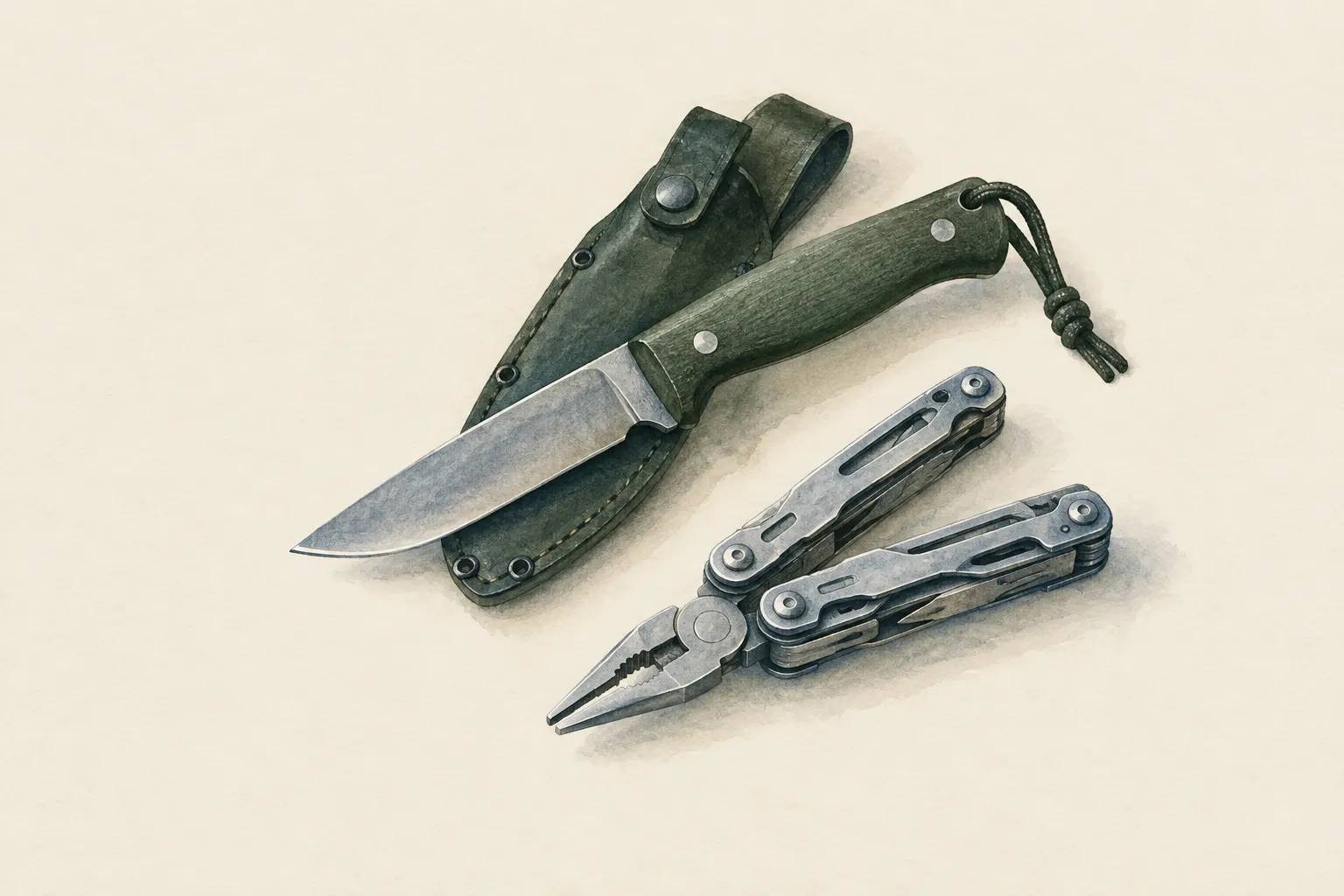
A knife is a tool: blade shape, steel, handle, locking mechanism and sheath decide what it is good for. For carving and camp work a fixed, medium-length blade is practical; a multitool adds pliers and screwdrivers. Rules on carrying differ greatly between countries – check before buying and before travelling.
- 15 minutes reading
Explained simply
A knife is a tool – like a hammer or a saw. It is not a toy and not a weapon. Whether a knife is good for a job depends on its design: how long and thick the blade is, what steel it is made of, how the handle sits in your hand and whether the blade can be locked. For carving and camp tasks a knife with a fixed, medium-length blade is practical. A multitool is a kind of pocket-sized toolbox, with pliers and screwdrivers.
The most important rule when working: always cut away from your body and make sure nobody is within reach of the blade. A folding knife without a lock can close during work and cut your fingers.
Also important: every country has different rules about which knives you may own and carry. Check the local rules before you buy a knife or travel with one. Children only use knives with instruction from adults.
How a blade works
A cutting edge is basically a very narrow wedge. The thinner the wedge, the more easily it slides into the material – but the more delicate it is too. The way the blade tapers towards the edge is called the grind. With the so-called Scandi grind, one wide, flat bevel runs straight down to the edge. It guides well in wood, carves precisely and is comparatively easy to sharpen. A thicker spine, on the other hand, withstands more stress.
The steel is a compromise as well. Very hard steel holds its edge for a long time but can lose small pieces of the edge under hard blows or twisting. Tougher steel is more forgiving but dulls faster. Carbon steel is usually easy to sharpen but rusts if it stays wet. Corrosion-resistant steels – often called “stainless” – need less care and are the better choice in damp or salty environments.
By the way, a sharp knife is safer than a blunt one. With a sharp blade you need less force, and the blade slips less often. That is why sharpening is part of looking after a good knife.
What matters when choosing
First think about what you need the knife for: carving, cooking, repairs or a bit of everything? Shape and size follow from that. For all-round camp work a medium-length blade with a point and a straight edge is practical. Overly long blades are hard to control and unsuitable for fine work. Buying a knife that is too big is one of the most common mistakes.
The handle should sit securely in the hand even when wet and with gloves. A guard or finger choil stops the hand from sliding forward onto the blade if you push. A fixed blade needs a sheath that holds the knife securely so it does not fall out when you bend down or climb.
Folding knives are compact and sufficient for carving if their blade locks securely, meaning it clicks firmly into place when open. There are various locking mechanisms. What matters is that the lock holds reliably and can be released deliberately. For forceful work, fixed or securely locking blades are a must.
Multitool or knife?
A multitool combines pliers, screwdrivers, a small blade and often further tools such as a file, saw or scissors. For repairs – a loose screw on a pack, a bent part on a stove, a wire that needs straightening – it is often more useful than a big knife. Its small blade, on the other hand, is less suited to carving or rough woodwork.
With a multitool, make sure the individual tools lock in place. A screwdriver or blade that folds shut under pressure can injure you just like a folding knife without a lock. Many people carry a small knife and a multitool to cover both jobs. In the emergency bag at home, a multitool is often the more versatile choice.
Legal matters: check local rules
The rules on knives differ greatly from country to country and sometimes even from place to place. They can concern blade length, knives that open with one hand, fixed blades and locking mechanisms, and carrying in public, at events, on public transport and on flights. On flights, knives are usually not allowed in cabin baggage – ask the airline.
So check the local rules before buying and before every trip. What is allowed in one country may be banned in the next. A knife you do not need right now is best carried closed away in the pack rather than ready to hand on your belt.
This text is not legal advice. Laws change and are interpreted differently. And quite apart from the law: a knife is a tool for camp work, not for self-defence or intimidation.
Safety and care
Always cut away from your body and keep the hand holding the wood behind the blade. Make sure nobody is within your reach – imagine a circle as wide as your outstretched arm plus knife, which no one may enter. Work seated or standing firmly, not while walking. After use, put the knife back in its sheath or fold it closed instead of leaving it lying around.
Keep knives out of reach of small children. Older children learn to handle them only with instruction and supervision, ideally with a small knife with a rounded tip. For a cut, press a clean cloth onto the wound; with heavy bleeding call the local emergency number (112 in the EU) immediately.
Care includes cleaning and drying the knife after use, protecting carbon steel from rust with a little oil and sharpening the edge regularly. Do not misuse the knife as a lever or screwdriver – that is what the multitool is for.
Step by step
Define the purpose
Carving, cooking, repairs or a bit of everything? Blade shape and size follow from that.
- 1
Define the purpose
Carving, cooking, repairs or a bit of everything? Blade shape and size follow from that.
- 2
Blade
For all-round camp work a medium-length blade with a point and a straight edge; overly long blades are hard to control.
- 3
Steel
Carbon steel: easy to sharpen, rusts. Stainless steel: easier care. Choose stainless for damp and salty environments.
- 4
Handle and sheath
The handle should grip safely wet and with gloves, with a guard or finger choil. The sheath must hold the knife securely.
- 5
Multitool
A multitool with pliers, screwdrivers and a small blade is more useful for repairs than a big knife. Look for locking tools.
Common mistakes
- Buying a knife that is too big
- Not checking local rules
- A non-locking folder for forceful work
- Carrying a knife without a secure sheath
Quick view
Materials
Knife (fixed or locking blade)
Cut away from your body.
Rules on carrying knives differ by region – check local rules.
Multitool
Rules on carrying blades differ by place – check local rules.
Suitable for
- Buying a first outdoor knife
- Adding to emergency gear
- Carving and camp tasks
Not suitable for
- Self-defence or intimidation
- Carrying in places where it is prohibited
Prerequisites
- Clarity about the intended use
- Knowledge of local carrying rules
Safety
- Rules on blade length, one-handed opening, locking mechanisms and carrying in public, on transport and on flights differ by country and place – check before buying and travelling.
- Folding knives without a lock can close during work and cut the fingers. Use fixed or securely locking blades for forceful work.
- Store knives out of reach of small children; older children only with instruction.
How it works
A blade is a compromise: hard steel holds an edge longer but can chip; tough steel is more forgiving but dulls faster. Stainless steels need less care. A flat grind (e.g. Scandi) carves precisely, while a thicker spine withstands more stress.
Advantages
- A tool suited to the task
- Fewer injuries through a suitable design
Disadvantages
- Legal rules can limit choice
Deep knowledge
Background
Bushcraft textbooks describe the knife as a central tool and emphasise a controllable, not too large blade. Sharpening books explain how steel and grind affect sharpening.
This entry is not legal advice. Laws change and differ locally.
Variants
- Folding knife
- Compact and discreet; sufficient for carving if it locks securely.
Common mistakes
- Buying a knife that is too big
- Not checking local rules
- A non-locking folder for forceful work
- Carrying a knife without a secure sheath
Limits and risks
- No legal advice
- No product recommendations
- No weapons
Sources
Ray Mears – Hodder & Stoughton (2002): Bushcraft
The knife as a basic tool, choice by use
Leonard Lee – The Taunton Press (1995): The Complete Guide to Sharpening
Steel, grind and sharpenability