Understanding sleeping pads and R-values
The R-value describes how well a sleeping pad slows heat loss to the ground – higher means better insulated. Values are only comparable when they were measured with the same standardised test method, such as ASTM F3340. Foam, air and self-inflating pads differ in weight, comfort and vulnerability to punctures.
- 10 minutes reading
Explained simply
When you lie on the ground, the cold ground draws warmth away from you – like a cold stone you sit on. Your sleeping bag hardly helps underneath, because you squash it flat with your weight. That is why you need a sleeping pad. It holds a layer of still air between you and the ground, and that air slows the loss of heat.
How well a pad insulates is shown by its R-value. The higher the number, the better the pad keeps the cold out – roughly the way a thicker wall keeps a house warmer. If you lay two pads on top of each other, their values roughly add up.
On snow or frozen ground you need much more insulation than on a summer night. Without a good pad you can get badly chilled there even in the best sleeping bag.
How it works
Heat always flows from warm to cold. If you lie directly on the ground, it flows out of your body into the ground through contact (conduction), across the whole area you are lying on. The ground is large and can absorb a lot of heat without warming up itself. That is why people often cool down more on cold ground than in air of the same temperature.
The sleeping bag helps little underneath: your weight squashes its fill so much that hardly any air stays in it. The sleeping pad takes over this job. It holds still air – in the cells of a foam, in air chambers or in a fill inside an air pad. Still air conducts heat poorly and therefore acts as a brake.
The R-value is a measure of this thermal resistance. Higher means the pad slows heat loss more. Because resistances in a row add up, two pads on top of each other give roughly the sum of their R-values. That is especially useful in winter.
Understanding the R-value correctly
In the past, manufacturers measured the R-value with their own methods. The figures from different manufacturers were therefore hard to compare. The ASTM F3340 standard established a uniform test method for camping mattresses, which many manufacturers have adopted. So only compare R-values determined under the same standard.
The R-value is not a temperature rating. It does not say down to what temperature you will sleep warm on a pad, because that also depends on your sleeping bag, your clothing, your body and how tired or hungry you are. People who feel the cold easily need more insulation than others.
The R-value also says nothing about comfort, durability or weight. A very well insulating pad can be heavy or delicate, a comfortable pad can insulate poorly. Choosing remains a trade-off between what matters to you and the conditions you expect.
Pad types compared
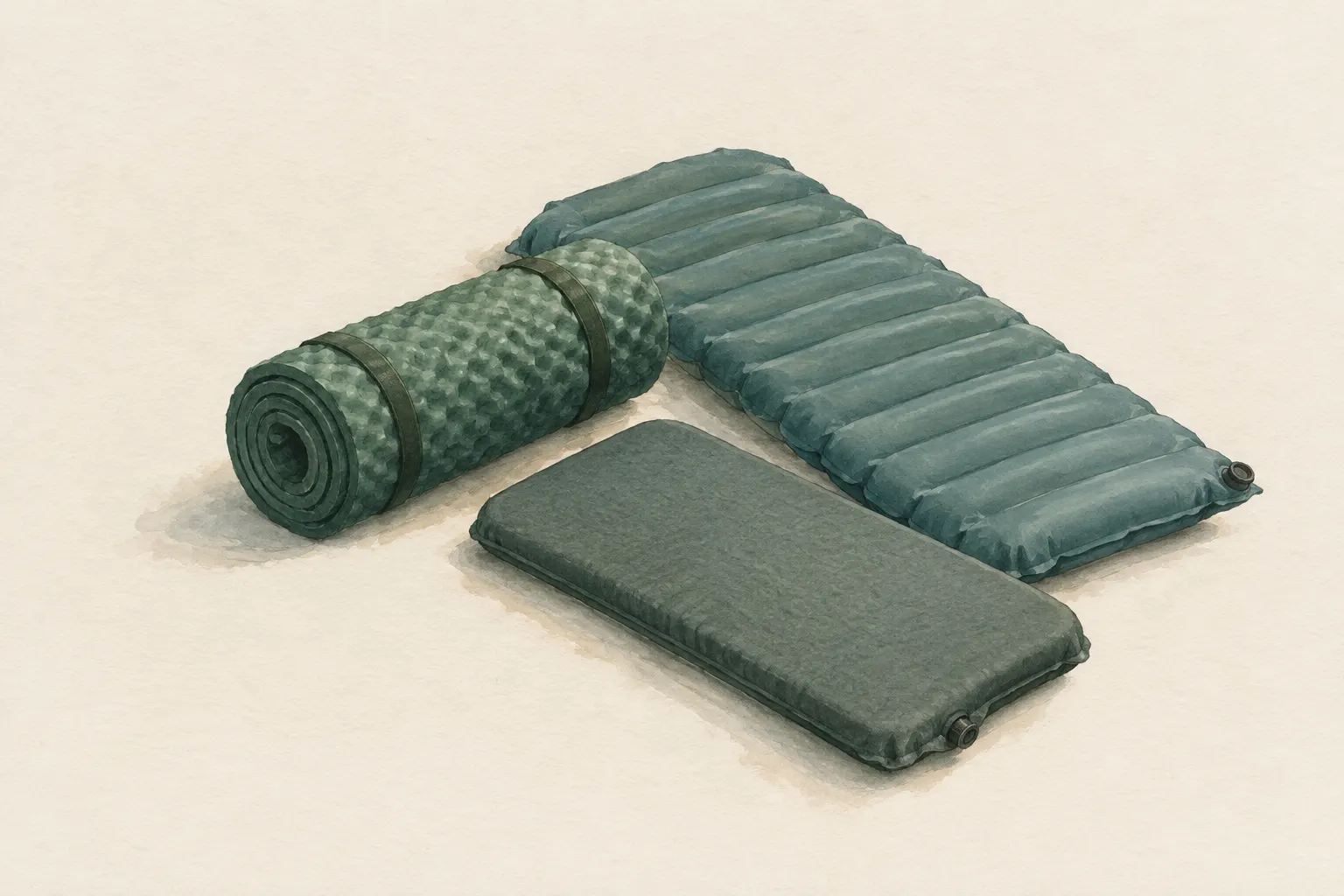
Foam pads are made of closed-cell foam containing lots of small air bubbles. They are robust, cannot burst and need no care – but they are bulky and less comfortable. They can also be used as a sit pad during breaks or as protection under a more delicate pad.
Air pads are inflated and pack very small. They are often thick and comfortable. Their insulation comes from inner chambers, fills or reflective layers. Their drawback: a thorn, a sharp stone or a spark can make a hole, and then you are suddenly lying on the cold ground. So a patch kit always goes with them.
Self-inflating pads are a middle way: inside is open-cell foam. When you open the valve, the foam expands and draws in air; with a few breaths you make the pad firmer. They are more comfortable than pure foam pads and less prone to punctures than pure air pads, but usually heavier than the latter.
What really matters
In winter or on snow a combination has proved itself: a foam pad underneath and an air or self-inflating pad on top. The values roughly add up, the foam pad protects the upper pad from sharp things, and if the air pad does get a hole, you are still lying on foam instead of snow.
Some manufacturers advise against inflating air pads by mouth, because the moisture from your breath can condense inside and freeze in frost. They offer pump sacks for this – read the manufacturer's instructions. At home, store air and self-inflating pads as the manufacturer specifies, usually open, dry and not tightly rolled.
Without a pad, everyday things also insulate: cardboard, an empty backpack, a layer of clothing or a thick layer of dry leaves. They are not a full substitute but much better than bare ground. And do not invest only in a warm sleeping bag – a good pad is often the cheaper way to sleep warmer at night.
Safety: what to watch out for
On snow, ice or frozen ground you can get badly chilled without enough insulation underneath, even in a good sleeping bag. Plan considerably more insulation for such nights than for summer and take a reserve, such as an extra foam pad.
Watch for warning signs of hypothermia: intense shivering, clumsiness, confusion or unusual drowsiness. Then act in time: insulate the person well from the ground, put on dry layers, protect them from wind and get help via the local emergency number (112 in the EU). Children often cool down faster than adults and need a good pad just as much.
Step by step
Pad type
Foam pad: robust, puncture-proof, bulky. Air pad: comfortable, packs small, can puncture. Self-inflating: a middle ground of foam and air.
- 1
Pad type
Foam pad: robust, puncture-proof, bulky. Air pad: comfortable, packs small, can puncture. Self-inflating: a middle ground of foam and air.
- 2
Check the standard
Only compare R-values determined under the same standard; many manufacturers now state ASTM F3340.
- 3
Estimate conditions
Snow and frozen ground need considerably higher values than summer nights. People who feel the cold need more.
- 4
Combine
In winter put a foam pad under an air pad – more insulation and a backup if one punctures.
- 5
Care
Do not inflate air pads by mouth if the manufacturer advises against it (moisture), carry a patch kit, and store open and dry.
Common mistakes
- Comparing R-values from different test methods
- Investing only in the sleeping bag
- Air pad without a patch kit in winter
Quick view
Materials
Sleeping pad
Gear repair kit
Use and store adhesives and solvents according to the manufacturer's instructions.
Suitable for
- Buying a sleeping pad
- Combining two pads in winter
- Understanding manufacturer figures
Not suitable for
- Exact temperature predictions – warmth perception is individual
Prerequisites
- Basic understanding of heat loss to the ground
Safety
- On snow or frozen ground without enough insulation you can get badly chilled even in a good sleeping bag. Act early on signs of hypothermia.
How it works
The sleeping bag is compressed under the body and barely insulates there. The pad takes over this job by trapping still air in foam, chambers or fill. The R-value is a measure of thermal resistance; the values of stacked pads roughly add up.
Advantages
- Standardised values make comparison easier
- Combining adds a reserve
Disadvantages
- Older or non-standardised figures are hard to compare
Deep knowledge
Background
ASTM F3340 established a uniform test method for the R-value of camping mattresses that many manufacturers have adopted. Before that, manufacturers used their own methods whose values were hard to compare.
The R-value says nothing about comfort, durability or weight. Choosing remains a trade-off.
Variants
- Improvised insulation
- Without a pad, cardboard, a backpack or dry leaves also insulate – see everyday insulation.
Common mistakes
- Comparing R-values from different test methods
- Investing only in the sleeping bag
- Air pad without a patch kit in winter
Limits and risks
- No product values
- No temperature limits
Material alternatives
Derived from material properties: a substitute must have all relevant properties. Observe the notes on the substitute.
- Sleeping pad
- Dry leaves, grass or conifer boughs (Collect only where allowed; no protected plants. Check for ticks and insects.), Backpack, Dry spare clothing (Carry it in waterproof packaging – wet clothing barely insulates.), Wool blanket / duvet (Keep away from candles, stoves and heaters.), Insulated cool box (Keeps cold only for a limited time; without ice packs or ice it is not a fridge.), Sleeping bag (Do not store compressed long-term; do not pack away damp.), Newspaper and cardboard (Flammable – keep away from candles, stoves, heaters and embers.), Insulated cooking box (hay box, thermal cooker) (Never put open flame or embers inside – only the hot, closed pot.)
Results come exclusively from structured entries. No improvised instructions are generated.
Sources
ASTM International: ASTM F3340 – Standard Test Method for Floor Insulation R-Value of Camping Mattresses
Standardised test method for the R-value of camping mattresses
The Mountaineers Books (2017): Mountaineering: The Freedom of the Hills, 9th edition
Sleeping pads and ground insulation when camping