Improvised pegs and deadman anchors in snow and sand
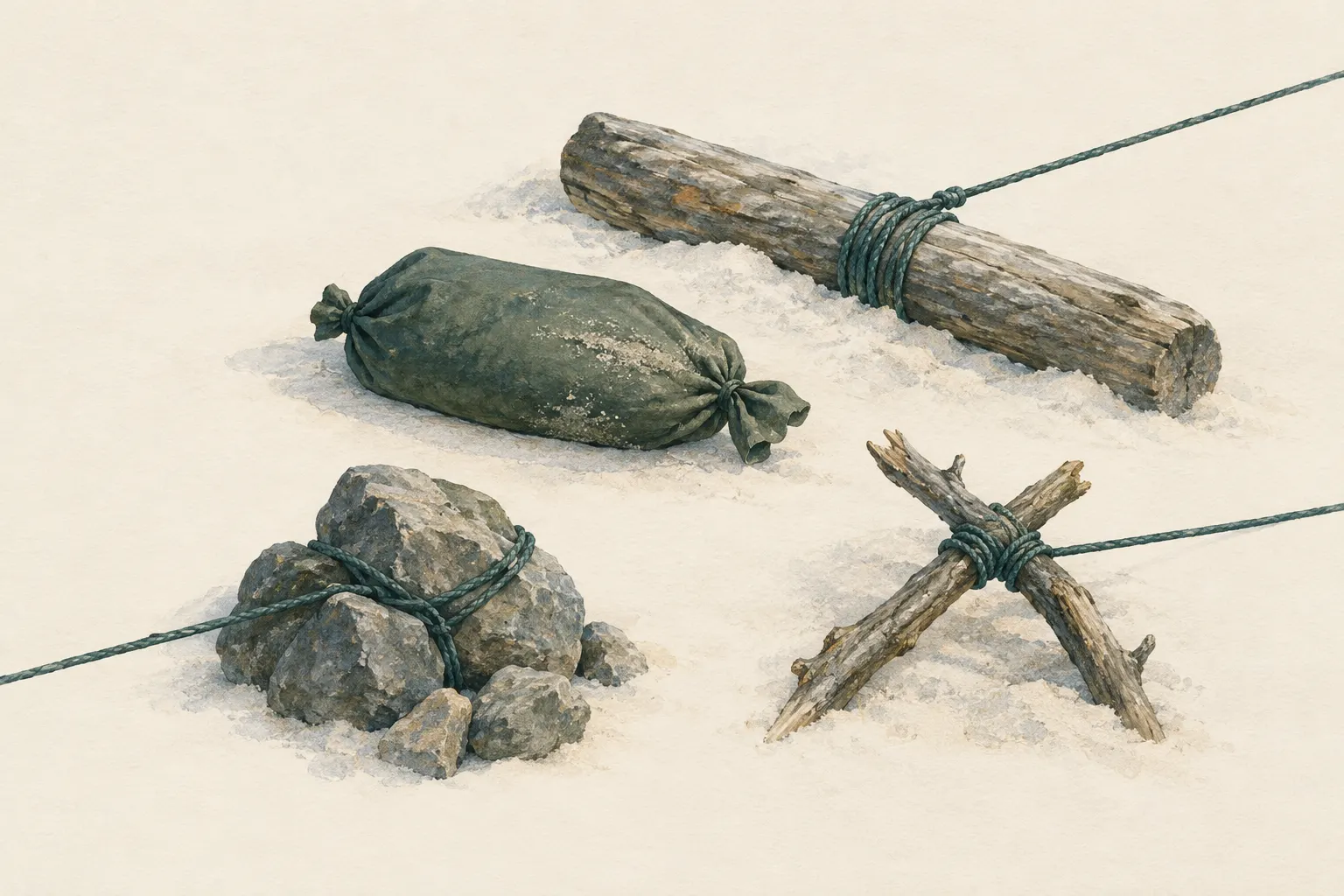
In snow and sand ordinary pegs hold poorly. An object buried crosswise – stick, bag of sand, peg or ski – with the line tied to its middle spreads the pull over a large area: the "deadman". On hard ground rocks and angled sticks help.
- 5–10 minutes per anchor
Explained simply
Imagine sticking a spoon into a pudding and pulling on it. It comes straight out. Something similar happens to an ordinary tent peg in soft snow or loose sand: it has too little surface to hold on with.
With a "deadman" you instead bury an object crosswise in the ground – a stick, for example, or a bag full of sand. You tie the line to its middle. When the wind pulls on the tent, the stick would have to lift all the snow or sand above it. That is so hard that it stays down. The deeper and wider the anchor, the better it holds.
Important: anchors like this are only meant for tents and tarps. Securing people, for example in mountaineering, needs proper training and tested equipment.
How it works
A peg driven in vertically only holds through the narrow area of its shaft. In firm forest soil that is enough, because the ground is dense and tough. Snow and dry sand, however, consist of loose grains that easily move aside. A crosswise anchor presses on a much larger area, and to come out it would have to push a whole wedge of snow or sand ahead of it.
The direction of pull is crucial. The line should pull at right angles to the anchor and as flat to the surface as possible. Then the anchor presses against the trench wall and against the material above it. If the line pulls steeply upward, it levers the anchor out more easily. That is why the line is led through a narrow slot in the direction of pull rather than coming straight up out of the hole.
In snow there is an extra advantage: stamped-down snow "sinters". That means the snow grains gradually bond to each other after being compressed, and the snow becomes firmer. So it pays to stamp the anchor in and only then tension it. In wet, warm snow or during a thaw an anchor holds much less well than in cold snow.
What really matters
The line belongs in the middle of the anchor, for example with a clove hitch. If you tie it to the end, the anchor turns lengthwise when pulled and slides out through the trench like a sledge. A bag is tied off at the neck after being packed full of sand or snow.
Dig deeper than you are used to with ordinary pegs, and across the direction of pull. Fill the trench back in and stamp everything down firmly. Only then tension the line, and let an adjustable hitch take up small movements. Check the guylines when the wind picks up, and especially after a thaw or rain.
Almost anything wide and sturdy makes an anchor: a stout stick, a stuff sack or plastic bag filled with sand or snow, a peg laid flat, at a pinch a ski. Bear in mind, though, that gear frozen in overnight is hard work to get out in the morning – better not to bury anything you will urgently need the next day.
On hard and rocky ground
Sometimes the problem is the other way round: the ground is so hard or stony that no peg will go in. Then a large rock helps. Run the line around the rock and stack more rocks on top. The weight of the rocks and the friction on the ground hold the line.
Alternatively you can drive sticks in at an angle, with the top leaning slightly away from the direction of pull. That way the line pulls the stick deeper into the ground rather than out. Short, thick sticks are often more stable for this than long, thin ones.
Make sure stacks of rocks cannot topple and that no sharp edges rub on the line. When packing up, put the rocks back where you found them.
Safety: what to watch out for
This technique is only for guying out tents and tarps. Anchors that people are secured to – for example in snow when mountaineering – are a specialist field that belongs in hands-on training. How much force an improvised anchor holds is unknown, which is why no figures are given here.
In a storm in an exposed spot, even the best guying is no guarantee. If the weather is getting worse and you have nowhere to retreat to, a more sheltered spot is often more important than an extra anchor. Plan for such situations in advance and keep an eye on forecasts.
Taut lines are trip hazards, especially in the dark. Mark them, for example with a bright strip of fabric, and keep them away from paths. When digging in snow, gloves protect your hands from cold and wet.
Packing up and good to know
Anchors in snow often freeze in overnight. Do not yank them out by the line – the line may snap or the object break. Dig them out instead. A handy trick: put the line around the anchor as a loop rather than with a fixed knot. Then, if needed, you can pull the loop free and dig out the anchor later.
Take everything with you when you pack up: bags, sticks, pegs. A forgotten plastic bag in the snow reappears as litter in spring. It helps to count beforehand how many anchors you have set.
The name "deadman" describes an anchor that simply lies in the ground as a heavy, motionless object. The principle is described in mountaineering and polar literature and is also used with sandbags and buried objects on beaches and in deserts.
Step by step
Tie the line
Tie the line to the middle of the stick or around the neck of the bag with a clove hitch.
- 1
Tie the line
Tie the line to the middle of the stick or around the neck of the bag with a clove hitch.
- 2
Dig
Dig a trench across the direction of pull, clearly deeper than usual in loose ground. Cut a narrow slot for the line in the direction of pull.
- 3
Bury
Place the anchor, fill with snow or sand and stamp it down firmly. Snow sinters after a while and then holds better.
- 4
Tension
Only tension after stamping down; let an adjustable hitch take up slack.
- 5
On hard ground
Run the line around a large stone and stack more stones on top, or drive sticks at an angle against the direction of pull.
Common mistakes
- Burying the anchor too shallow
- Line tied at the end instead of the middle
- Tensioning immediately before the snow has set
- Forgetting anchors when packing up
Quick view
Materials
Sturdy sticks / poles
Do not cut live wood where prohibited.
Accessory cord
Use only certified cord after training for life-safety purposes.
The diameter must suit the main rope or friction hitches will not grip.
Dry bag
Or a plastic bag filled with sand or snow
Snow shovel
Always take it inside when digging a snow shelter.
Suitable for
- Guying tents and tarps in snow and sand
- Beach and dunes
- Rocky ground with stones
Not suitable for
- Securing people – snow and sand anchors for mountaineering require training
- Storm conditions without a retreat option
Prerequisites
- Basic knots (clove hitch, tensioning hitch)
- Guying out a tent or tarp
Safety
- Mark lines so that nobody trips; dig out every object when packing up.
How it works
A vertical peg only holds through the narrow area of its shaft. An object buried crosswise must move the whole mass of snow or sand above it to come out. The deeper and wider, the more hold. The line should pull at right angles to the anchor and at a shallow angle to the surface.
Advantages
- Holds in loose ground
- Material available on site
Disadvantages
- More work than pegs
- Laborious digging out in frost
Deep knowledge
Background
The deadman anchor is described in mountaineering and polar literature as a method of anchoring in snow, as are sandbags and buried objects in deserts and on beaches.
This entry deals exclusively with guying tents and tarps.
Variants
- Freeing frozen anchors
- Do not yank out anchors frozen overnight; dig them out, and next time use a loop instead of a knot so they release more easily.
Common mistakes
- Burying the anchor too shallow
- Line tied at the end instead of the middle
- Tensioning immediately before the snow has set
- Forgetting anchors when packing up
Limits and risks
- No securing of people
- No holding force figures
Material alternatives
Derived from material properties: a substitute must have all relevant properties. Observe the notes on the substitute.
- Accessory cord
- Rope (Never use unknown or damaged rope for life-safety purposes.), Paracord (Not a climbing or safety rope.), Thin twine (Low breaking strength – light loads only.), Webbing (tubular webbing) (Inspect knotted webbing before every use.), Jute or sisal twine (bought) (Low strength, absorbs water and rots – light loads and practice only.), Tree straps (Load only within the manufacturer's limits.)
Results come exclusively from structured entries. No improvised instructions are generated.
Sources
The Mountaineers Books (2017): Mountaineering: The Freedom of the Hills, 9th edition
Anchoring in snow, deadman principle, tent anchoring