Improvising a stove windscreen – without overheating the canister
Wind carries heat away from the pot and can greatly increase fuel consumption. A windscreen of aluminium foil, stones, terrain or your body helps – but with canister-top stoves it must never enclose the canister, otherwise the canister can overheat and burst.
- 5 minutes
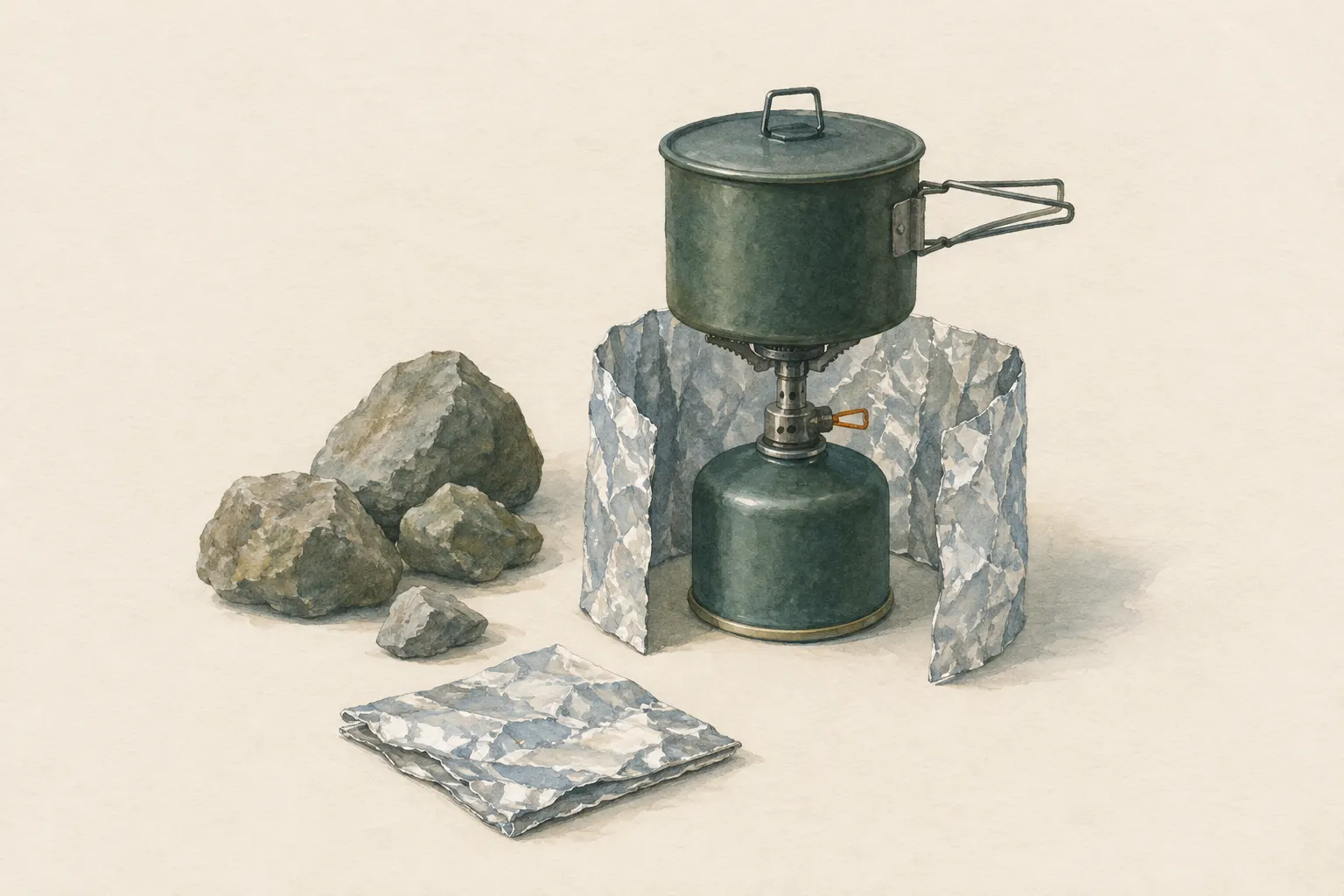
Explained simply
When you cook in wind, it acts like a hairdryer blowing the heat sideways past the pot. The flame flickers to one side and much of the heat is lost. The water then takes much longer to boil, and you use more fuel. A small wall against the wind – made of foil, rocks, a boulder or your own body – keeps the heat at the pot.
But be careful with gas canisters: a canister is a bit like a sealed fizzy drink can. If it gets hot, the pressure inside rises, and in the worst case it can burst. So a windscreen must never wrap all the way around a canister that the stove sits on. Touch the canister now and then: it must not get warm.
And: cooking always happens outside in the fresh air – never in a tent, vestibule, car or home. A stove produces carbon monoxide, a poisonous gas you can neither smell nor see.
How it works
A stove flame heats the air, and this hot air flows along the bottom and sides of the pot. Wind tears this layer of air away and replaces it with cold air – this is called convection. It also pushes the flame sideways so that it partly misses the pot. How much extra fuel this costs depends heavily on the stove, the pot and the wind; there are no fixed figures for it.
A windscreen slows the airflow before it reaches the flame. The hot air stays at the pot longer and the flame burns more evenly. A lid helps as well, because less heat escapes upward with the steam.
But a flame needs oxygen, and the exhaust gases must be able to escape. That is why a gap must remain between windscreen and pot – the entry suggests about a finger's width. If everything is enclosed too tightly, the flame gets too little air, burns poorly, produces soot and creates more carbon monoxide. "As tight as possible" does not mean "as good as possible".
Which stove? That decides the windscreen
With canister-top stoves the burner sits directly on the gas canister. Here an enclosing windscreen is dangerous, because heat builds up around the canister and the pressure inside rises. The screen may only stand beside the burner, as a half-open arc on the windward side, and must not reach down to the canister. A very large pot that reflects heat back down onto the canister is also a poor idea with these stoves.
With hose-connected (remote-canister) stoves the canister stands some distance away. Here the windscreen can largely enclose the burner – as long as the canister and hose stay outside and the manufacturer explicitly allows it. With alcohol and liquid-fuel stoves a windscreen is often part of the system; here too, what counts is what the instructions say.
So the most important rule is simple: read your stove manufacturer's instructions on windscreens and follow them. Also use only the fuel your stove is built for – no improvised or mixed fuels.
What really matters
Start with the terrain before you build anything. Behind a boulder, a wall or a bank it is often noticeably calmer already. Your body or a backpack can block extra wind – the backpack at a good distance, though, because it can burn. The ground must be level and non-flammable, such as rock, gravel or bare soil, so the stove cannot tip over.
For a foil wall, fold several layers of foil into a strip a little taller than the flame. Stand it as a half-open arc on the windward side and weigh it down with stones. Multi-layer foil creases less and lasts longer; even so, it tears over time and needs replacing.
Never leave the stove unattended. In gusts, watch the flame: if it shoots out sideways from under the pot or flickers hard, improve the screen or wait for the gust to pass. With canister-top stoves, keep checking by hand that the canister stays cool.
Safety: what to watch out for
Canister: if it gets warm, that is a warning sign. Turn the stove off if you can do so safely, remove the windscreen and let everything cool before you carry on cooking with a more open screen. A canister must never be wrapped, covered or surrounded by hot stones.
Carbon monoxide: stoves are run outdoors only, never in a tent, vestibule, car or living space – not even "just for a moment" because of the wind. Carbon monoxide is odourless and invisible. Headache, dizziness or nausea while cooking can be warning signs: get into fresh air at once and if symptoms continue call the local emergency number (112 in the EU).
Burns and fire: foil and stones by the stove get hot and stay hot for a while. Do not touch them with bare hands and keep children away. Alcohol flames are almost invisible in daylight – never refill an alcohol stove while it is burning or still hot. Do not use flammable materials such as cardboard or fabric as a windscreen, and watch out for dry grass nearby. When fire danger is high, stoves may be restricted too – check local rules.
How to practise it
Try your windscreen first on a windy day in the garden, on a stone-paved patio or at a barbecue spot – not only once you are on a trip. Boil the same amount of water once without and once with the screen and compare how long it takes. That way you see for yourself how much the screen helps.
Practise the canister check at the same time: after a few minutes, put your hand on the canister. If it stays cool, your set-up is fine. If it becomes noticeably warm, the screen is too tight or too close.
A pre-folded foil strip weighs almost nothing and packs flat inside the pot. Once you have found a shape that suits your stove and that the manufacturer allows, always take it with you.
Step by step
Use natural shelter
Cook behind a rock, wall or terrain edge; your body or a backpack (at a distance) blocks additional wind. The ground level and non-flammable.
- 1
Use natural shelter
Cook behind a rock, wall or terrain edge; your body or a backpack (at a distance) blocks additional wind. The ground level and non-flammable.
- 2
Shape a foil wall
Fold several layers of foil into a strip a little higher than the flame. Stand it as a half-open arc on the windward side, fix it with stones.
- 3
Leave a gap
Leave a gap of about a finger's width around the pot. With canister-top stoves keep the screen beside the burner only, not down around the canister; check the canister by hand – it must not become warm.
- 4
Supervise
Never leave the stove unattended. Watch the flame in gusts, use a lid.
Common mistakes
- Wrapping the canister all round
- Windscreen pressed against the pot with no gap
- Cooking in the vestibule because it is windy outside
- Flammable materials as a windscreen
Quick view
Materials
Stove
Never operate inside a tent, shelter or enclosed room – carbon monoxide and fire risk.
Aluminium foil (heavy-duty)
Edges can be sharp; conducts heat and electricity.
Stove fuel (canister, liquid fuel, alcohol)
Store fuels apart from food and in original containers or bottles intended for them.
Store cool, well ventilated and out of children's reach.
Suitable for
- Cooking in wind on trips and in the garden during outages
- Alcohol and liquid-fuel stoves, remote-canister stoves
Not suitable for
- A fully enclosing windscreen on stoves screwed onto the canister
- Cooking in a tent, vestibule or indoors
Prerequisites
- Able to run the stove according to the manufacturer's instructions
- A safe, non-flammable spot outdoors
Safety
- Foil and stones get hot. Do not touch them with bare hands, keep children away; alcohol flames are almost invisible in daylight.
How it works
A windscreen reduces the convection that carries heat sideways away from the pot and keeps the flame on the pot base. A gap must remain between windscreen and pot so the flame gets oxygen and exhaust can escape. If the fuel source itself is enclosed, heat builds up there – with gas canisters the pressure then rises.
Advantages
- Saves fuel and time
- Light and cheap
Disadvantages
- Dangerous if used incorrectly
- Foil tears and creases
Deep knowledge
Background
Mountaineering handbooks such as "Mountaineering: The Freedom of the Hills" cover running stoves outdoors, windscreens and the hazards of carbon monoxide and fuel.
How much wind increases consumption depends on stove, pot and wind; no fixed figures are given here.
Variants
- Remote-canister stove
- With hose-connected stoves the canister stands outside – here the screen can largely enclose the burner, provided canister and hose stay outside and the manufacturer allows it.
Common mistakes
- Wrapping the canister all round
- Windscreen pressed against the pot with no gap
- Cooking in the vestibule because it is windy outside
- Flammable materials as a windscreen
Limits and risks
- No substitute for the manufacturer's instructions
- Not intended for wood fires
Material alternatives
Derived from material properties: a substitute must have all relevant properties. Observe the notes on the substitute.
- Aluminium foil (heavy-duty)
- Emergency blanket (Tears easily once punctured; short-term shelter only.), Signal mirror (Do not flash into the eyes of people nearby or of drivers.), High-visibility vest (Keep within reach inside the cabin, not in the boot/trunk.), Warning triangle (Whether warning triangles are mandatory, or should be placed at all on certain roads (e.g. motorways), differs between countries – check local rules.)
- Stove fuel (canister, liquid fuel, alcohol)
- Dry firewood (Collect only where permitted.), Tinder (Carry in waterproof packaging.), Char cloth (charred cotton) (Store dry in a tin.), Finest-grade steel wool (Store separately from batteries – fire risk.), Fatwood (resin-rich wood) (Collect only dead wood where permitted.), Petroleum jelly cotton balls (Use only pure cotton.)
Results come exclusively from structured entries. No improvised instructions are generated.
Sources
The Mountaineers Books (2017): Mountaineering: The Freedom of the Hills, 9th edition
Running stoves outdoors and windscreens
Centers for Disease Control and Prevention: Carbon Monoxide Poisoning – Prevention guidance
No fuel-burning devices in enclosed spaces