Improvising a stable pot support
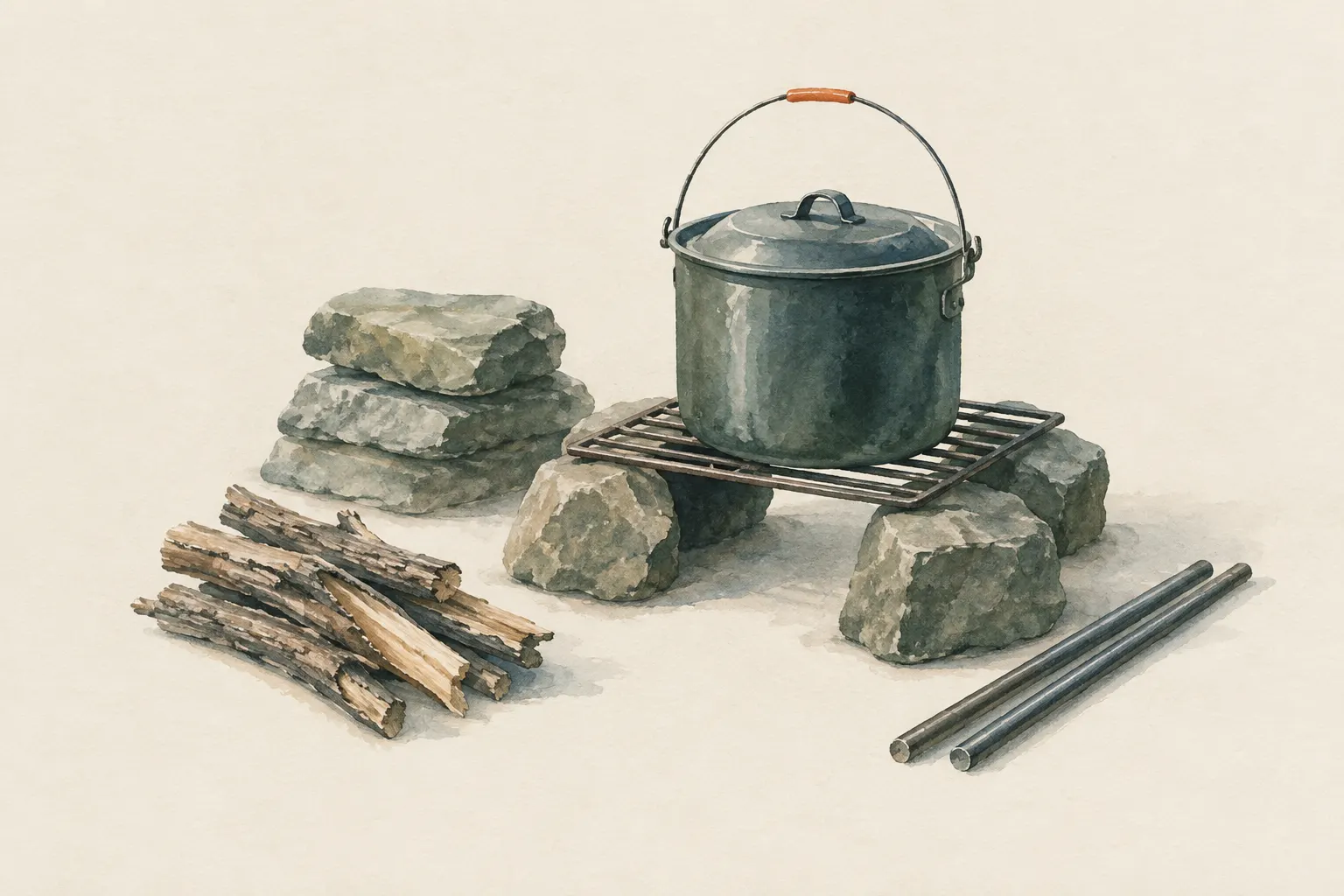
A pot of boiling water that tips over is a common scalding hazard. A stable, level support of dry stones, a grill grate, metal rods or a stove's frame carries the pot safely over a small fire or substitute cooking spot. A wide base, a low centre of gravity and no wet river stones are what matter.
- 10–15 minutes
Explained simply
Have you ever noticed that a three-legged stool never wobbles, even on uneven ground? A chair with four legs, on the other hand, often rocks. That is exactly what you use when cooking outdoors: three flat, dry stones in a triangle hold the pot as securely as a little stool.
The pot should sit low and on a wide support. The higher it stands, the more easily it tips over when you stir – just as a tall tower of building blocks falls over more easily than a flat one. A pot of hot water that tips over can cause bad scalds.
One important rule: do not use wet stones or stones from a stream or lake. Water can be trapped inside them. When the stone gets hot, the water turns into steam and the stone can burst. And children always stay back from the cooking spot.
How it works
Three points always define a plane. That is why a pot sits steadily on three supports even if they are not quite the same height – at most it leans a little. With four or more supports, they must all match exactly, otherwise the pot rests on only three and rocks over the fourth.
The second point is the centre of gravity. A pot tips when, as it is knocked, its centre of gravity moves beyond the edge of the support. The lower the centre of gravity and the further apart the supports, the harder you have to knock it before that happens. A full pot high up on wobbly branches is therefore far more dangerous than the same pot low down on wide stones.
The supports should also be arranged so that the fire or burner underneath gets enough air. So leave a gap between the stones through which air can flow in – usually on the side the wind is coming from.
What really matters
Choose a level, mineral surface – rock, gravel or bare soil – and clear leaves, dry grass and twigs from around it. Have extinguishing water ready before you start. Then set three dry, flat stones of about the same height in a triangle, so the pot rests securely on all three.
Always do the tip test: put the empty pot on and tap it from the side. If it wobbles, adjust the stones now – with an empty, cold pot that is easy. Only when it stands firm does water go in. Fill the pot only half to two thirds so nothing slops over while it boils.
While cooking, turn the handles outward, away from the flame and away from where people walk past. Hold the pot steady with a pot grip or glove while stirring and never lift it off with a bare hand – metal handles get very hot over a fire.
Gear and materials
Besides stones, anything made of metal that will not burn is suitable: a grill grate, two or three metal rods or metal pegs laid across two rows of stones, or the frame of a stove. Wooden sticks are not a good idea – even green, fresh wood dries out over the fire and eventually burns through, and then the pot falls.
A large, empty metal tin can also serve as a pot support over a small burner if it has air holes at the bottom and top. You must deburr the cut edges – that is, smooth them – so you do not cut yourself. Many tins have a coating or paint inside or outside; let it burn off outdoors beforehand and keep away from the smoke while it does.
A support is also worthwhile for a stove on uneven ground: a flat stone slab or a board under the stove makes sure it stands level. A stove standing at a slant with a pot on top tips far more easily.
Safety: what to watch out for
Wet stones and stones from streams, rivers or lakes do not belong in the fire or right next to it. Water in cracks and pores can turn to steam when heated and make the stone shatter, which can send fragments flying. How often this happens is not reliably known – but the risk is easy to avoid by taking dry stones from above the shoreline.
Scalds are the most common danger at a cooking spot. Keep children back, never leave the pot unattended and work without rushing. If something does happen: cool the affected skin with cool, not ice-cold water, and for larger areas or if a child is affected, call the local emergency number (112 in the EU).
Outdoor fires are restricted or banned in many places, especially in dry weather and when there is a wildfire risk. Check local rules beforehand. A cooking spot like this has no place on balconies with flammable flooring or indoors. After cooking, put the fire out completely until no embers are warm any more.
Typical situations
During a power cut, a safe cooking spot in the garden can help you heat water or make a warm meal – with a stove designed for outdoor use, or at a permitted fire place. The same rules apply as on a trip: a level, non-flammable spot, the tip test, extinguishing water, children kept back.
On trips it is often the ground that causes problems: roots, sloping meadows or scree. Here a few minutes spent on the support can save a lot of trouble. Feel free to practise this at home first with an empty pot and a few stones.
Survival and mountaineering handbooks have long described cooking spots and fire rings. The idea behind them is always the same: a stable pot is the simplest protection against scalds – simpler than any treatment afterwards.
Step by step
Ground
Choose a level, mineral surface, clear flammable material around it, have extinguishing water ready.
- 1
Ground
Choose a level, mineral surface, clear flammable material around it, have extinguishing water ready.
- 2
Three supports
Set three dry, flat stones of about equal height in a triangle so the pot rests securely on all three and the fire between them gets air.
- 3
Or bars
Lay two or three metal rods or metal pegs across two rows of stones. Wooden sticks burn through – do not use them.
- 4
Tip test
Put the empty pot on and tap it sideways. If it wobbles, adjust before adding water.
- 5
Handle safely
Lift the pot with a pot grip or glove, never with a bare hand. Hold the pot while stirring.
Common mistakes
- Using stones from a stream
- Pot high on wobbly branches
- Pot filled to the brim
- Green wood as support that burns through
Quick view
Materials
Metal pot (stainless steel, aluminium, titanium)
Hot – scalding risk.
Tent stakes
Metal pegs as support bars
Suitable for
- Small cooking fires where permitted
- Substitute cooking spots in the garden during outages
- Stoves on uneven ground
Not suitable for
- Wildfire danger or fire bans – check local rules
- Indoors, balconies with flammable flooring
Prerequisites
- A permitted, safe fire or cooking spot outdoors
- Extinguishing water within reach
Safety
- Fill the pot only half to two thirds, handles outward, children kept back. For scalds cool the skin with cool, not ice-cold water and for larger areas or children call the local emergency number (112 in the EU).
- Outdoor fires are restricted or banned in many places – check local rules.
How it works
A pot is stable when its centre of gravity is low and directly above a wide support with three or more points. Three points do not wobble because three points always define a plane; four or more need a very level base. The higher the pot sits, the more easily it tips when stirred.
Advantages
- Little material
- Much less risk of tipping and scalding
Disadvantages
- Stones of the right size are not available everywhere
Deep knowledge
Background
Survival and mountaineering handbooks such as FM 3-05.70 and "Mountaineering: The Freedom of the Hills" describe cooking spots, fire rings and cooking in the field.
The warning that wet stones can burst in a fire is widespread in outdoor literature; how often it happens is not reliably quantified.
Variants
- Perforated tin
- A large empty metal tin with air holes at the bottom and top can serve as a pot support over a small burner. Deburr the edges and let coatings burn off beforehand – outdoors only.
Common mistakes
- Using stones from a stream
- Pot high on wobbly branches
- Pot filled to the brim
- Green wood as support that burns through
Limits and risks
- No fire-making instructions
- Fire rules differ by place
Material alternatives
Derived from material properties: a substitute must have all relevant properties. Observe the notes on the substitute.
- Metal pot (stainless steel, aluminium, titanium)
- Single-wall stainless steel bottle (Heat only single-wall bottles without paint/plastic; remove the lid before heating.)
- Tent stakes
- Sturdy sticks / poles (Do not cut live wood where prohibited.)
Results come exclusively from structured entries. No improvised instructions are generated.
Sources
Headquarters, Department of the Army (USA) (2002): FM 3-05.70 Survival
Cooking spots and fire rings in the field
The Mountaineers Books (2017): Mountaineering: The Freedom of the Hills, 9th edition
Cooking in the backcountry