Natural direction signs: what works and what is a myth
Some signs in nature show a direction fairly reliably: wind-shaped trees in exposed places, snow lingering on north-facing slopes, old churches whose altar is usually at the east end, or satellite dishes that in Central Europe point roughly south. Others are myths – moss does not grow only on the north side, and anthills are no compass. You only get a dependable answer when several independent signs say the same thing.
- 10–20 minutes of observing
Explained simply
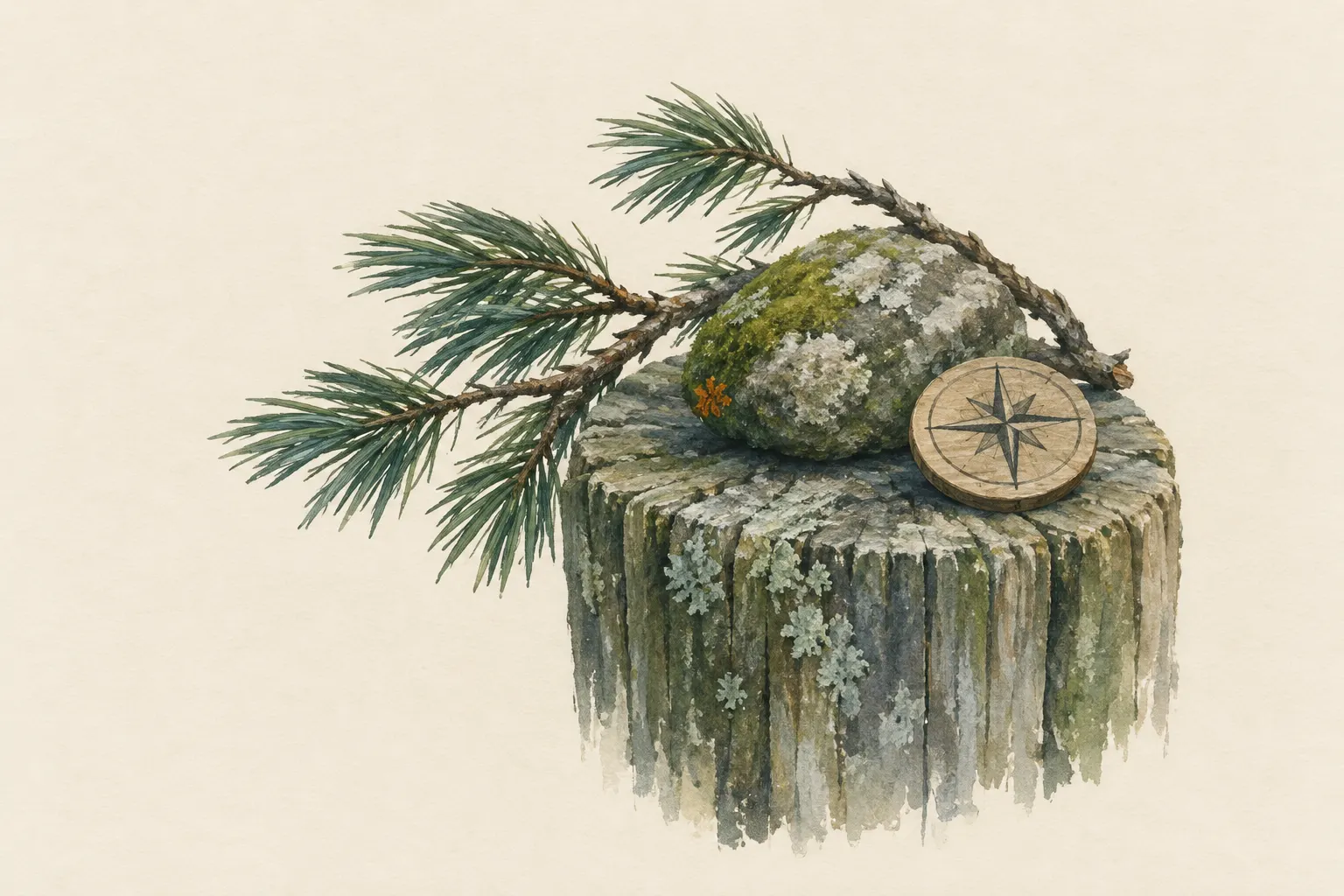
Maybe you have heard: 'Moss grows on the north side of trees.' That sounds handy, but sadly it is not true. Moss grows where it is damp and shady – and that can be any side. If you rely on it, you can get properly lost.
But there are signs that really help. Trees standing all alone on a hill get bent by the wind like a flag. Where we live, the wind mostly comes from the west, so such trees often point east. And in spring snow stays longer on slopes that face north, because less sunshine reaches them.
The most important thing is: one sign is never enough. Only when two or three different signs point the same way can you trust the result. And before you set off at all, you stop and think about whether waiting would be better.
How it works
A natural sign is only useful if it was shaped by a force that always acts from the same direction. In the northern hemisphere the sun stands in the south at midday; south slopes therefore become warmer and drier, and snow melts there earlier. A prevailing wind – in Central Europe mostly from the west – bends the crowns of free-standing trees over years and makes branches grow longer on the side away from the wind.
People have also built rules into the landscape. Many old churches in Europe are aligned so that the altar is in the east. Satellite dishes for television in Central Europe point roughly south because the satellites sit above the equator. You find such signs where you are almost safe anyway – near villages.
Myths arise where a sign depends on too many local factors. Moss and lichen need moisture and shade; in forests, by streams or in gorges, both exist on all sides. Ants build their mounds wherever suits them. Tree rings get wider on one side if the tree leans, has neighbours or grows on a slope – that has little to do with compass direction.
What really matters
Go to a place with an open view: a forest edge, a clearing, a hilltop or a field. In dense forest neither wind nor sun acts evenly, and almost all signs are disturbed there. Look at many trees, not a single one – a single tree can lean because of a neighbour or a storm.
Compare whole slopes rather than single stones. If one side of a valley still has a lot of snow and the other hardly any, the snowy side is very probably the north-facing one. Plants tell you too: north slopes are often damper and cooler, south slopes drier.
Collect several independent signs and check whether they agree. Wind-shaped trees, remaining snow and a bright patch of sun behind clouds are three different observations. If they point the same way, you may trust them. If they contradict each other, one of them is wrong – then you keep looking instead of guessing.
Safety: what to watch out for
The biggest danger is false confidence. Anyone who believes they know the direction sets off and may move far away from the search area. That is why the STOP rule always comes first: stop, think, observe, plan. If someone knows your trip plan, staying at a clearly visible place is usually safer than any attempt to find your way out with natural signs.
All sun-dependent signs are reversed in the southern hemisphere – there the sunny side is the north side. Valleys and coasts also have their own rules, because the terrain deflects the wind. And if you have phone signal: call 112; in Austria you can also reach the mountain rescue on 140.
When it makes sense – and when not
Natural signs make sense when the sun and stars are hidden behind clouds and you only need a rough direction – for example to reach a long road or a large river that runs across your direction. They also help to confirm a direction found by other means.
They are unsuitable for precise navigation to a small target, for dense forest and for dangerous terrain. There, maps, compasses and known paths count – or the decision to stay and wait for help.
Good to know
Natural navigation is an old art. Sailors and travellers have read clouds, waves, birds and plants. Modern books on it – for example by Harold Gatty or Tristan Gooley – all stress the same thing: single signs are unreliable, only many observations together give a picture.
Practise at home and on familiar paths: on every walk, look at where free-standing trees point, where snow lingers and how churches are aligned, and check it with a compass. That way you learn which signs really work in your area – long before you need them in an emergency.
Step by step
Stop first, then observe
Stop, have a drink and think about whether you need to move at all (STOP rule). Then find a spot with a view, such as a forest edge or a clearing – in the middle of dense forest almost all signs are disturbed.
- 1
Stop first, then observe
Stop, have a drink and think about whether you need to move at all (STOP rule). Then find a spot with a view, such as a forest edge or a clearing – in the middle of dense forest almost all signs are disturbed.
- 2
Read wind-shaped trees
In exposed places – hilltops, ridges, coasts, single trees in a field – a prevailing wind shapes the crowns: branches grow more on the side away from the wind, and whole trees lean with it. In Central Europe the wind blows mostly from the west, so the 'flags' then point roughly east. Look at several trees, not one.
- 3
Recognise the sunny side
In the northern hemisphere south-facing slopes get more sun. In spring and after fresh snow, snow lingers much longer on north-facing slopes and on the north side of rocks, walls and ditches. South slopes are often drier, north slopes damper and cooler. Compare whole slopes, not single stones.
- 4
Use man-made signs
Many old churches in Europe are 'oriented': the altar end lies to the east and the tower often to the west – but there are many exceptions. Satellite dishes in Central Europe point roughly south because TV satellites sit above the equator. Such signs are a hint, not proof.
- 5
Rule out the myths
Moss and lichen grow where it is damp and shady – in forest often all round, by streams on any side. Anthills sit wherever suits the ants, not reliably on the south side. Wider tree rings on one side have many causes. Leave these signs out.
- 6
Combine the signs
Collect at least two, better three independent signs – for example wind-shaped trees, remaining snow and the sun behind the clouds. If they point the same way, the result is usable. If they contradict each other, trust none of them and look for more clues.
- 7
Mark and hold the direction
Lay the direction you found on the ground as a cross of sticks and mentally label N, E, S, W. Then pick a distinctive far-off target in the direction you want and walk towards it – check the signs themselves again and again along the way.
Common mistakes
- Walking by moss on the 'north side'
- Trusting a single tree
- Reading signs in dense forest or a sheltered valley
- Forgetting that everything is reversed in the southern hemisphere
- Marching off without using the STOP rule
Quick view
Materials
Sturdy sticks / poles
To mark the direction you found on the ground
Do not cut live wood where prohibited.
Field notebook and pencil
Note down signs and results
Suitable for
- Confirming a rough direction when sun and stars are hidden
- Open sites, forest edges, hilltops and coasts
- Villages and farmland with churches and houses
Not suitable for
- Precise navigation to a destination
- Dense forest where wind and sun hardly act
- A single sign as the only basis for a decision
Prerequisites
- Knowing which hemisphere you are in
- Knowing the sun methods (shadow stick)
- Calm – the STOP rule first
Safety
- Moss, lichen, anthills and tree rings are not reliable direction indicators. Walking by them can lead you badly astray. Never decide by a single sign.
- All sun-dependent signs apply in this form only in the northern hemisphere. In the southern hemisphere the sunny side is the north side.
How it works
Useful signs are created by a force that acts from the same direction for years: the sun (in the northern hemisphere in the south at midday) or a prevailing wind (in Central Europe mostly from the west). Man-made signs follow a rule, such as old churches with the altar in the east. Myths rely on things that depend on many local factors – moss mainly needs moisture and shade, and those can be found on any side of a tree.
Advantages
- Needs no equipment
- Works under an overcast sky too
- Trains your eye for the terrain
Disadvantages
- Only a rough direction
- Many local exceptions
- Easy to overestimate
Deep knowledge
Background
Books on natural navigation – for example by Harold Gatty and Tristan Gooley – stress that single signs are of little use and only the combination of several observations gives a direction. The moss myth persists nonetheless.
Westerly winds prevail in Central Europe because it lies in the westerly wind belt of the mid-latitudes. Locally, however, terrain and weather can produce quite different winds.
Variants
- Valleys and mountains
- In valleys mountains deflect the wind – there it follows the valley and not the large westerly flow. Wind-shaped trees then show the valley direction, not east. The rule of thumb only fits on open hilltops and ridges.
- Coasts
- On coasts the sea wind often shapes the trees. The lean then points away from the sea – useful local information, but not automatically east.
Common mistakes
- Walking by moss on the 'north side'
- Trusting a single tree
- Reading signs in dense forest or a sheltered valley
- Forgetting that everything is reversed in the southern hemisphere
- Marching off without using the STOP rule
Limits and risks
- No accuracy figures – they depend on the place
- Applies in this form to the northern hemisphere and Central Europe
- Does not replace a map or compass
Sources
Tristan Gooley – Virgin Books (2010): The Natural Navigator
Wind-shaped trees, sunny side, churches and satellite dishes as signs; moss as an unreliable clue; combining several signs
Harold Gatty – Dover Publications (1999): Finding Your Way Without Map or Compass (first published as 'Nature Is Your Guide', 1958)
Natural direction signs and their limits
Deutscher Wetterdienst (DWD): Wetter- und Klimalexikon
The westerly wind belt of the mid-latitudes
Headquarters, Department of the Army (USA) (2002): FM 3-05.70 Survival
Field-expedient direction finding without a compass