Play in a crisis: giving children space and normality
Play is children's most important way to process experiences and feel normality – even in an emergency shelter, power cut or evacuation. A safe play area, fixed play times, simple materials and a calm adult nearby are enough. When children play out the disaster, that is usually normal; persistent, very distressed or rigid play is a cause for concern.
- Daily, with few materials
Explained simply
For children, play is not just fun. It is their way of understanding the world. When something bad happens – a flood, a long power cut, a night in an emergency shelter – play helps them cope with what they have been through and feel a bit normal again.
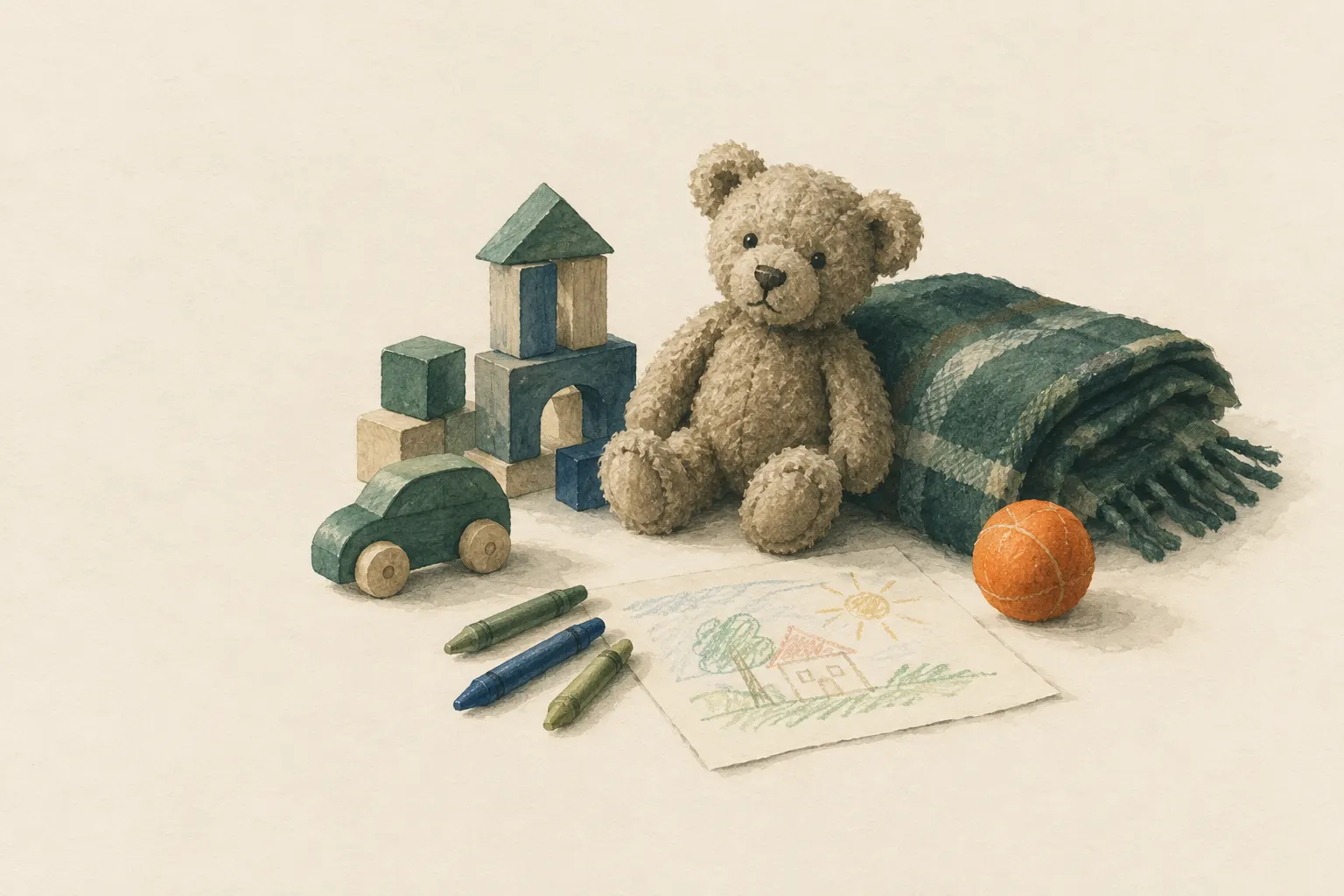
Sometimes children play out the disaster: the dolls get evacuated, the house made of building blocks gets flooded. To adults that looks alarming, but it is usually quite normal. In play the child is in charge and can let the story end the way they want.
What children need for this is very little: a safe place without broken glass, floodwater, power lines, traffic or exhaust fumes, a few simple things like paper and pens – and a calm adult nearby.
How it works
Play gives children control in a world that is currently out of control. Adults often process experiences by talking; children frequently do it through play. They use it to sort what they have seen and heard, to express feelings they do not yet have words for, and to try out how a story can end well.
At the same time, play is a piece of normality. A child who plays again experiences joy and notices: not everything has changed. Fixed play times also create predictability, which children particularly need in uncertain times.
The adults benefit too. Children at play are usually calmer, and parents get small breaks to deal with urgent matters or simply take a breath.
What really matters
A fixed place: a quiet corner or a defined area, ideally always the same one. Simple materials are quite enough – paper, pens, cards, dice, balls, boxes, books and a favourite toy. Build play into the daily routine and alternate between quiet and active games.
Accompany, do not steer: let children play what they want. Listen when they talk while playing, and answer questions honestly and in a child-appropriate way. Do not forbid or punish disaster play – it is usually part of processing.
Typical mistakes are forbidding play as “inappropriate”, keeping children occupied with screens all the time, or letting them overhear news and adult conversations about the crisis. The last one in particular can frighten children more than the event itself.
Safety: what to watch out for
Check every play area for hazards: debris, glass, floodwater, fallen power lines, traffic and generator exhaust. Floodwater can be contaminated and may have currents or hidden holes. Generator exhaust contains carbon monoxide, an invisible and odourless gas – children should never play near a running generator.
Do not let children play unsupervised in unfamiliar surroundings, such as an emergency shelter or a damaged neighbourhood. An adult supervisor always belongs with them. In the dark a headlamp or torch helps – no open flames in play areas.
Ideas and play groups in a shelter
Many games need almost nothing: “I spy”, stories where everyone adds one sentence, drawing, card games, houses made of boxes. During a power cut, shadow puppets with a torch are fun for many children. Outdoors, ball games are possible if the place is safe.
In emergency shelters several families can take turns supervising; older children take on small tasks and feel needed as a result. Coordinate this with the shelter management. Because noise quickly causes arguments in cramped rooms, fixed times for loud games and quiet games during rest periods help.
When children need extra help
A child playing out the disaster is usually normal. You should pay attention if a child plays exactly the same distressing scene again and again over a long period, seems desperate while doing so, if the play stays rigid and unchanging, or if the child stops playing altogether. Then it makes sense to involve professionals such as a paediatrician or a counselling service.
These tips are neither play therapy nor a diagnosis. The IASC guidelines name safe spaces and child-friendly activities as part of basic support in emergencies, and the NCTSN guide describes how caregivers can support children. If a child or an adult is in acute danger, the rule always applies: the local emergency number (112 in the EU).
Step by step
Create a safe space
Set up a quiet corner or a defined area, ideally always the same one.
- 1
Create a safe space
Set up a quiet corner or a defined area, ideally always the same one.
- 2
Simple materials
Paper, pens, cards, dice, balls, boxes, books, favourite toys – nothing more is needed.
- 3
Fixed play times
Build play into the daily routine, alternating quiet and active games.
- 4
Accompany, do not steer
Let children play what they want; listen when they talk; answer questions honestly and age-appropriately.
- 5
Observe
If a child plays the same distressing scene over a long period, seems desperate while doing so or stops playing altogether, involve professionals (paediatrician, counselling service).
Common mistakes
- Forbidding play as inappropriate
- Stopping or punishing disaster play
- Keeping children occupied with screens all the time
- Letting children overhear news and adult conversations
Quick view
Materials
Comfort and activity items for children
Headlamp / flashlight
Suitable for
- Families in shelters or during long power cuts
- Neighbourhoods and groups with several children
Not suitable for
- Children with very strong or persistent stress reactions – professional help as well
Prerequisites
- Safe place without hazards (debris, water, traffic)
- An adult supervisor
Safety
- Check play areas for hazards: debris, glass, floodwater, power lines, traffic, generator exhaust. Do not let children play unsupervised in unfamiliar surroundings.
- These tips do not replace psychological or medical help. If distress lasts for weeks or paralyses daily life, involve a family doctor, counselling service or mental health professional.
How it works
Play gives children control in a world that is currently out of control. Through play they order experiences, express feelings and experience joy. Fixed play times create predictability, and children at play also relieve the adults.
Advantages
- Hardly any materials needed
- Relieves children and adults
Disadvantages
- Needs supervision and space
- Noise can cause conflicts in cramped shelters
Deep knowledge
Background
The IASC guidelines on mental health and psychosocial support in emergency settings name structured, child-friendly activities and safe spaces for children as part of basic support. The NCTSN psychological first aid guide describes children's reactions and how caregivers can support them.
Ready.gov offers child-friendly preparedness material in "Ready Kids".
Variants
- Play group in a shelter
- Several families take turns supervising; older children can take on small tasks. Coordinate with the shelter management.
Common mistakes
- Forbidding play as inappropriate
- Stopping or punishing disaster play
- Keeping children occupied with screens all the time
- Letting children overhear news and adult conversations
Limits and risks
- No play therapy
- No diagnosis of child distress
Material alternatives
Derived from material properties: a substitute must have all relevant properties. Observe the notes on the substitute.
- Headlamp / flashlight
- Mobile phone (The battery drains quickly in cold and with continuous screen and GPS use.), Battery lantern / LED light
Results come exclusively from structured entries. No improvised instructions are generated.
Sources
Inter-Agency Standing Committee (IASC) (2007): IASC Guidelines on Mental Health and Psychosocial Support in Emergency Settings
Structured, child-friendly activities and safe spaces for children
National Child Traumatic Stress Network and National Center for PTSD (USA) (2006): Psychological First Aid: Field Operations Guide, 2nd Edition
Children's reactions and support by caregivers
Ready.gov – U.S. Federal Emergency Management Agency (FEMA): Ready Kids
Child-friendly preparedness material