A child's own go bag
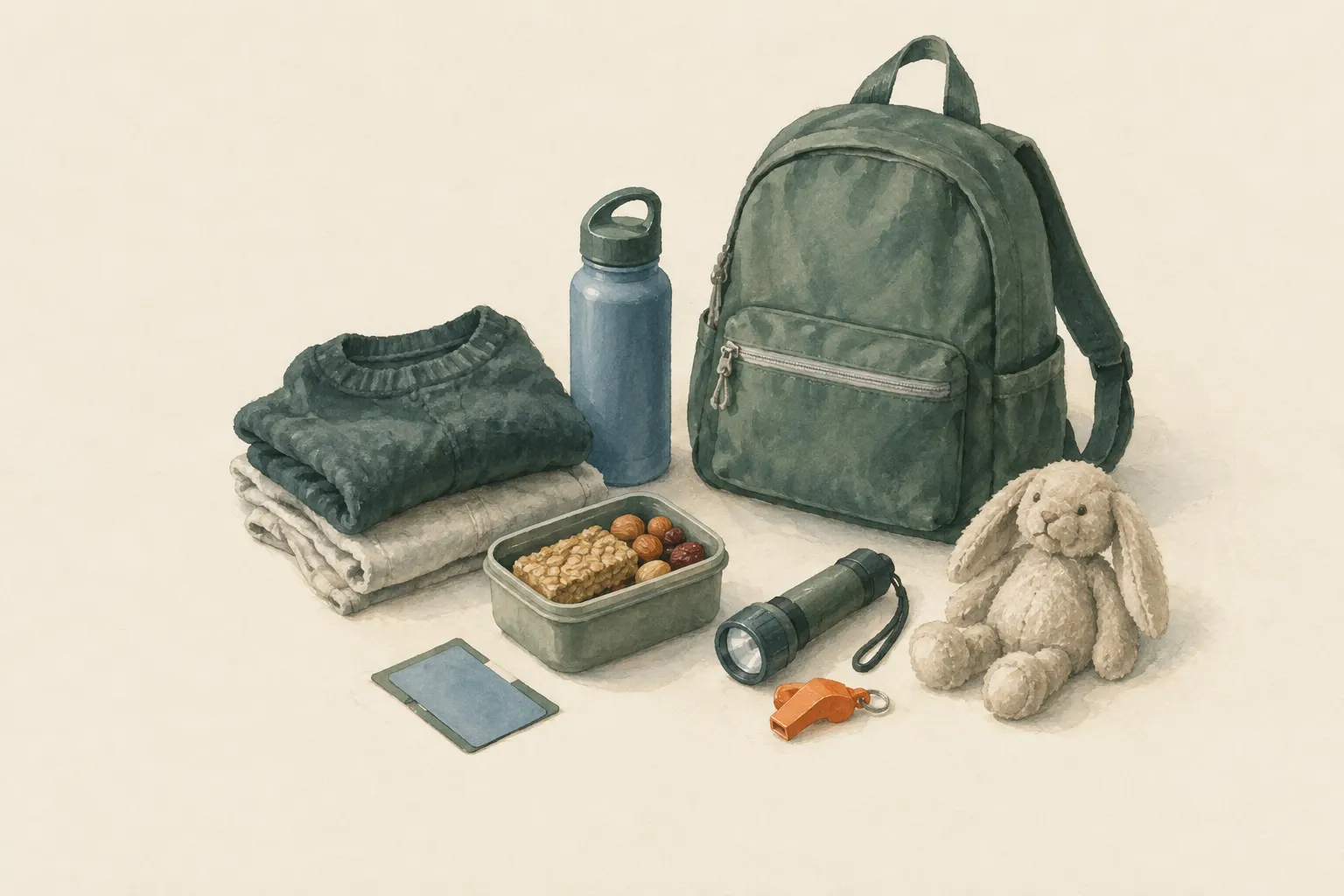
A small backpack a child can carry themselves supplements the family go bag: a change of clothes, snack and water, torch, whistle, contact card and something familiar. Children who help pack it know what is inside – and feel less helpless during an evacuation.
- 30–60 minutes, check every six months
Explained simply
A go bag is a backpack that is already packed in case the family has to leave the house quickly – for example during a flood or a fire nearby. The parents have a big one. Children can have a small one of their own that they carry themselves.
Inside are things a child needs and can carry easily: a change of clothes, a rain jacket, a water bottle, a snack, a torch, a whistle and a card with the most important phone numbers. And something they love – a small soft toy, a book or a card game. The child may choose that themselves.
Important: an adult always carries the child's medication and important papers. And the whistle is only for real emergencies, for example if you have lost your family and want to be found.
Why a bag of their own helps
During an evacuation many things happen at once, and children quickly feel helpless: adults are stressed, everything is fast and nobody has time for explanations. A familiar bag of their own gives a child something to hold on to – literally and figuratively. They have a task (“Get your backpack and put it on”) and know that their things are coming along.
At the same time, the child's backpack takes light items such as spare clothes, snacks and toys off the adults. But everything heavy and everything important – medication, emergency medication, documents, larger water supplies – stays in the parents' bags. The child's bag supplements the family go bag; it does not replace it.
Children who help pack their bag know what is inside. That makes it their bag, not a strange object pushed into their hands.
What goes in
The backpack itself should be small and light, with padded straps. The most important rule: fully packed, the child must be able to carry it comfortably, even for a while. There is no fixed weight limit; try it out by having the child carry it on a walk. If it becomes uncomfortable, something comes out.
The basics include a change of clothes, rain protection, a water bottle, a long-lasting snack the child likes, a torch or headlamp, a whistle and tissues. Add something familiar that the child chooses themselves: a small soft toy, a book, a card game or crayons. This item is often the most important one, because it gives comfort in unfamiliar surroundings.
The contact card has the child's name, the parents' names and phone numbers, the contact person outside the region and the agreed meeting point. It goes inside the backpack, not visible from outside, and no home address is readable from outside. The family code word does not belong on the card.
Whistle, lamp and card: if a child gets lost
Three things in the backpack are meant for the case where a child is briefly separated from the family. A whistle is much louder than a child's voice and lasts longer than shouting. Several short blasts in a row, often three, are widely understood as a call for help. Above all, though, explain one simple rule to the child: the whistle is only for real emergencies, not for play.
The lamp helps the child to be seen in the dark and to see. The contact card helps helpers reach the parents if the child is too upset to remember their numbers. Talk with the child about whom they may show the card to: emergency services, teachers or staff at an assembly point.
Safety: what to watch out for
The child's medication, emergency medication and important documents always belong in the adults' bags, not in the child's backpack. A child can lose their bag, leave it behind or swap it with another child. Besides, no child should have to make decisions about medication in an emergency.
Babies and toddlers do not need a bag of their own – the parents carry everything for them. When a child can sensibly carry a small backpack depends on the child, not on a fixed age. If the child carries a school bag, a mini version with contact card and small lamp can also stay there, if the school allows it.
How to practise it – and keep it up to date
Include the backpack in drills at home. During an escape-route drill, the child fetches their backpack, puts it on and comes along to the meeting point. That way they know where the bag is, and grabbing it becomes second nature. The backpack should stand in a fixed place the child can reach easily.
Children grow fast, and snacks expire. So check the backpack together about every six months: do the clothes still fit? Is the snack still good, and does the child still like it? Does the lamp work, or do the batteries need replacing? Are the phone numbers on the card correct? The backpack has to “grow” with the child.
Ready.gov and Ready Kids recommend involving children in packing the emergency kit and including familiar items such as toys or books. Packing can become a small joint project the child is proud of.
Step by step
Choose the bag
Small, light, with padded straps; fully packed, the child should be able to carry it comfortably.
- 1
Choose the bag
Small, light, with padded straps; fully packed, the child should be able to carry it comfortably.
- 2
Basics
Change of clothes, rain cover, water bottle, long-lasting snack, torch, whistle, tissues.
- 3
Contact card
The child's name, the parents' names and numbers, out-of-area contact, meeting point – inside the bag.
- 4
Something familiar
Small soft toy, book, card game, crayons – chosen by the child.
- 5
Practise
During a drill let the child fetch and put on the backpack; explain the whistle: emergencies only.
- 6
Check regularly
About every six months check clothing size, snack dates and batteries.
Common mistakes
- Backpack too heavy
- Clothes long outgrown
- Medication in the child's bag
- Child does not know where the bag is
Quick view
Materials
Backpack
Child-sized, light
Headlamp / flashlight
Signal whistle
Carry within easy reach, not deep in the pack.
Do not blow right next to other people's ears.
Emergency card (contacts and health details)
Contact card
Note only necessary data; for children do not display the address visibly on clothing but carry the card in a pocket.
Comfort and activity items for children
Suitable for
- Children who can carry a small backpack
- Families in regions with evacuation risk
- Drills at home
Not suitable for
- A replacement for medication and documents in the adults' bags
- Babies and toddlers – the parents carry everything
Prerequisites
- A family go bag
- An emergency plan with meeting point and contact person
Safety
- The child's medication, emergency medication and important documents belong in the adults' bags, not in the child's backpack.
- Keep the contact card inside, not visible from outside; no home address readable from outside.
How it works
Their own familiar bag gives children something to hold on to and a task. It takes light items off the adults while heavy and important things stay with the parents. Whistle, lamp and contact card help if the child gets separated for a moment.
Advantages
- Children feel involved
- Takes load off the adults
- Helps during a brief separation
Disadvantages
- Has to "grow" with the child
Deep knowledge
Background
Ready.gov and Ready Kids recommend involving children in packing the emergency kit and including familiar items such as toys or books.
The family go bag and supplies for infants are covered in separate entries.
Variants
- School bag set
- A mini version with contact card and small light can stay in the school bag if the school allows it.
Common mistakes
- Backpack too heavy
- Clothes long outgrown
- Medication in the child's bag
- Child does not know where the bag is
Limits and risks
- No fixed weight or age limits
- No product recommendations
Material alternatives
Derived from material properties: a substitute must have all relevant properties. Observe the notes on the substitute.
- Backpack
- Sleeping pad, Dry leaves, grass or conifer boughs (Collect only where allowed; no protected plants. Check for ticks and insects.), Dry spare clothing (Carry it in waterproof packaging – wet clothing barely insulates.), Wool blanket / duvet (Keep away from candles, stoves and heaters.), Insulated cool box (Keeps cold only for a limited time; without ice packs or ice it is not a fridge.), Sleeping bag (Do not store compressed long-term; do not pack away damp.), Newspaper and cardboard (Flammable – keep away from candles, stoves, heaters and embers.), Insulated cooking box (hay box, thermal cooker) (Never put open flame or embers inside – only the hot, closed pot.)
- Headlamp / flashlight
- Mobile phone (The battery drains quickly in cold and with continuous screen and GPS use.), Battery lantern / LED light
Results come exclusively from structured entries. No improvised instructions are generated.
Sources
Ready.gov – U.S. Federal Emergency Management Agency (FEMA): Build A Kit
Emergency kit; considering children's needs
Ready.gov – U.S. Federal Emergency Management Agency (FEMA): Ready Kids
Involving children in packing, familiar items