Agreeing whistle signals: three blasts for help and group codes
Three blasts are widely understood as a call for help; in the Alps the alpine distress signal is customary. For groups – families, school classes, hiking teams – it is worth agreeing and practising a few simple whistle signals before the trip. Whistling saves your voice and carries further.
- Five minutes of agreement before the trip
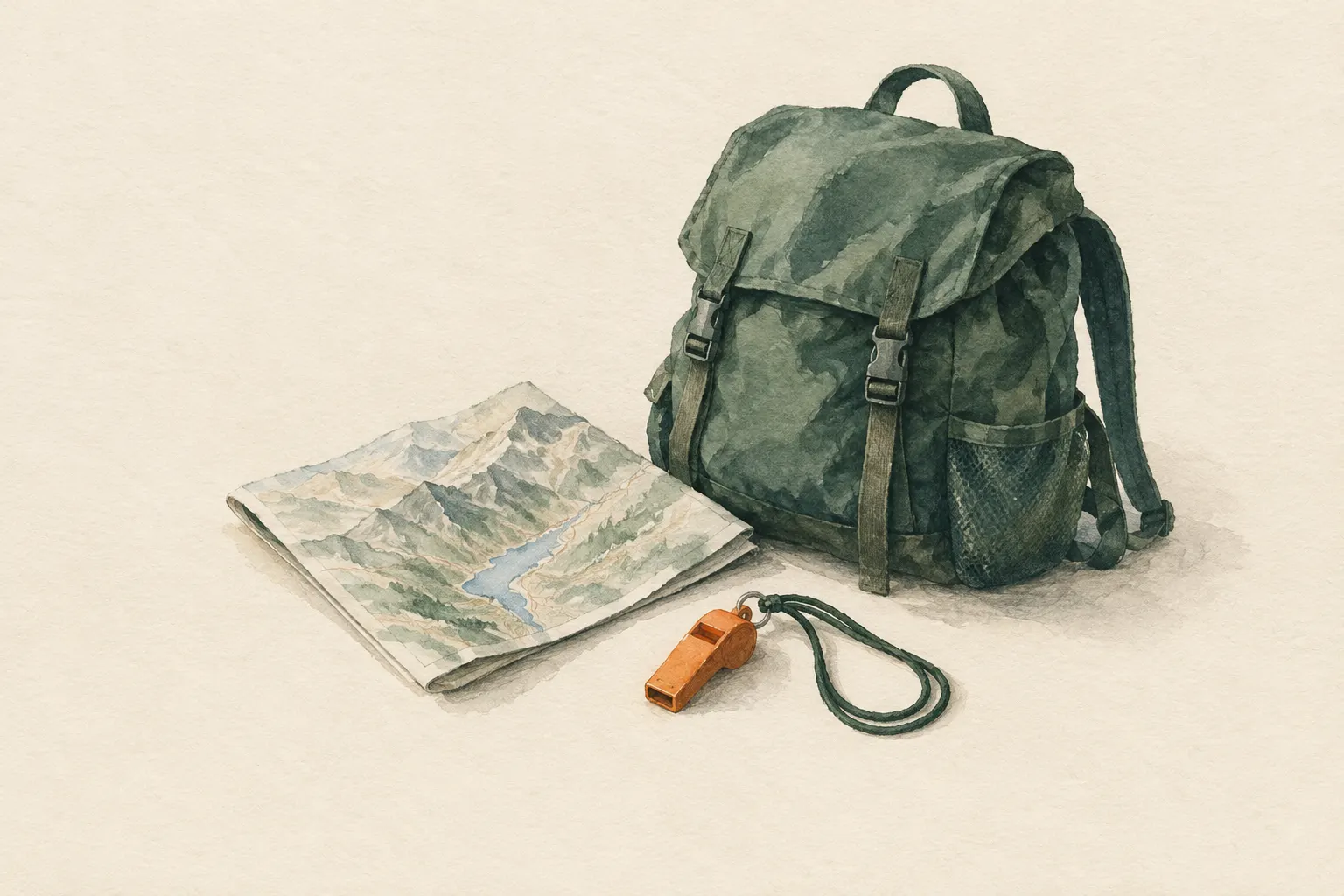
Explained simply
A whistle is like a little telephone without a battery – but only if everyone knows what the blasts mean. So before the outing, agree on a few very simple rules in your family or group. For example: one blast means 'Where are you?', two blasts mean 'Come to me', three blasts mean 'I need help'.
Many strangers also understand three blasts as a call for help. Whoever was called answers with the same signal, so the other person knows: I have been heard. Between the blasts you always pause and listen.
For children one rule is especially important: if you are lost, stay where you are and blow your whistle. You will not be in trouble for it – on the contrary, it is exactly the right thing to do. And because the whistle matters, it is not a toy.
How it works
A whistle blast is louder than the voice, carries further and costs little effort. Especially in forest, fog or driving snow, where you cannot see each other, that is a big advantage. But a single blast does not say anything yet. Only a rhythm that does not occur in nature – such as three even blasts, then a pause – is recognised as a human signal.
Three signals are a widespread convention for distress in many countries and organisations: three blasts, three shouts, three flashes. In the Alps the alpine distress signal has also become established – six signals per minute and a minute's pause. Neither is a binding worldwide rule, but both are understood in many places.
Your own group codes are something different: they only apply within the group that agreed them. To strangers, two blasts mean nothing in particular. That is why the call for help should always be one that outsiders know too.
What really matters: few, clear signals
Under stress you quickly forget what was agreed. So the rule is: as few signals as possible. Two or three meanings are quite enough – for example 'Where are you? / Attention', 'Come to me' and 'I need help'. More codes tend to cause confusion rather than better communication. These are examples; what matters is that everyone in the group means the same thing.
Also agree how to reply – for example by giving the same signal back. That way the caller knows they have been heard and can wait calmly. After every group of blasts: pause and listen. Replies are often faint or come from an unexpected direction, because slopes and trees bounce the sound back.
Everyone should carry their own whistle within reach on the body, not in the pack. Otherwise someone who is injured or lost may not be able to get at it.
Practising with children
Children learn whistle signals quickly if they are practised in a playful but serious way. Go through the signals together before the outing and try them out in a quiet place where nobody will take them for a real emergency. A child can hide behind a tree and guide the others to them by whistling – that practises listening for replies.
The most important thing a child must know: if you have lost the group, stay where you are and blow your whistle. Do not walk around looking for the others. And you will not be in trouble for it. Many children hide out of fear of being told off instead of making themselves noticed – this sentence takes away that fear.
Just as important: the whistle is not a toy. If people constantly whistle for fun, at some point nobody takes the signals seriously any more. And strangers who hear three blasts might alert rescuers.
When it makes sense – and when not
Whistle signals help wherever you cannot see each other but can still hear: in forest, fog, snow, at dusk, on the coast. A whistle is also ideal for injured people who cannot shout. Preparedness guides also recommend whistles for households, for example to attract attention after a building collapse.
There are limits at long distances and with noise. A waterfall, a raging stream or a storm can drown out blasts. And whistle signals do not replace an emergency call: if a phone has signal, call the local emergency number first (112 in the EU). Blasts then help guide rescuers to you over the last stretch.
Without a whistle
If you have no whistle, you can create the same rhythm by other means: knocking a stone on wood or metal, shouting in groups of three or sounding a vehicle horn. Knocking often carries surprisingly well in buildings and along pipes.
What matters is always the same: an even, repeated rhythm and pauses to listen. If you shout, save your voice and do not yell non-stop. Best of all, though, is not to forget the whistle in the first place – it weighs almost nothing and fits on any key ring.
Step by step
Fix the call for help
Agree: three short, strong blasts, pause, repeat = 'I need help'. In the Alps, alternatively the alpine distress signal.
- 1
Fix the call for help
Agree: three short, strong blasts, pause, repeat = 'I need help'. In the Alps, alternatively the alpine distress signal.
- 2
A few group signals
For example one blast = 'Where are you? / Attention', two blasts = 'Come to me'. More than two or three signals get forgotten under stress.
- 3
Agree on a reply
Decide how to reply (e.g. the same signal back) so the caller knows they have been heard.
- 4
Practise with children
Children should know: if you are lost, stay where you are and blow the whistle – you will not be in trouble.
- 5
Pause to listen
Listen after each group of blasts. Replies are often faint or come from an unexpected direction.
Common mistakes
- Whistle used as a toy – signals are no longer taken seriously
- Too many codes agreed
- No pauses to listen
- Whistle in the pack instead of on the body
Quick view
Materials
Signal whistle
One whistle per person, especially for children
Carry within easy reach, not deep in the pack.
Do not blow right next to other people's ears.
Suitable for
- Groups in forest, fog, snow
- Children who might get lost
- Injured people who cannot shout
Not suitable for
- Long distances beyond earshot
- Noisy surroundings (waterfall, storm)
Prerequisites
- Everyone has their own whistle within reach
- Signals agreed beforehand
Safety
- Whistle conventions are not uniform worldwide. Three blasts are widely understood but carry no guarantee. Group signals are only valid within the group that agreed them.
How it works
A whistle blast is louder and carries further than the voice and costs little effort. A rhythm that does not occur in nature – three even blasts, then a pause – is recognised as a human signal. Simple meanings agreed in advance prevent misunderstandings under stress.
Advantages
- Cheap and light
- Works in fog and darkness
- Easy for children to learn
Disadvantages
- Only within earshot
- Wind and water drown it out
- Conventions not universal
Deep knowledge
Background
Three signals – blasts, shouts, flashes, fires – are a widespread convention for distress in many countries and organisations. In the Alps the alpine distress signal has become established.
Whistles are also recommended for households in preparedness guides, for instance to attract attention after a building collapse.
Variants
- Without a whistle
- Knocking stone on wood or metal, shouting in groups of three or sounding a vehicle horn in the same rhythm.
Common mistakes
- Whistle used as a toy – signals are no longer taken seriously
- Too many codes agreed
- No pauses to listen
- Whistle in the pack instead of on the body
Limits and risks
- No range figures
- Group codes are examples, not a standard
Sources
Headquarters, Department of the Army (USA) (2002): FM 3-05.70 Survival
Audio signals and the convention of three
Ready.gov – U.S. Federal Emergency Management Agency (FEMA): Build A Kit
Whistle as part of an emergency kit
ICAR – International Commission for Alpine Rescue: International Commission for Alpine Rescue (ICAR) – recommendations and information (organisation website)
The alpine distress signal in the Alpine region