Knowing your water, electricity and gas shut-offs
After a burst pipe, water near electrics or a storm, every minute counts. If you know in advance where the main water valve and the breaker panel are and how to operate them, you prevent further damage. Gas follows a different rule: if you smell gas, do not operate anything, leave the building and call the gas emergency service or the emergency number from outside.
- About 30–60 minutes once to locate and label
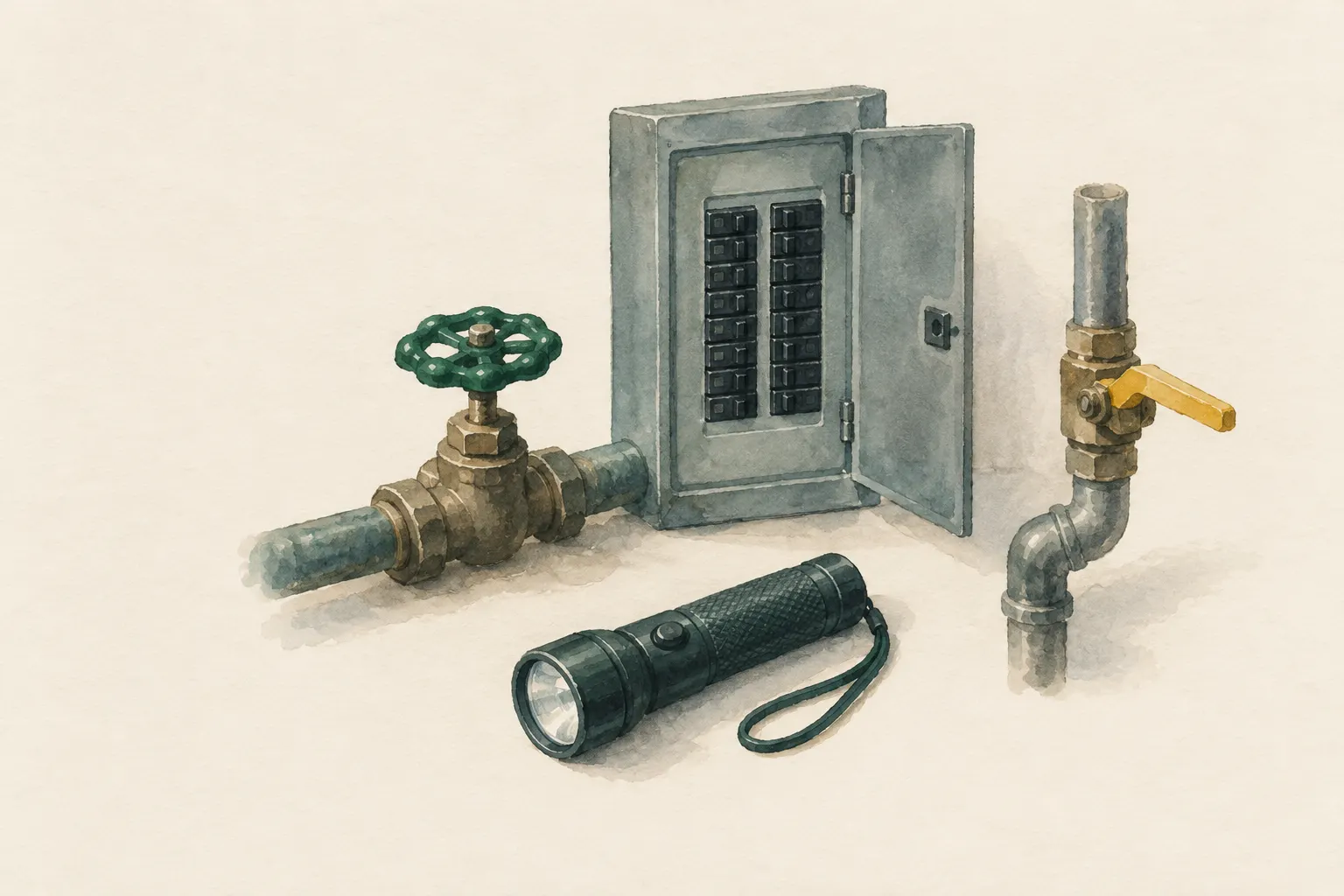
Explained simply
Water, electricity and gas come into your home through pipes and cables – like invisible roads. Each of these roads has a place where it can be closed for the whole home: for water the main water valve, for electricity the breaker panel with its small switches. If a pipe bursts, the main water valve lets you stop your home from flooding. But that only works if you already know where it is.
Gas follows a completely different rule. Gas escaping from a pipe can be lit by a tiny spark – even the spark inside a light switch. So if you smell gas, you touch nothing: no switches, no doorbell, no phone inside the building. You go outside with everyone and call the gas emergency service or the emergency number (112 in the EU) from out there.
One more important thing: if water is standing near sockets or the breaker panel, you do not go in. Water conducts electricity. Repairing gas or electrical installations is always work for qualified professionals – your job is only to know where the shut-offs are and to act correctly.
How it works
The water pipe usually enters the building at one point, often in the basement or a utility room. That is typically where you find the water meter with a shut-off valve before or after it. If you close this valve, no fresh water flows in – a burst pipe then only drains what is already in it instead of being fed more and more water. Flats often have extra valves too, for example under the washbasin, at the toilet cistern or on a riser in the bathroom.
Electricity is split in the breaker panel (also called the consumer unit or distribution board) into individual circuits: kitchen, bathroom, rooms. Each circuit has its own circuit breaker. Many installations also have a residual-current device, which switches off very quickly with certain faults, and sometimes a main switch for the whole home. These switches are designed to be operated by occupants – opening the cover or working on cables is not.
Gas also has a main shut-off, usually where the pipe enters the building, and often further valves in front of individual appliances. Who should operate them and when is set by the utility and the authorities; this differs by country. What matters for you as an occupant: if you smell gas, you operate nothing and get yourself to safety.
What really matters
The most important part happens beforehand, in a calm moment. Take a torch and look for the main water valve and the breaker panel – and if there is gas in the building, ask the landlord, building management or utility where the gas shut-off is. Label what you find clearly. A note saying “Main water valve – turn clockwise to close” can save a lot of time in an emergency.
Most turning valves close clockwise. With lever valves, a lever across the pipe usually means “closed” and a lever in line with the pipe means “open”. Check this on your own valve by closing and reopening it once deliberately. If it is stiff or drips afterwards: do not keep turning with force or an extension bar – tell the landlord or a professional. A broken valve is worse than a stiff one.
Also check whether the circuits in the breaker panel are labelled. If not, you can work out together with a second person which switch supplies which room: switch off, see which light goes out, switch back on, write it down. Keep access to all shut-offs clear – boxes and shelves in front of them cost valuable minutes in an emergency.
Safety: what to watch out for
A smell of gas is an emergency. Mains gas only smells because an odorant is added so that leaks are noticed. If you smell it: do not operate any switches (not even to turn them off), no doorbell, no phone or mobile inside the building, no flame. Leave doors open, warn everyone, go outside and call the gas emergency service or the local emergency number (112 in the EU) from there. Do not look for the leak yourself.
Once gas has been shut off, you do not turn it back on yourself. Appliances without a lit flame could then release gas; restoring the supply belongs to the utility or a qualified professional. The same care applies to electricity: only operate the breaker panel if you are standing on dry ground and can reach it safely. If water is near sockets, appliances or the panel, do not enter the room – call the utility or the fire service.
If a breaker keeps tripping, that is a sign of a fault. Do not keep switching it back on; unplug the appliances on that circuit and call a qualified electrician. Any work behind covers, on cables, sockets or gas pipes is off-limits for laypeople – exactly where the legal line runs differs from country to country, so check local rules.
Typical situations
Burst pipe: water sprays from a pipe or runs from the ceiling. First check whether water is reaching electrics – if so, do not go in. Otherwise close the nearest valve first and, if that is not enough, the main water valve. Then call the landlord or a plumber and take photos for the insurer.
Frost: in hard frost, pipes in unheated rooms can freeze because water expands when it freezes. If you are away for a long time or have an outdoor tap, you can have that branch shut off and drained. A burst pipe often only shows when it thaws – that is when it pays to find the valve straight away.
Flood warning or storm: authorities sometimes advise whether and when to switch off electricity or other supplies before water enters the building. Follow these announcements. If the water is already there, the rule applies again: do not enter flooded rooms with electrics. In apartment buildings, main shut-offs are often in rooms only the caretaker has a key to – find out in advance whom you can reach in an emergency.
How to practise it
Take a short tour with everyone in the household: here is the main water valve, this is how it turns. Here is the breaker panel, this switch belongs to the kitchen. And here – if there is one – is the gas shut-off, which we do not touch; if we smell gas, we go outside. Older children understand this well and are often proud to explain it.
Write the phone numbers of the gas emergency service, water utility, electricity network operator and landlord into your emergency plan and hang a copy near the breaker panel. Keep a torch within reach there too, because basements are often dark – and even more so during a power cut.
Repeat the tour about once a year or when someone new moves in. Check that the labels are still readable and the access is clear. That way the knowledge becomes a habit you can call on in an emergency without long thought.
Step by step
Find the main water valve
It is usually where the water pipe enters the building – often in the basement or utility room near the water meter. In flats there are often additional valves in the bathroom, kitchen or on a riser.
- 1
Find the main water valve
It is usually where the water pipe enters the building – often in the basement or utility room near the water meter. In flats there are often additional valves in the bathroom, kitchen or on a riser.
- 2
Find the breaker panel and main switch
Find out where your home's breaker panel (consumer unit) is and whether there is a main switch. Check whether the individual circuits are labelled.
- 3
Know where the gas shut-off is
If there is gas in the building: ask the landlord, utility or a qualified professional to show you where the main shut-off is. Whether and when occupants should operate it is set by the utility and authorities – when in doubt, touch nothing and call the gas emergency service.
If you smell gas, do not operate switches or valves – get out and call from outside.
- 4
Label and keep clear
Mark the main water valve and breaker panel clearly and keep the access free of boxes and shelves. Keep a torch nearby.
- 5
Operate the water valve once deliberately
Turn the main water valve off and on again once in a calm moment so you know the direction and whether it moves freely. If it is stuck or leaks: do not force it, inform a professional or the landlord.
- 6
Brief everyone in the household
Show all adults and older children the locations and explain the gas rule. Note the numbers of the gas emergency service, water utility and landlord in the emergency plan.
Common mistakes
- Looking for the main water valve only during an emergency
- Operating the breaker panel with wet hands or while standing in water
- Switching on lights or making phone calls inside the building when gas can be smelled
- Turning gas back on yourself after it was shut off
- Blocking access to shut-offs
Quick view
Materials
Headlamp / flashlight
Basements and cupboards are often dark
Labels and waterproof marker
Label shut-offs clearly
Suitable for
- All households as basic knowledge
- Newly occupied flats and houses
- Preparing for frost, floods and storms
Not suitable for
- Work on gas lines or gas appliances – only by a qualified professional or the utility
- Work on electrical wiring – only by a qualified electrician
Prerequisites
- Access to the basement, utility room or flat distribution board
- In rented homes: agreement with the landlord or building management on where the shut-offs are
Safety
- Old valves can be stuck or start leaking when operated. Do not force them or use extensions; have defective valves replaced by a professional.
How it works
Every supply line has a point where it can be interrupted for the whole building or flat. If you know these points before an emergency, label them and keep them accessible, you can act quickly in water and electrical incidents. With gas, knowing where the valve is matters mainly for responders and professionals – your own task is to get to safety and call for help.
Advantages
- Prevents further damage after a burst pipe
- Costs only a little time
- Gives confidence in an emergency
Disadvantages
- Shut-offs are not always accessible
- Old valves can start leaking when tested
Deep knowledge
Background
In its guide “Are You Ready?”, the US emergency management agency FEMA advises knowing where the utility shut-offs are. For gas it stresses that, once turned off, it should only be turned back on by professionals; if gas can be smelled, occupants should leave the building.
How shut-offs are built and who may operate them differs by country, utility and building. This entry therefore only gives the basic rules – your utility's instructions take precedence.
Variants
- Rented flat and apartment building
- Main shut-offs are often in shared rooms and sometimes only accessible to the caretaker. Clarify in advance who can be reached in an emergency, and find the shut-offs inside your own flat.
Common mistakes
- Looking for the main water valve only during an emergency
- Operating the breaker panel with wet hands or while standing in water
- Switching on lights or making phone calls inside the building when gas can be smelled
- Turning gas back on yourself after it was shut off
- Blocking access to shut-offs
Limits and risks
- No instructions for work on gas or electrical installations
- Rules on operating the gas shut-off differ by country and utility – check local rules
Material alternatives
Derived from material properties: a substitute must have all relevant properties. Observe the notes on the substitute.
- Headlamp / flashlight
- Mobile phone (The battery drains quickly in cold and with continuous screen and GPS use.), Battery lantern / LED light
Results come exclusively from structured entries. No improvised instructions are generated.
Sources
U.S. Federal Emergency Management Agency (FEMA): Are You Ready? An In-Depth Guide to Citizen Preparedness
Know where shut-offs are; gas turned back on only by professionals; leave the building if gas is smelled
Bundesamt für Bevölkerungsschutz und Katastrophenhilfe (BBK), Deutschland: Ratgeber für Notfallvorsorge und richtiges Handeln in Notsituationen
General household preparedness