A practice routine for emergency skills
Supplies alone are not enough: under stress you fall back on what you have practised. A simple routine – a few minutes, regularly, with the whole household – keeps knowledge fresh: knowing the meeting point, finding a light in the dark, operating the radio, tying a knot, reading a map. Small, repeated exercises do more than a single big course.
- 10–20 minutes per exercise, about monthly
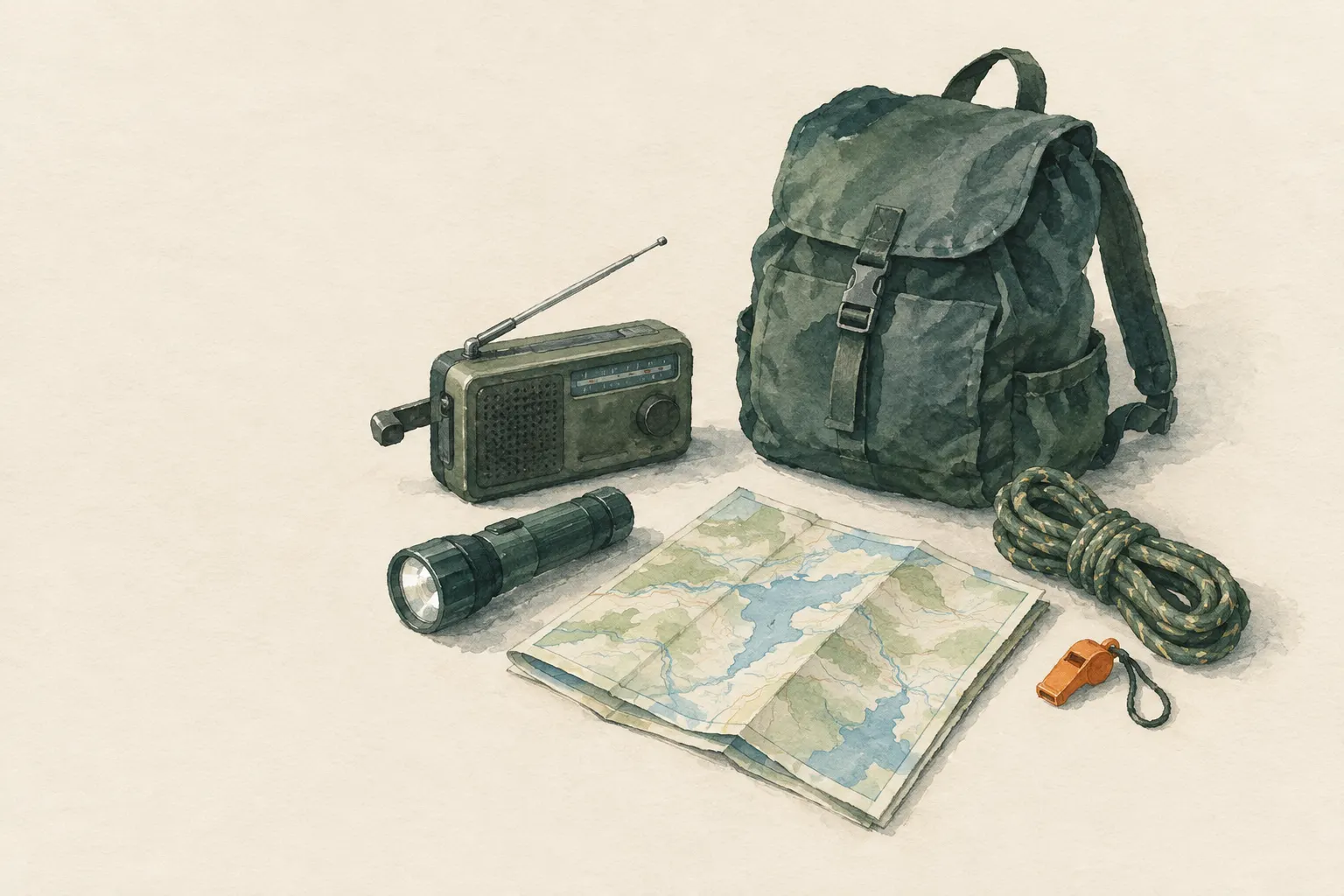
Explained simply
Imagine you are learning a song on the piano. If you play it only once, you will have forgotten it a week later. But if you play it for a few minutes every week, at some point you can almost play it in your sleep. Things for emergencies work the same way: what you have practised still works when you are nervous.
A practice routine means: about once a month you practise one small thing at home for ten to twenty minutes. For example: lights off – who finds the torch first? How do you tune the radio? Where is our meeting point if we get separated? What is the emergency number? It can be real fun if you make it a game.
The one thing that matters: practise in a way that puts no one in danger. So no real fire in the home and no risky climbing exercises. First aid is best learned in a proper course.
How it works
Stress changes how we think. The body releases stress hormones, the heart beats faster and attention narrows. Many people find it hard to take in new information in such moments – reading a plan for the first time often does not go well then. What you have already done several times, on the other hand, runs almost by itself.
Research on learning has long shown that spaced repetitions are remembered better than a single long session. Short exercises at intervals are therefore more effective than one big practice day a year. Each repetition refreshes the knowledge and makes the routine more familiar.
Practising has a second benefit: it reveals gaps. While practising you notice that the torch battery is flat, the grandparents' phone number has changed or the key for the back door is not hanging where everyone thought. You would rather find such faults on a quiet Sunday than in a real emergency.
What really matters
Starting small and keeping at it matters more than planning big. Write down five to ten skills that would matter for you in an emergency: making an emergency call, reaching the meeting point, finding the main water valve and breaker panel, tuning the radio, grabbing a light in the dark, finding the first-aid kit, tying a simple knot, reading a map. Each month you pick one of them.
Fixed occasions help you keep going. The clock change in spring and autumn is a good time to check batteries, supplies and water; the start of the school year to go through the family plan. Put the dates in the calendar as if they were doctor's appointments.
Practise under slightly harder conditions, but not dangerous ones: lights off and find the torch by feel, put the phone away and dial a number from paper, actually walk the route to the meeting point once. Afterwards debrief briefly: what worked, what was missing? Write down a single improvement and make it before the next exercise. One small improvement a month adds up to quite a lot over a year.
Safety: what to watch out for
An exercise must not endanger anyone. No open fire indoors, no camping stoves, grills or generators inside – not even “just to try it out”, because this can produce toxic carbon monoxide, which you can neither see nor smell. No abseiling or climbing exercises without training and suitable equipment.
First aid is best learned in a recognised course and refreshed regularly. The home routine can keep what you learned alive – for example: where is the first-aid kit? What is the emergency number (112 in the EU)? What information does the dispatcher need? But it does not replace a course.
Also think about the people involved: for small children or anxious people a sudden “alarm” can be unsettling. Announce exercises, explain why you practise and keep the mood calm and friendly. The goal is safety and confidence, not fear.
Practising with children
Children learn best through play. Who finds the torch in the dark first? Who can recite the address of our meeting point? Who knows which number to dial in an emergency? Short rounds, lots of praise and no pressure turn the exercise into something children even look forward to.
Give children real, age-appropriate tasks: a primary-school child can learn to say their own address and the emergency number. Older children can show where the main water valve is or tune the radio. Having a task makes people feel less helpless in an emergency.
Rotate roles: each person should take on each task once. If only one adult knows where the breaker panel is, and that very adult is not at home, the knowledge helps no one.
Good to know
Authorities such as Ready.gov explicitly recommend not only writing emergency plans down but discussing and practising them with the household. The guide of Germany's BBK also relies on prepared routines rather than improvisation. The reason is simple: a plan nobody knows is just a sheet of paper in an emergency.
The routine is deliberately small. Big, complex exercises usually never happen because something always gets in the way. Ten minutes a month, on the other hand, fit into almost any daily life. Perfection is not the goal – the goal is that important actions are not performed for the first time in a real emergency.
Adapt the list to your household. Someone living alone practises different things from a family with toddlers; someone in a flood area different things from someone in a city flat. For specialist skills such as first aid or using fire extinguishers, courses run by relief organisations or the fire service are a good addition.
Step by step
Choose the skills
List five to ten things that would matter in an emergency: making an emergency call, reaching the meeting point, finding shut-offs, tuning the radio, grabbing a light in the dark, finding the first-aid kit, tying a knot, using map and compass.
- 1
Choose the skills
List five to ten things that would matter in an emergency: making an emergency call, reaching the meeting point, finding shut-offs, tuning the radio, grabbing a light in the dark, finding the first-aid kit, tying a knot, using map and compass.
- 2
Set dates
Plan one short exercise per month. Fixed occasions help, such as the clock change for batteries and supplies or the start of the school year for the family plan.
- 3
Practise realistically
Practise under slightly harder conditions: lights off and find the torch, put the phone away and dial numbers from paper, actually walk the route to the meeting point once.
- 4
Debrief briefly
What did not work? What was missing? Note one improvement and implement it before the next exercise.
- 5
Rotate roles
Each person should take on each task once. If only one person knows where the main water valve is, that knowledge may not be available in an emergency.
Common mistakes
- Writing a plan once and never practising
- Exercises so big and complex they never happen
- Leaving children out
- Dangerous exercises without instruction
Quick view
Materials
Battery or crank radio
Check batteries regularly and keep spares.
Headlamp / flashlight
Paracord
For practising knots
Not a climbing or safety rope.
Suitable for
- Families and shared households
- People living alone who want to refresh their knowledge
- Groups who travel together
Not suitable for
- Dangerous exercises without instruction, e.g. fire indoors or first-aid measures without a course
Prerequisites
- A written household emergency plan
- Willingness of everyone to take part for a few minutes
Safety
- Choose exercises so that no one is put at risk: no open fire indoors, no generators or stoves inside, no risky abseiling or climbing exercises without training.
- First aid is best learned in a recognised course and refreshed regularly; this routine does not replace a course.
How it works
Under stress the ability to process new information drops. What has been practised several times beforehand runs more reliably. Short, repeated exercises in everyday situations make routines familiar and reveal gaps in the plan – such as a flat battery or an outdated phone number.
Advantages
- Costs almost nothing
- Reveals gaps in the plan
- Builds confidence and calm
Disadvantages
- Requires discipline
- Does not replace professional training
Deep knowledge
Background
Authorities such as Ready.gov explicitly recommend not only writing emergency plans but discussing and practising them with the household. The BBK guide also relies on prepared routines rather than improvisation in an emergency.
This routine is deliberately kept small. The goal is not perfection, but that basic routines are not carried out for the first time in a real emergency.
Variants
- With children
- Turn exercises into games: who finds the torch first? Who knows the address of the meeting point? Keep it short and give praise.
Common mistakes
- Writing a plan once and never practising
- Exercises so big and complex they never happen
- Leaving children out
- Dangerous exercises without instruction
Limits and risks
- No substitute for first-aid courses or professional training
- Content must be adapted to your own household
Material alternatives
Derived from material properties: a substitute must have all relevant properties. Observe the notes on the substitute.
- Headlamp / flashlight
- Mobile phone (The battery drains quickly in cold and with continuous screen and GPS use.), Battery lantern / LED light
- Paracord
- Rope (Never use unknown or damaged rope for life-safety purposes.)
Results come exclusively from structured entries. No improvised instructions are generated.
Sources
Ready.gov – U.S. Federal Emergency Management Agency (FEMA): Make A Plan
Discuss and practise the emergency plan
Bundesamt für Bevölkerungsschutz und Katastrophenhilfe (BBK), Deutschland: Ratgeber für Notfallvorsorge und richtiges Handeln in Notsituationen
Prepared household routines