Adjusting a tarp when the weather turns
Unlike a tent, a tarp can be reshaped at night: lower the ridgeline, pull the weather side to the ground, add guylines and re-tension. Choosing a basic pitch that is easy to adapt and acting early keeps you dry when wind and rain arrive. In storms or thunderstorms in exposed places, retreating matters more than any adjustment.
- About 5–15 minutes per adjustment
Explained simply
A tent has a fixed shape. A tarp, on the other hand, is like a large cloth that you can fold and stretch in new ways again and again. That is handy when the weather changes at night: if wind or rain arrives, you can pitch the tarp lower and steeper and pull the side the weather is coming from down to the ground – like a wall.
The lower and steeper the tarp hangs, the less the wind can get into it and the faster the rain runs off. The most important thing is to react early: at the first gusts or drops, not only when your sleeping bag is already wet. In the evening, put your lamp and spare cords where you can find them in the dark.
In a storm or thunderstorm in open, high places, even the best adjustment does not help. Then it is more important to move to a safer place. In forest during a storm, you must watch out for falling trees and branches.
How it works
Wind pushes on every surface it reaches. A tarp pitched high and flat offers it a lot of surface, much like an open umbrella that flips inside out in a gust. If you lower the ridgeline and set the sides steeper, the surface becomes smaller and the wind tends to slide over it. At the same time, rain runs off a steep surface faster.
Many tarp fabrics, especially nylon, stretch when they get wet and cold. A tarp that was taut in the evening can sag in the rain at night and start to flap or collect water. Polyester fabrics usually stretch less. Adjustable hitches and tensioners make up for this stretch without you having to pitch everything again.
Extra lines at the middle of the sides hold the fabric where it would otherwise flap most. Flapping is not only noisy; it also strains seams and grommets with every movement.
What really matters
Good preparation makes adjusting in the dark easy. Before sleeping, check the clouds, wind direction and forecast. Attach lines to the middle tie-outs already in the evening, have a few more stakes ready than you need and put your headlamp where you can find it blindly. Use tensioning hitches that you can release and tighten with cold fingers.
Choose a basic pitch that is easy to adapt in the first place. An A-frame or a lean-to on a ridgeline is easy to lower and close. You can even convert a lean-to into an A-frame by pulling the high side over the line and staking it out on the other side.
The order for adjusting: first lower the ridgeline or shorten the poles. Then stake the weather side down to the ground or fold one end in. After that, add extra lines and re-tension all hitches. In persistent rain, check now and then whether water is collecting or lines are slackening.
Safety: what to watch out for
In thunderstorms or storms in exposed terrain – on ridges, summits, open ground – retreating to a safer place matters more than any adjustment. A tarp does not protect against lightning, and poles or lines do not make it safer. A separate entry describes how to behave in thunderstorms.
In forest during a storm there is a danger of trees falling or branches breaking off. Already when pitching, look for dead branches and unhealthy trees above you; in strong wind a spot under tall trees is generally risky.
Adjusting at night in the rain costs warmth. Put on your rain jacket before going out and work quickly so that sleeping bag and sleep clothes stay dry. Anyone who cannot warm up afterwards, shivers heavily or is confused needs dry clothing, shelter and if necessary help via the local emergency number (112 in the EU).
How to practise it
Practise the adjustments in daylight and good weather before you need them at night. Pitch a tarp as a high lean-to and turn it step by step into a low, closed roof. Time how long it takes and note which lines you need first.
Then repeat it at dusk with a headlamp and with gloves on. That way you notice which hitches are hard to release and where lines are missing. A night with light rain forecast close to home is a good opportunity to try the whole thing in real conditions.
Good to know
Adaptability is considered one of the main advantages of tarps over tents. Many forms can be built from the same sheet – open and airy in fine weather, low and closed in wind and rain. You do not have to strike camp, only re-rig.
The price is that you sometimes have to get up at night, and a low pitch is more cramped. Many tarp users therefore get into the habit of pitching a little lower in the evening than the weather currently requires. Then there is less to do when the weather turns.
Step by step
Watch the weather
Before sleeping, check clouds, wind direction and forecast; arrange gear so it can be reached in the dark.
- 1
Watch the weather
Before sleeping, check clouds, wind direction and forecast; arrange gear so it can be reached in the dark.
- 2
React early
Act at the first gusts or drops, not only when the sleeping bag is wet.
- 3
Lower
Lower the ridgeline or shorten the poles; the surface becomes steeper and smaller.
- 4
Close the weather side
Stake the windward side down to the ground, fold one end in or switch to a closed form.
- 5
Add guylines
Add lines at the middle tie-outs and re-tension all hitches.
- 6
Check during the night
In rain, check occasionally whether water is collecting or lines are slackening.
Common mistakes
- Reacting too late
- No spare lines within reach
- Keeping a high open pitch in a storm
- Not re-tensioning a nylon tarp after rain
Quick view
Materials
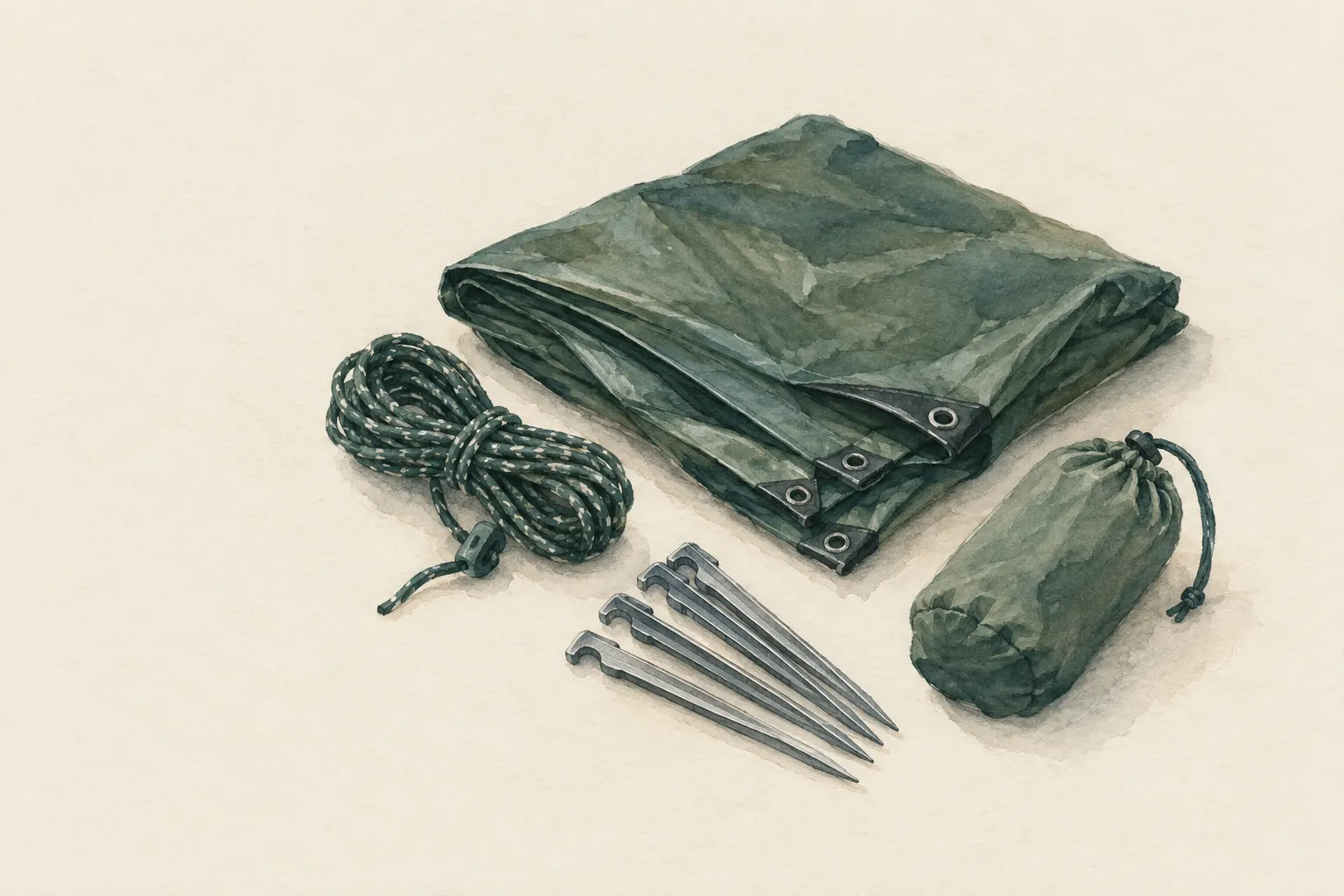
Tarp
Paracord
Extra lines within reach
Not a climbing or safety rope.
Tent stakes
A few more than needed
Headlamp / flashlight
Suitable for
- Changeable weather
- Multi-day tarp trips
Not suitable for
- Thunderstorms or storms on ridges and open ground
- Terrain without anchor points
Prerequisites
- A basic A-frame or lean-to pitch
- Tensioning hitches that can be adjusted
How it works
A lower, steeper pitch offers the wind less surface and lets rain run off faster. Many tarp fabrics, especially nylon, stretch when wet; adjustable hitches and tensioners compensate for this. Extra lines at the middle of the sides reduce flapping.
Advantages
- The tarp stays usable in many conditions
- No need to strike camp
Disadvantages
- Night-time job in cold and wet
- A lower pitch is more cramped
Deep knowledge
Background
Adaptability is considered one of the main advantages of tarps over tents. Bushcraft and survival literature describes many forms made from the same sheet.
Good preparation – lines already attached, adjustable hitches, lamp within reach – makes adjusting in the dark much easier.
Variants
- From lean-to to A-frame
- A lean-to on a ridgeline can be converted by pulling the high side over the line and staking it out on the other side.
Common mistakes
- Reacting too late
- No spare lines within reach
- Keeping a high open pitch in a storm
- Not re-tensioning a nylon tarp after rain
Limits and risks
- No wind speeds or load limits
- For thunderstorm behaviour see the separate entry
Material alternatives
Derived from material properties: a substitute must have all relevant properties. Observe the notes on the substitute.
- Tarp
- Plastic sheet / large bin bag (Tears easily; never pull over the head (suffocation risk).), Emergency blanket (Tears easily once punctured; short-term shelter only.), Document folder (waterproof) (Store securely – contains sensitive personal data.), Rain poncho (When used as a shelter, it no longer protects your body from rain.), Bivy bag (Never fully close off the face.), Tent (Do not cook or heat inside the tent (fire and carbon monoxide danger).), Heavy-duty bin bag (large) (Suffocation risk: never pull plastic bags over the head or face and keep them away from small children.), Group shelter bag (Airtight – ventilate regularly.)
- Paracord
- Rope (Never use unknown or damaged rope for life-safety purposes.)
- Tent stakes
- Sturdy sticks / poles (Do not cut live wood where prohibited.)
- Headlamp / flashlight
- Mobile phone (The battery drains quickly in cold and with continuous screen and GPS use.), Battery lantern / LED light
Results come exclusively from structured entries. No improvised instructions are generated.
Sources
Mors L. Kochanski – Lone Pine Publishing: Bushcraft: Outdoor Skills and Wilderness Survival
Sheet and tarp shelters, camp practice
Headquarters, Department of the Army (USA) (2002): FM 3-05.70 Survival
Principles of improvised shelters, site selection and shelter construction