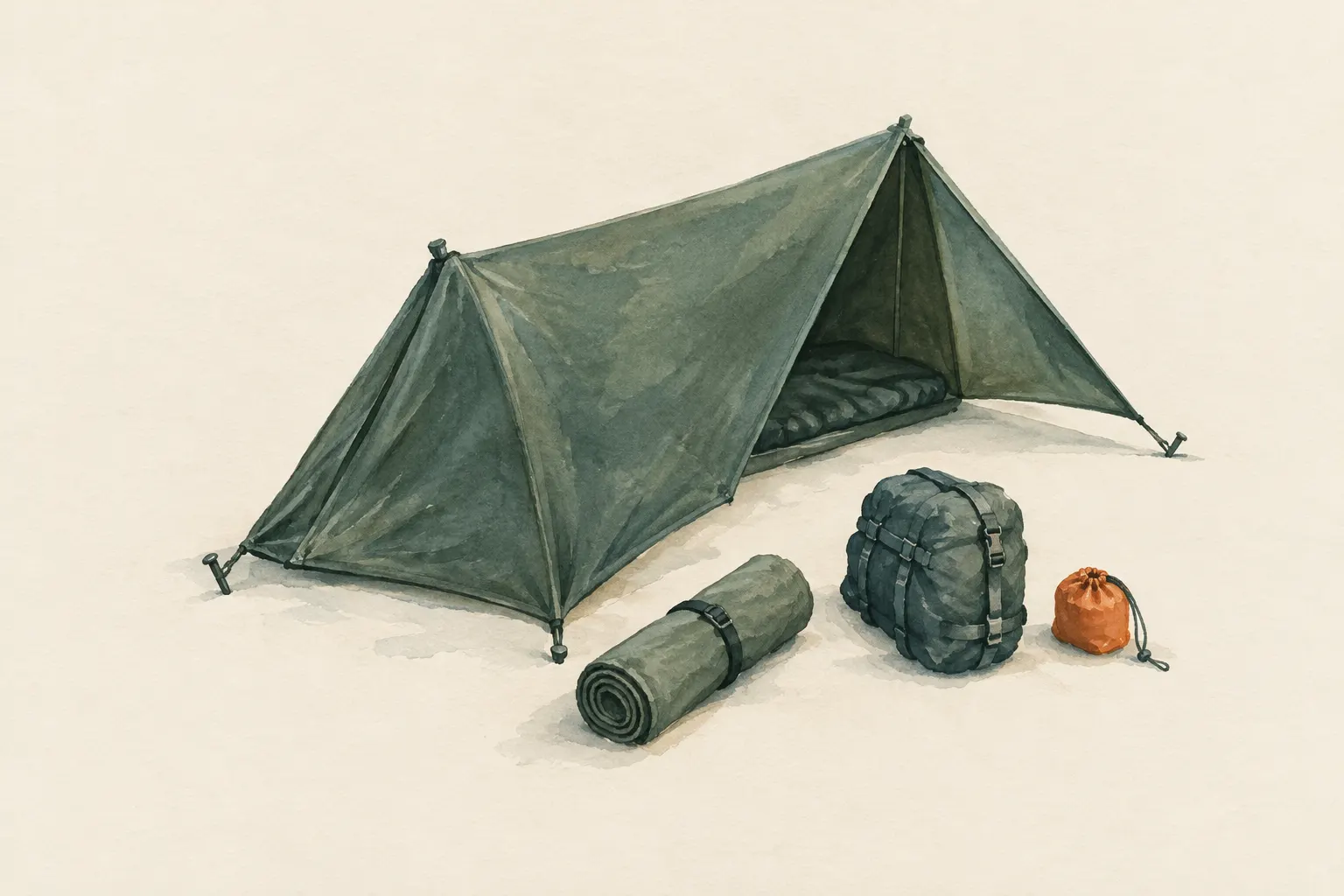
Tarp tent with a closed end
A variation of the A-frame in which one end of the tarp is folded in and staked so that the weather side is closed. The result resembles a small tent with an open entrance on the lee side. The pitch is shorter than a normal A-frame and takes some practice to fold.
- About 20–30 minutes with practice
Explained simply
A tarp is a large waterproof sheet with loops along the edge. If you stretch it like a roof over a line, you get a small tent with two open ends – like a tunnel. But wind whistles straight through such a tunnel, and slanting rain blows in.
With a closed-end tarp tent you fold one side of the sheet inwards and stake it to the ground. Then the end the weather comes from is shut – like a door you close behind you. Only the entrance on the side away from the wind stays open.
Most important: look up before you pitch. Dead trees and broken branches can fall. And always let some air in, otherwise it gets damp inside.
How it works
An open A-frame loses warmth at both ends because wind flows through and carries the warmed air away. If you close one side, wind can only enter from the front – and that is where the entrance is, on the side facing away from the wind, the so-called lee side. The air inside stays calmer, and you feel noticeably warmer even though the sheet itself does not insulate.
The end is closed by folding: the rear end of the tarp is folded into a triangle so that the two side panels meet at the back. The folded corners are fixed to the ground. The ridgeline drops towards the closed end, often right down to the ground. The result looks a little like a small tent.
The price: folding costs length, and because less air circulates, more condensation forms. That is moisture from your breath and body that settles on the cool sheet.
What really matters
The most important decision comes before the first stake: where are wind and rain coming from? That is exactly where the closed end has to point. If the tarp faces the wrong way, you have built a funnel that channels the weather straight to you. Watch treetops, grass or smoke to read the wind direction, and remember that the wind can shift during the night.
Check the length before you tighten everything. Lie inside as a test: if your feet or head stick out, the tarp is too small for this pitch, or the ridgeline needs to be a little higher. Very small tarps are therefore hardly suitable.
The folded corners are the weak point. If they are not secured properly, the wind tears them open and the shape collapses. Tension the corners first, then the midpoints of the sides. Even tension stops flapping and lets rain run off better.
Safety: what to watch out for
Always look up before you pitch. Dead trees and broken or hanging branches can fall without warning in wind or under snow and ice load. A thin sheet offers no protection at all against that.
Stoves, candles and fire do not belong under or directly next to the tarp. Synthetic sheets melt and burn quickly, and in a partly enclosed space carbon monoxide can collect – a gas you can neither see nor smell. Cook outside, at a distance.
The more closed the pitch, the more condensation. Leave the entrance or a vent open. And remember the rules: wild camping, bivouacking and collecting material are regulated very differently from region to region. Check local rules and leave the site without a trace.
When it makes sense – and when not
The closed end is worthwhile when wind and rain come from a fairly steady direction and you want more protection than an open A-frame without carrying a tent. For a night in changeable, cool weather it is a good solution.
But it is not a storm-worthy tent. In very strong wind any tarp pitch can reach its limits. Against mosquitoes it only helps with an additional net, and on warm, humid nights a more open pitch is more pleasant. Anyone trying the fold for the first time in the dark with cold hands often fails – then a simple A-frame is the better choice.
How to practise it
Practise the fold in good weather in the garden or at a permitted spot. First pitch a normal A-frame, then turn one end into the closed shape step by step. That way you understand which corner goes where.
Take notes or photos: which loops do you use, how high is the ridgeline, how many stakes do you need? Once you have pitched it a few times, it goes much faster even in the rain. A trial night close to home also shows you how much condensation forms with your tarp.
Step by step
Choose the weather side
Determine where wind and rain come from. That end will be closed.
- 1
Choose the weather side
Determine where wind and rain come from. That end will be closed.
- 2
Rig a low ridgeline
Rig a ridgeline or set up a pole at the entrance. Towards the closed end the ridge can drop to the ground.
- 3
Fold in the end
Fold the rear end of the tarp into a triangle so that the end is closed, and stake down the folded corners.
- 4
Stake the sides
Stake the sides taut and evenly; first the corners, then the midpoints.
- 5
Check the interior
Lie inside, check the length, keep ventilation at the entrance, re-tension after rain and wind.
Common mistakes
- Closed end not facing the weather
- Interior too short after folding
- Fully closed – heavy condensation
- Folded corners not secured; the wind tears them open
Quick view
Materials
Tarp
Square tarps are particularly suitable; many tie-outs help
Paracord
Not a climbing or safety rope.
Tent stakes
More stakes than for an A-frame
Trekking poles
Sleeping pad
Suitable for
- Wind and rain from one main direction
- Cold nights when open ends cost too much warmth
- More exposed spots above dense forest
Not suitable for
- Heat and mosquitoes without a net
- Very small tarps
- Beginners in the dark
Prerequisites
- Experience with the tarp A-frame
- A tarp with tie-out points along the edges
Safety
- The more closed the pitch, the more condensation. Leave the entrance or a vent open.
- Wild camping, bivouacking, collecting material and fires are regulated very differently from region to region. Check local rules, do not damage living trees and leave the site without a trace.
How it works
An open A-frame loses warmth at both ends and lets in driving rain. If one end is closed by folding the tarp in, only one opening remains on the lee side. Wind and rain protection improve considerably, but ventilation decreases.
Advantages
- Much better wind and rain protection than the open A-frame
- Only one tarp needed
- Warmer on cold nights
Disadvantages
- More condensation
- Less space
- More complex and error-prone
Deep knowledge
Background
Closed tarp pitches are described in outdoor literature under many names. What they have in common is that they close the weather side and so offer more protection without needing a tent.
This pitch is best practised in good weather: folding it correctly is hard with cold hands and in the dark.
Variants
- Half pyramid with pole
- One pole at the middle of the entrance edge, back edge to the ground: less room but very wind-stable.
Common mistakes
- Closed end not facing the weather
- Interior too short after folding
- Fully closed – heavy condensation
- Folded corners not secured; the wind tears them open
Limits and risks
- Not a substitute for a storm-worthy tent
- Insect protection only with an additional net
Material alternatives
Derived from material properties: a substitute must have all relevant properties. Observe the notes on the substitute.
- Tarp
- Plastic sheet / large bin bag (Tears easily; never pull over the head (suffocation risk).), Emergency blanket (Tears easily once punctured; short-term shelter only.), Document folder (waterproof) (Store securely – contains sensitive personal data.), Rain poncho (When used as a shelter, it no longer protects your body from rain.), Bivy bag (Never fully close off the face.), Tent (Do not cook or heat inside the tent (fire and carbon monoxide danger).), Heavy-duty bin bag (large) (Suffocation risk: never pull plastic bags over the head or face and keep them away from small children.), Group shelter bag (Airtight – ventilate regularly.)
- Paracord
- Rope (Never use unknown or damaged rope for life-safety purposes.)
- Tent stakes
- Sturdy sticks / poles (Do not cut live wood where prohibited.)
- Trekking poles
- Sturdy sticks / poles (Do not cut live wood where prohibited.), Tent pole repair sleeve (Temporary only – have broken sections replaced at home.)
- Sleeping pad
- Dry leaves, grass or conifer boughs (Collect only where allowed; no protected plants. Check for ticks and insects.), Backpack, Dry spare clothing (Carry it in waterproof packaging – wet clothing barely insulates.), Wool blanket / duvet (Keep away from candles, stoves and heaters.), Insulated cool box (Keeps cold only for a limited time; without ice packs or ice it is not a fridge.), Sleeping bag (Do not store compressed long-term; do not pack away damp.), Newspaper and cardboard (Flammable – keep away from candles, stoves, heaters and embers.), Insulated cooking box (hay box, thermal cooker) (Never put open flame or embers inside – only the hot, closed pot.)
Results come exclusively from structured entries. No improvised instructions are generated.
Sources
Headquarters, Department of the Army (USA) (2002): FM 3-05.70 Survival
Principles of improvised shelters, site selection and shelter construction
Wilderness & Environmental Medicine (Wilderness Medical Society) (2019): Wilderness Medical Society Clinical Practice Guidelines for the Out-of-Hospital Evaluation and Treatment of Accidental Hypothermia: 2019 Update
Wind, wet and ground contact as factors in hypothermia