Being seen in the dark: reflectors, hi-vis vest, light
On foot or by bike on country roads, after a breakdown or walking through a dark city during a power cut: if you are not seen, you are in danger. Fluorescent colours work in daylight and dusk, reflectors only when light falls on them (e.g. headlights), your own lights always. Combining all three is best.
- Equip once
Explained simply
When you walk along a road in the dark, a driver often sees you very late – especially if you wear dark clothes. To them you are almost invisible. That is why there are three helpers that make you visible: fluorescent colours, reflectors and your own light.
Fluorescent colours like neon yellow or neon orange stand out especially in daylight and dusk. Reflectors work like a mirror that sends light back exactly where it came from – back to the driver when their headlights shine on you. A lamp makes you visible even when no light falls on you at all. It is best to use all three together.
But careful: even with a hi-vis vest, being on the carriageway is life-threatening. After a car breakdown, wait behind the crash barrier or well away from the road if you can.
How it works
Fluorescent colours have a special trick: they take in invisible UV light from daylight and give it off again as visible light. That is why they look brighter than normal colours and seem to glow in daylight and at dusk. In complete darkness, with no light falling on them, they help very little.
Reflectors work differently. A normal mirror throws light off at an angle, depending on how you hold it. A retroreflector, by contrast, sends light back almost exactly where it came from – using many tiny glass beads or prisms. For a driver this means: the light from their headlights comes back from your vest straight to their eyes, and you light up brightly.
Your own light is the only thing that always works, even when no headlight is pointing at you. Someone carrying a lamp is also seen by people who have no light themselves, such as other pedestrians during a power cut.
What really matters
Combine the three helpers: fluorescent colour for daylight and dusk, reflectors for night when vehicles come, and your own lamp for every situation. Do not rely on reflectors alone where there are no headlights, for example on farm tracks or during a power cut in town.
Reflectors on parts that move are particularly effective. Reflective bands on ankles and wrists show a typical walking motion that helps drivers recognise more quickly that this is a person and not a post or sign.
On roads without a pavement, walk as local rules require – in many places facing oncoming traffic, so that you see vehicles coming. In a group, walk in single file at the edge, and at least someone at the front and someone at the back carries a light. Whether and how this is regulated differs by country – check local rules.
Safety: after a breakdown
A hi-vis vest makes you more visible, but it does not protect you from an impact. Being on the carriageway or right next to it remains life-threatening. After a breakdown, the most important thing is therefore to reach a safe place quickly: behind the crash barrier or well away from the road.
Keep the vest within reach inside the vehicle, not in the boot. Put it on while still in the car and then, if possible, get out on the side away from traffic. Do not stay sitting on the hard shoulder next to the traffic.
From your safe spot, call the breakdown service or, if people are in danger, the local emergency number (112 in the EU). Whether hi-vis vests must be carried in vehicles, and how many, is set by each country – check the rules, especially before driving abroad.
Typical situations
The way to school in winter: in the morning and afternoon it is often dim or dark. A bright jacket, reflectors on the school bag and reflective bands on arms or legs make children visible to drivers much earlier. Older people benefit in just the same way.
Power cut in town: when street lights and traffic lights fail, it is suddenly very dark and drivers are unsure. A small lamp and reflectors on your clothing help you be seen on the way home or to a help point.
In the field during a search: reflective elements on jacket and pack can help searchers with lamps spot you at night. The principle is the same as in road traffic: if you want to be seen, you need contrast and light.
Gear and care
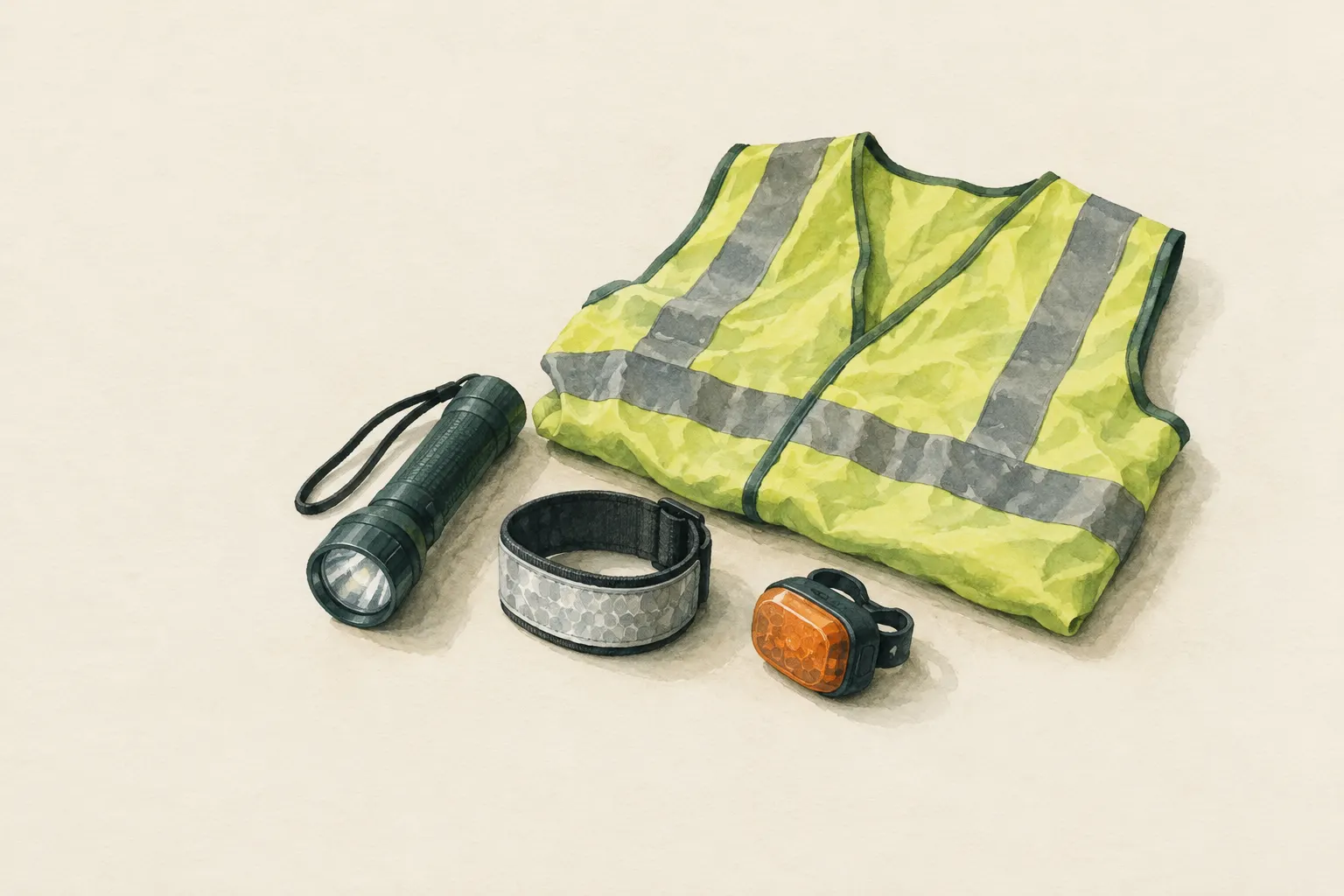
The basic kit is cheap and light: a hi-vis vest in the car, reflective bands and a small lamp in your jacket or pack. Many jackets, packs and shoes already have reflective strips; look out for them when buying.
Reflective material wears out over time. Frequent washing, abrasion and dirt can reduce its effect. Check your vest and bands now and then: do they still light up brightly when you shine a torch on them in the dark from eye level? If not, replace them.
A simple test for the whole family: one evening, take turns standing by a dark path in different clothing while someone shines a lamp from some distance away. You will see how big the difference is between dark clothing and reflectors.
Step by step
Equip
Hi-vis vest in the car within reach (not in the boot), reflective bands and a small lamp in your jacket or pack.
- 1
Equip
Hi-vis vest in the car within reach (not in the boot), reflective bands and a small lamp in your jacket or pack.
- 2
Put it on before getting out
After a breakdown, put the vest on inside the vehicle, then get out on the side away from traffic if possible.
- 3
Reflectors on moving parts
Reflective bands on ankles and wrists make movement recognisable.
- 4
Walk sensibly
On roads without a pavement, walk as local rules require – in many places facing oncoming traffic – in single file and at the edge.
- 5
Your own light
Switch on your lamp when vehicles approach; in a group, at least one light at the front and one at the back.
Common mistakes
- Dark clothing at dusk
- Vest in the boot
- Relying on reflectors without your own lamp where there are no headlights
- Staying seated on the hard shoulder next to traffic
Quick view
Materials
High-visibility vest
Keep within reach inside the cabin, not in the boot/trunk.
Headlamp / flashlight
Suitable for
- Walking on roads without a pavement
- Vehicle breakdown
- Power cut in town
- Children walking to school in winter
Not suitable for
- As a substitute for a safe place behind the crash barrier or off the carriageway
Prerequisites
- A hi-vis vest or reflective items to hand
Safety
- Whether hi-vis vests must be carried in vehicles and how pedestrians should walk on country roads is set by each country – check local rules.
How it works
Fluorescent colours convert invisible UV light into visible light, which is why they stand out especially in daylight and dusk. Retroreflectors send light back towards its source – that is, to the driver behind the headlights. Your own lights make you visible even when no light falls on you. Moving reflectors on arms and legs also show that you are a person.
Advantages
- Cheap and light
- Works without power (reflectors)
- Also protects children and older people
Disadvantages
- Reflectors need a light source
- Material wears out and loses effect
Deep knowledge
Background
Traffic codes such as the UK Highway Code advise pedestrians to wear light-coloured or fluorescent clothing in daylight and poor light and reflective materials in the dark.
The same principles apply away from traffic: if you want to be seen during a power cut or in a search, you need contrast and light.
Variants
- In a search in the field
- Reflective elements on clothing and pack can help searchers with lamps spot you at night.
Common mistakes
- Dark clothing at dusk
- Vest in the boot
- Relying on reflectors without your own lamp where there are no headlights
- Staying seated on the hard shoulder next to traffic
Limits and risks
- No standard values for reflection classes
- No binding traffic rules for individual countries
Material alternatives
Derived from material properties: a substitute must have all relevant properties. Observe the notes on the substitute.
- High-visibility vest
- Emergency blanket (Tears easily once punctured; short-term shelter only.), Signal mirror (Do not flash into the eyes of people nearby or of drivers.), Warning triangle (Whether warning triangles are mandatory, or should be placed at all on certain roads (e.g. motorways), differs between countries – check local rules.), Aluminium foil (heavy-duty) (Edges can be sharp; conducts heat and electricity.)
- Headlamp / flashlight
- Mobile phone (The battery drains quickly in cold and with continuous screen and GPS use.), Battery lantern / LED light
Results come exclusively from structured entries. No improvised instructions are generated.
Sources
Department for Transport and Driver and Vehicle Standards Agency (United Kingdom): The Highway Code
Light, fluorescent and reflective clothing for pedestrians; walking on roads without a pavement
European Commission: 112 – the European emergency number
Europe-wide emergency number 112