Solving wildlife problems legally
Martens in the roof, raccoons at the bin, wild boar in the garden or mice in the cellar: most conflicts can be solved without traps by removing food and access. Where that is not enough, the wildlife authority, the holder of hunting rights or licensed professionals are responsible – in many countries only they may catch or relocate wild animals. For house mice and rats separate rules apply: follow local guidance and manufacturer instructions, and if in doubt hire a pest controller.
- A few hours to days, depending on the problem
Explained simply
Wild animals come to your house because they find something there: food from the bin, cat food on the patio, fallen fruit in the garden or a warm hiding place under the roof. It is like a restaurant – as long as it is open, guests come. If you close the “restaurant”, the animals usually move on by themselves.
Simply catching an animal and taking it somewhere else often does little good: as long as the food and the hiding place are still there, the next animal soon arrives. Also, in many countries only professionals or authorities may catch or relocate wild animals. For mice and rats in the house, separate rules apply – if in doubt, a pest controller can help.
Two things are especially important: never close a hole while an animal could still be inside – young animals in particular would be shut in and die. And never approach wild boar, especially not a mother with young. If there is danger, go indoors and call the police or the responsible authority.
How it works: removing attractions, not animals
Every wild animal looks for three things: food, water and a safe shelter. A property that conveniently offers one of these gets regular visits. Foxes and raccoons quickly learn which bin can be opened; martens find warm, quiet attics; wild boar dig up lawns when larvae and worms live underneath.
If an animal is removed but the attraction remains, the spot is soon taken again – often by an animal from the neighbourhood that uses the vacancy. That is why prevention is the first step in wildlife management in many countries: removing food and access solves the problem at the root and permanently.
Interventions in wildlife populations – catching, relocating or killing – are, by contrast, the task of those authorised. They must bring together hunting law, conservation, animal welfare and the local situation. This is not just a legal question: catching and relocating are costly, very stressful for the animals and do not solve the problem without prevention.
What really matters: looking closely
Before you do anything, find out who you are dealing with. What signs, damage or noises are there, and at what time? Scratching at night under the roof, knocked-over bins, dug-up lawn or droppings at certain spots give clues. Photos, a wildlife camera in your own garden or a smoothed sand plot help you identify the animal without disturbing it.
Then you remove the food: close or secure bins, do not leave pet food outside, no food scraps on the compost, collect fallen fruit and set up bird feeders so nothing falls to the ground. Spilled bird food attracts mice and rats. Often that alone is enough.
Next comes access. Climbing aids on the façade such as trellises or nearby branches can make it easier for animals to reach the roof; cellar and ventilation openings can be secured with grilles. But only have occupied openings closed once professionals have confirmed that no animal remains inside.
Safety: what to watch out for
Trapped animals: anyone who closes a hole in the roof or house wall while an animal or a nest with young is behind it shuts them in. The animals die miserably, and the young can no longer be cared for. Special protection rules often apply during the breeding season. Bats and birds also use building openings and are strictly protected in many places.
Poison: poison does not distinguish between animals. It can harm children, pets and birds of prey that eat poisoned rodents. Many rodenticides are reserved for professionals or available only with restrictions in many countries. If at all, then only per manufacturer instructions and local rules, and always out of reach of children and animals – it is best left to professionals.
Large animals and hygiene: do not approach wild boar, especially sows with piglets, and do not corner them; if there is danger, go indoors and contact the authority or police, and in acute danger the local emergency number (112 in the EU). Droppings and nests of rodents and wildlife can contain pathogens: wear gloves, clean damp instead of sweeping, follow local health guidance.
Who can help?
For wildlife, depending on the country, wildlife, hunting or conservation authorities are responsible, as well as the holders of hunting rights in the area and licensed professionals. Many municipalities have contact people or leaflets on typical conflicts such as martens or raccoons. A call to the local council is often a good start if you do not know who is responsible.
For house mice and rats, pest controllers are usually responsible, in some cases also health or public-order offices. Anyone acting themselves chooses humane, approved products according to local guidance, follows the manufacturer's instructions exactly and keeps children and pets away. Glue traps are not an option.
Tenants agree measures on the building with their landlord. For martens in cars, a garage can advise; after a marten visit, have the engine compartment cleaned, because scent marks can attract further animals.
Typical mistakes
The most common mistake is to feed animals first – often unknowingly, through open bins or cat food – and then be surprised by visitors. A second is to catch an animal yourself and release it somewhere. That is prohibited in many countries, often fatal for the animal and does not solve the problem.
Just as wrong: putting out poison openly, using glue traps or sealing openings without knowing whether anyone is still inside. Patience pays off here. Many conflicts resolve within a few weeks once the attractions consistently disappear.
Step by step
Observe the problem
What signs, damage, noises, at what time? Photos, a wildlife camera in your own garden or a tracking plot help narrow down the cause.
- 1
Observe the problem
What signs, damage, noises, at what time? Photos, a wildlife camera in your own garden or a tracking plot help narrow down the cause.
- 2
Remove food
Close or secure bins, do not leave pet food outside, no food scraps in the compost, collect fallen fruit, set up bird feeders so nothing falls to the ground.
- 3
Secure access – properly
Remove climbing aids on façades, fit grilles to cellar and ventilation openings. Only have occupied openings closed once professionals have confirmed no animal is inside.
- 4
Ask the responsible people
For wildlife: wildlife, hunting or conservation authority, the holder of hunting rights or licensed professionals. For house mice and rats: pest controllers or the health/public order office according to local rules.
- 5
Rodents in the house
Store food sealed, seal holes, keep things tidy. Anyone acting themselves chooses humane, approved products according to local guidance, follows the manufacturer's instructions exactly and keeps children and pets away. No glue traps.
Common mistakes
- Catching wild animals yourself and releasing them elsewhere
- Sealing openings with animals inside
- Putting out poison openly
- Feeding animals and then being surprised by visits
- Using glue traps
Quick view
Materials
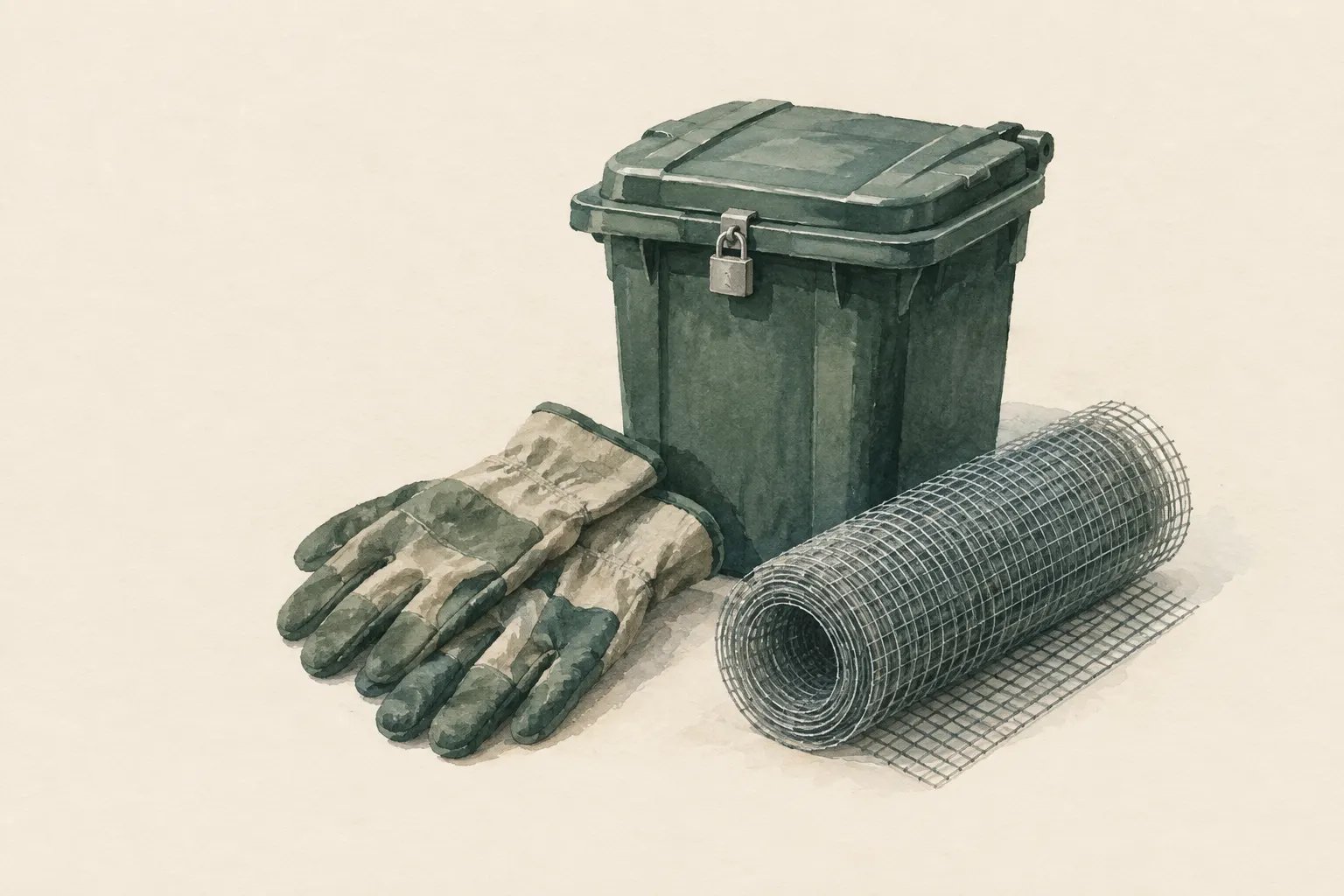
Airtight food-grade storage container
Store supplies and pet food sealed
Fill only when clean and completely dry; never use containers that previously held chemicals.
Disposable gloves
When removing droppings
Consider latex allergies – prefer latex-free gloves (e.g. nitrile).
Suitable for
- Home and garden owners
- Tenants (in agreement with the landlord)
- Shared housing
Not suitable for
- Catching, poisoning or relocating wild animals on your own
- Acute danger from large animals – then call police or the local emergency number
Prerequisites
- Observation: which animal, where, when?
- Contact details of the responsible authority or a professional
Safety
- Do not approach wild boar, especially sows with piglets, and do not corner them. If there is danger, go indoors and contact the authority or police.
- Droppings and nests of rodents and wild animals can contain pathogens. Wear gloves when cleaning, do not stir up dust (clean damp) and follow local health guidance.
How it works
Wild animals come because they find something: food, water, shelter. Removing these attractions makes properties unattractive – more sustainably than any trapping, because a removed animal is often replaced by another as long as the attraction remains. Interventions in wildlife populations are the task of those authorised, because they must bring together law, animal welfare and wildlife management.
Advantages
- Legal and humane
- Solves the cause rather than removing one animal
- Protects children and pets
Disadvantages
- May require patience and costs
- Responsibilities differ by region
Deep knowledge
Background
In many countries wildlife management relies first on prevention: removing food sources and shelter avoids conflicts permanently. Capture and relocation, by contrast, are costly, stressful for the animals and legally very restricted.
Different rules apply to house rodents than to wildlife; here too the view is spreading that glue traps and unnecessary suffering should be avoided. Local health and animal welfare regulations are decisive.
Variants
- Martens in the car
- Various deterrents against marten damage to cars are sold commercially; a garage can advise. Have the engine compartment cleaned after a marten visit, as scent marks may attract further animals.
Common mistakes
- Catching wild animals yourself and releasing them elsewhere
- Sealing openings with animals inside
- Putting out poison openly
- Feeding animals and then being surprised by visits
- Using glue traps
Limits and risks
- No trapping or baiting instructions
- No legal advice – check local rules
Material alternatives
Derived from material properties: a substitute must have all relevant properties. Observe the notes on the substitute.
- Airtight food-grade storage container
- Single-wall stainless steel bottle (Heat only single-wall bottles without paint/plastic; remove the lid before heating.), Double-wall insulated bottle (Never heat directly.), PET bottle (clear, max. 2 litres) (Do not heat or place in a fire.), Food-grade water container (Only use containers that never held chemicals or fuel.), Collapsible water container or bag (Protect from sharp objects.), Food-grade water bag (Use only for drinking water, never for chemicals or fuel.), Fermentation jar or crock (Use only food-grade containers of glass, food-safe glazed stoneware or food-grade plastic – no metal containers for acidic food.), Resealable food bags (Use only bags intended for food; do not use with boiling water unless the manufacturer explicitly allows it.)
Results come exclusively from structured entries. No improvised instructions are generated.
Sources
Leave No Trace Center for Outdoor Ethics: The Seven Principles of Leave No Trace (Principle 5: Minimize Campfire Impacts)
Do not feed wildlife, secure food and waste
Council of the European Communities (1992): Council Directive 92/43/EEC on the conservation of natural habitats and of wild fauna and flora (Habitats Directive)
Protection of certain species from capture and disturbance