A sand tracking plot in your own garden
A smoothly raked strip of fine sand or damp soil at a hedge, a gap under a fence or along a garden path shows in the morning who passed by at night. The plot holds nothing, does not lure with food and does not disturb the animals – it only makes their prints visible. Ideal for practising trail patterns, track ageing and plaster casting.
- 20 minutes to set up, 5 minutes daily
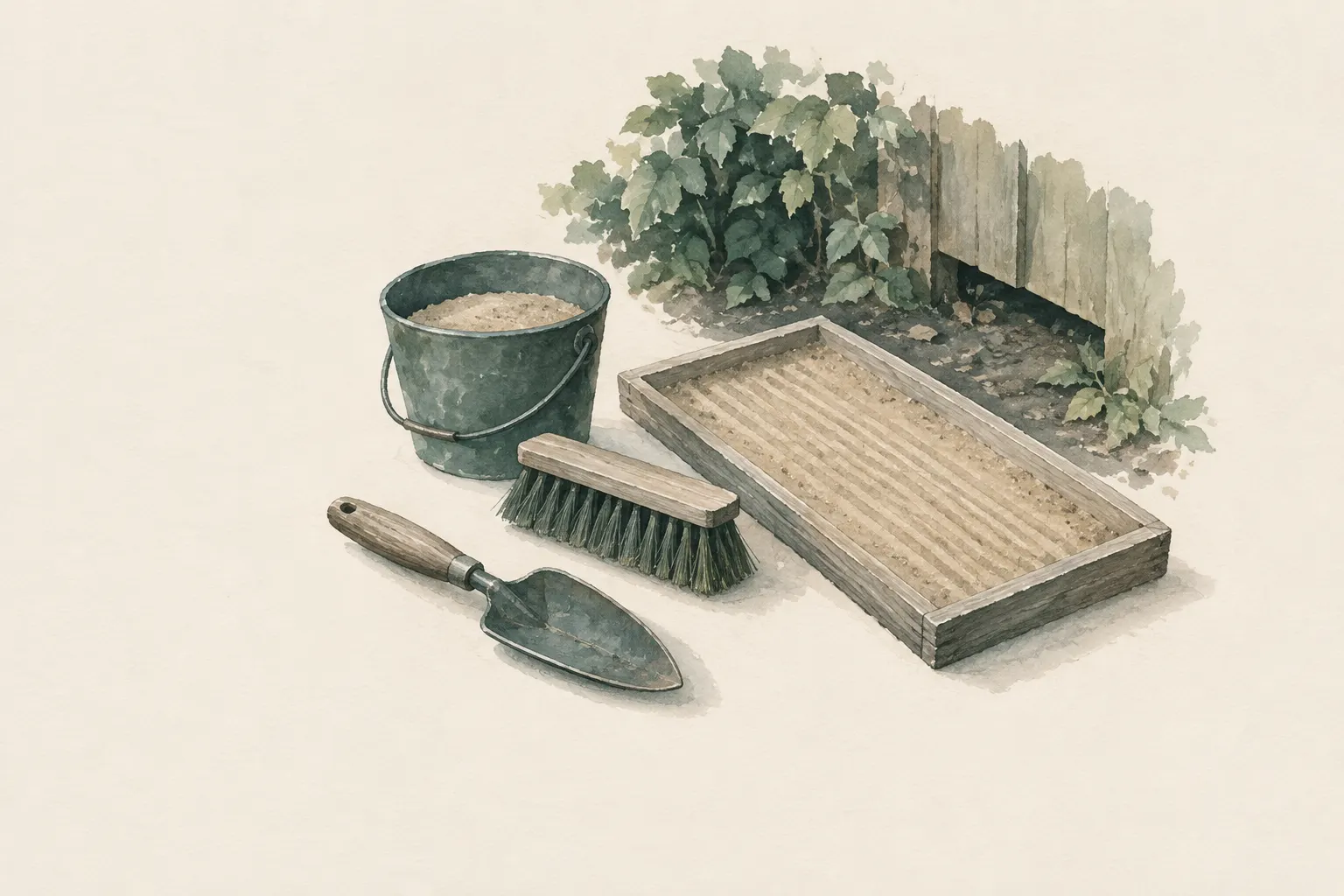
Explained simply
Imagine a blank sheet of white paper. Anyone who walks across it leaves a print. A tracking plot is exactly that kind of “blank sheet” – only made of fine, slightly damp sand or soil. You lay it in the garden at a spot animals pass anyway and smooth it in the evening.
The next morning you check: who walked across it during the night? Maybe a cat, a hedgehog, a bird or even a fox. Because you know when you smoothed the plot, you also know that all the tracks come from that night.
The plot is not a trap: it holds no animal and lures none with food. It only makes visible who is out and about anyway. After playing and exploring, wash your hands, and do not use the sand as a play sandpit any more.
How it works
Normal garden soil is usually too hard, too dry or too overgrown to show tracks. Lawn springs back, soil with small stones shows hardly any detail. A strip of fine, even material, by contrast, works like a blank sheet: every step leaves a clear print, with toes, pads and sometimes claws.
The big advantage over tracks in the wild is that you know the time. If you smoothed the plot at 8 pm, every track in the morning is at most that old. This is called the maximum age of a track. It also makes the plot a good place to practise how prints age and what trail patterns of different animals look like.
The plot does not change the animals' behaviour. There is no food, no scent and nothing that could hold an animal. Prepared strips of sand or soil are therefore a method used in tracking courses and nature education to make animal movements visible without capture or disturbance.
How to set it up
Choose a narrow spot that animals pass anyway: a gap under the fence, an opening in the hedge or the edge of a flower bed. Animals like to use the same routes. If you have already seen tracks, flattened grass or a small path somewhere, that is a good place.
Lay a strip there about one stride wide, of fine sand or sieved soil, a few centimetres thick. Moisten it slightly – damp sand holds the shape of a print much better than dry sand, which trickles together at once. Sand that is too coarse shows hardly any detail.
In the evening, smooth the strip with a board or rake and note the time. In the morning, check it, ideally in low light: early in the morning when the sun is low, or with a torch held to the side. The small shadows make the prints stand out clearly. Then photograph, work out the pattern, take notes and smooth the plot again.
Safety and hygiene
Sand that animals have walked on can contain germs or parasite eggs. So do not use it as a sandpit for children. After working on the plot, wash your hands thoroughly, especially before eating anything.
Cats like to use loose sand as a toilet. If you find droppings in the plot, remove them only with gloves or a shovel, never with bare hands. If this happens often, a different spot or slightly damper, firmer soil instead of sand may help.
And very important: do not put out food or scents to attract animals. That changes their behaviour, can spread disease and goes against the principle of not feeding wildlife. The plot is meant to show what happens anyway.
When it makes sense – and when not
A tracking plot is ideal for families and children. It costs almost nothing, needs no electronics and delivers a small surprise every morning. It is excellent for practising trail patterns, watching tracks age or making a plaster cast. Together with a wildlife camera you can even check which animal left which print.
Only lay the plot on your own land or with the owner's consent, not on public land and not in protected areas. Rain blurs the tracks, and at spots animals avoid you will of course find nothing.
After fresh snow you do not need a plot at all: then the whole garden is a tracking plot. Shortly after the snowfall, all tracks are younger than the snow – a perfect moment to practise.
Good to know
Over weeks a picture emerges of which animals use your garden and when. Perhaps a hedgehog always comes after midnight, perhaps some tracks disappear completely in winter. Write your finds in a tracking journal – that way single morning discoveries turn into real observations.
Identifying individual species remains demanding all the same. Cats and small dogs, or different birds, can look alike. A regional field guide helps, and it is perfectly fine to note a find as “uncertain”.
Step by step
Choose the spot
A narrow spot that animals already pass: gap under a fence, opening in a hedge, edge of a flower bed.
- 1
Choose the spot
A narrow spot that animals already pass: gap under a fence, opening in a hedge, edge of a flower bed.
- 2
Lay the strip
Lay a strip about one stride wide of fine sand or sieved soil a few centimetres thick and moisten it lightly.
- 3
Smooth
In the evening smooth it with a board or rake and note the time.
- 4
Read in the morning
In low light (early morning or with a torch from the side) prints stand out clearly. Photograph, work out the pattern, take notes.
- 5
Reset
Smooth again after evaluating. Over weeks a picture emerges of which animals use the garden and when.
Common mistakes
- Putting out food to attract animals
- Using sand that is too coarse or too dry
- Not noting the smoothing time
- Placing the strip where animals avoid going
Quick view
Materials
Clean sand
Fine, slightly damp sand
Improvised sand layers do not reliably remove pathogens.
Field notebook and pencil
Mobile phone
Photos in the morning
The battery drains quickly in cold and with continuous screen and GPS use.
Do not plan on it as your only means of navigation or emergency calls.
Suitable for
- Families and children
- Practising trail patterns and track age
- Complement to a wildlife camera
Not suitable for
- Public land and protected areas
- Luring animals with food or scents
Prerequisites
- Your own garden or the owner's consent
- A spot animals already pass
Safety
- Do not use sand that animals have walked on as a children's sandpit; wash hands after working. Remove any droppings only with gloves or a shovel.
How it works
Garden soil is usually too hard or overgrown to show tracks. A strip of fine, even material works like a blank sheet of paper: every step leaves a clear print. Because you know when the plot was smoothed, you also know the maximum age of every track.
Advantages
- Very cheap, no electronics
- Does not disturb animals
- Known maximum age of tracks
Disadvantages
- Rain blurs tracks
- Cats like to use sand as a toilet
Deep knowledge
Background
Prepared strips of sand or soil are a simple method used in tracking courses and nature education to make animal movements visible without capture or disturbance.
The plot is an observation tool, not a trap: it holds no animal and lures none.
Variants
- Fresh snow
- After fresh snow the whole garden is a tracking plot. Shortly after snowfall, all tracks are younger than the snow.
Common mistakes
- Putting out food to attract animals
- Using sand that is too coarse or too dry
- Not noting the smoothing time
- Placing the strip where animals avoid going
Limits and risks
- Only on your own or permitted land
- Identification remains demanding
Material alternatives
Derived from material properties: a substitute must have all relevant properties. Observe the notes on the substitute.
- Mobile phone
- Headlamp / flashlight, Battery lantern / LED light
Results come exclusively from structured entries. No improvised instructions are generated.
Sources
Leave No Trace Center for Outdoor Ethics: The Seven Principles of Leave No Trace (Principle 5: Minimize Campfire Impacts)
Do not feed or disturb wildlife