Keeping a tracking journal and reporting observations
A tracking journal turns single finds into knowledge: date, place, weather, substrate, sketch or photo, measurements with a size reference and a cautious interpretation. Over months, patterns emerge. Good observations can also be reported to citizen science projects or monitoring bodies – making them useful for conservation and wildlife management.
- 5–10 minutes per find
Explained simply
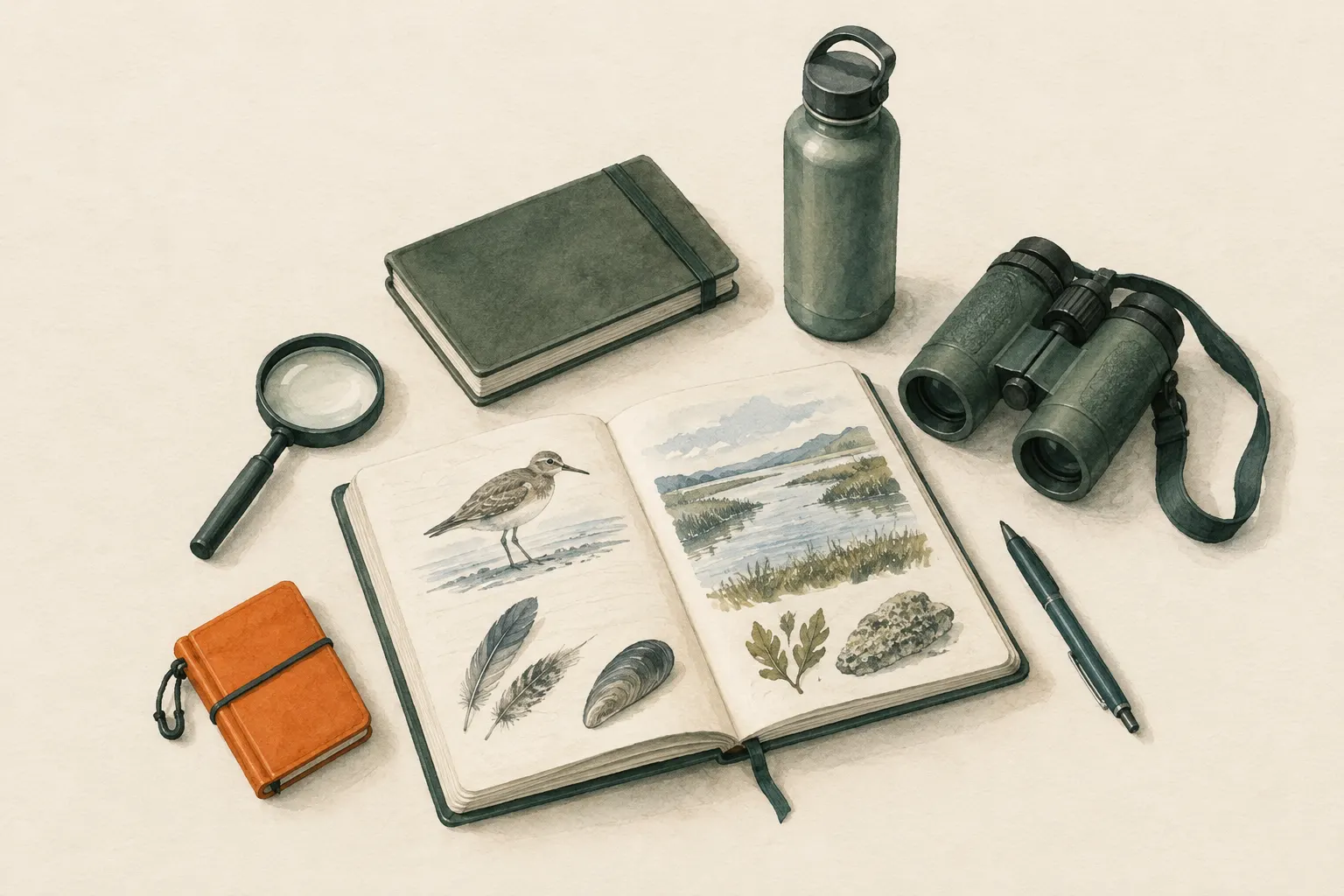
Our memory is sometimes like a sieve: a lot slips through. After a few weeks you no longer know exactly where you found the track, how big it was or whether it had rained before. A tracking journal records all that – like a researcher who writes everything down in a notebook.
For every find you note the same things: date, place, weather, what the ground was like, a sketch or a photo with an object for size comparison. Then you write down separately what you actually see (“four toes, claws visible”) and what you suspect (“maybe a dog”).
Over time you recognise patterns you would otherwise have missed. And some observations you can even report to conservation projects and so help research. There is just one thing you never share publicly: exact locations of nests, dens or rare animals.
How it works
Memory deceives, notes do not. Recording the same details for every find allows you to compare later: when do certain tracks appear? How do they age on which ground? Where do trails run? Over time, many single entries turn into real knowledge about an area.
The most important principle is separating observation from interpretation. An observation only describes what can be seen: “four toe prints, claws visible, seven centimetres long”. An interpretation is your guess: “probably a dog”. Anyone who mixes the two often writes down a species after a quick glance and then overlooks features that do not fit.
This separation trains careful looking. It has another advantage too: if you later realise your interpretation was wrong, the observation is still usable. You can check it again with new knowledge.
What really matters
For every find, first note the basic data: date, time, place as a place name or coordinates, the weather of the last few days and the substrate – mud, sand, snow, clay. These details sound boring, but are often decisive later, for example for estimating a track's age.
Then describe the observation as precisely as possible: number of toes, claws yes or no, shape, length and width, distance between prints and the trail pattern. Take a photo from directly above with a scale, or make a sketch. Drawing forces you to look closely – even simple outline sketches with measurements are often more valuable than many blurry photos.
Finally, write down your guess separately and how sure you are. Mark uncertain finds as uncertain. When you compare with a regional tracking guide at home or ask experts, add corrections to the journal instead of overwriting the old entry. That way it stays visible how you have learned.
Reporting observations
Many regions have monitoring programmes or citizen science platforms for wildlife observations. Citizen science means that volunteers collect data that helps researchers and conservationists. Modern monitoring programmes – such as snow track counts or camera projects – often rely partly on such observations.
For large predators, dedicated reporting bodies are often responsible. You can find out which bodies and platforms exist in your area from the conservation or wildlife authority. This entry deliberately names no specific platforms, because they differ by region.
Data quality matters. An observation honestly marked as “uncertain” is far more valuable than a wrong identification reported as certain. Photos with a scale and accurate basic data make your report checkable for experts.
Safety: what to watch out for
Do not share exact locations of nests, dens or rare species publicly – not on social media, in forums or in photos with stored location data. Such details can lead to many people going there and disturbing the animals, to poaching, or to eggs and plants being collected. Report such finds only to the responsible bodies.
Remember that many phone photos store the location automatically. Before sharing a photo, check whether it reveals the exact spot. For your private journal, on the other hand, the location is very useful.
And of course the usual rules apply when collecting observations: stay on the paths, do not follow fresh tracks of large animals, do not touch anything that can transmit disease.
Good to know
Field notebooks have been the basic tool of naturalists for centuries. Many well-known discoveries began with modest notes on weather, places and observations. A tracking journal stands in exactly this tradition.
For families and school classes the journal is a lovely shared project. Every child can contribute their own sketches, and at the end of the year you can see how much you have learned. A simple notebook and a pencil are enough – pencil still writes when the paper is damp.
Step by step
Basic data
Date, time, place (place name or coordinates), weather of the last few days, substrate.
- 1
Basic data
Date, time, place (place name or coordinates), weather of the last few days, substrate.
- 2
Describe the observation
What exactly can be seen? Number of toes, claws yes/no, shape, length and width, distance between prints, trail pattern. Sketch or photo with scale.
- 3
Interpret cautiously
Separately from the observation, note what you suspect and how sure you are. Mark uncertain finds as uncertain.
- 4
Review later
At home, compare with regional tracking guides or ask experts. Add corrections to the journal rather than overwriting.
- 5
Report where useful
Many regions have monitoring programmes or citizen science platforms for wildlife observations; for large predators, dedicated reporting bodies are often responsible. Ask the conservation or wildlife authority.
Common mistakes
- Noting interpretations without observations
- No scale in photos
- Posting locations of sensitive species on social media
- Reporting uncertain identifications as certain
Quick view
Materials
Field notebook and pencil
Mobile phone
Photos and location
The battery drains quickly in cold and with continuous screen and GPS use.
Do not plan on it as your only means of navigation or emergency calls.
Suitable for
- Learning across many outings
- Family and school projects
- Contributions to citizen science
Not suitable for
- Publishing exact locations of rare or sensitive species
- A substitute for expert identification
Prerequisites
- Interest in taking regular notes
- Basic map reading or location skills
Safety
- Do not share exact locations of nests, dens or rare species publicly – this can lead to disturbance, poaching or collecting. Report such finds only to the responsible bodies.
How it works
Memory deceives, notes do not. Recording the same details for every find allows later comparison: when do certain tracks appear, how do they age on which ground, where do trails run? Separating observation (“four toe prints, claws visible”) from interpretation (“probably a dog”) trains careful looking and prevents hasty conclusions.
Advantages
- Makes learning progress visible
- Provides data for conservation
- Cheap and possible anywhere
Disadvantages
- Requires discipline
- Reporting bodies and platforms differ by region
Deep knowledge
Background
Field notebooks have been the basic tool of naturalists for centuries. Modern wildlife monitoring programmes – such as snow track counts or camera projects – often rely partly on observations by volunteers.
Data quality matters: an observation honestly marked as “uncertain” is better than a wrong identification.
Variants
- Sketchbook
- Drawing forces you to look carefully. Even simple outline sketches with measurements are more valuable than many blurry photos.
Common mistakes
- Noting interpretations without observations
- No scale in photos
- Posting locations of sensitive species on social media
- Reporting uncertain identifications as certain
Limits and risks
- No list of specific platforms – ask regional bodies
- No identification help
Material alternatives
Derived from material properties: a substitute must have all relevant properties. Observe the notes on the substitute.
- Mobile phone
- Headlamp / flashlight, Battery lantern / LED light
Results come exclusively from structured entries. No improvised instructions are generated.
Sources
Mark Elbroch – Stackpole Books (2003): Mammal Tracks & Sign: A Guide to North American Species
Measuring and describing tracks and trail patterns