Estimating track age with reference prints
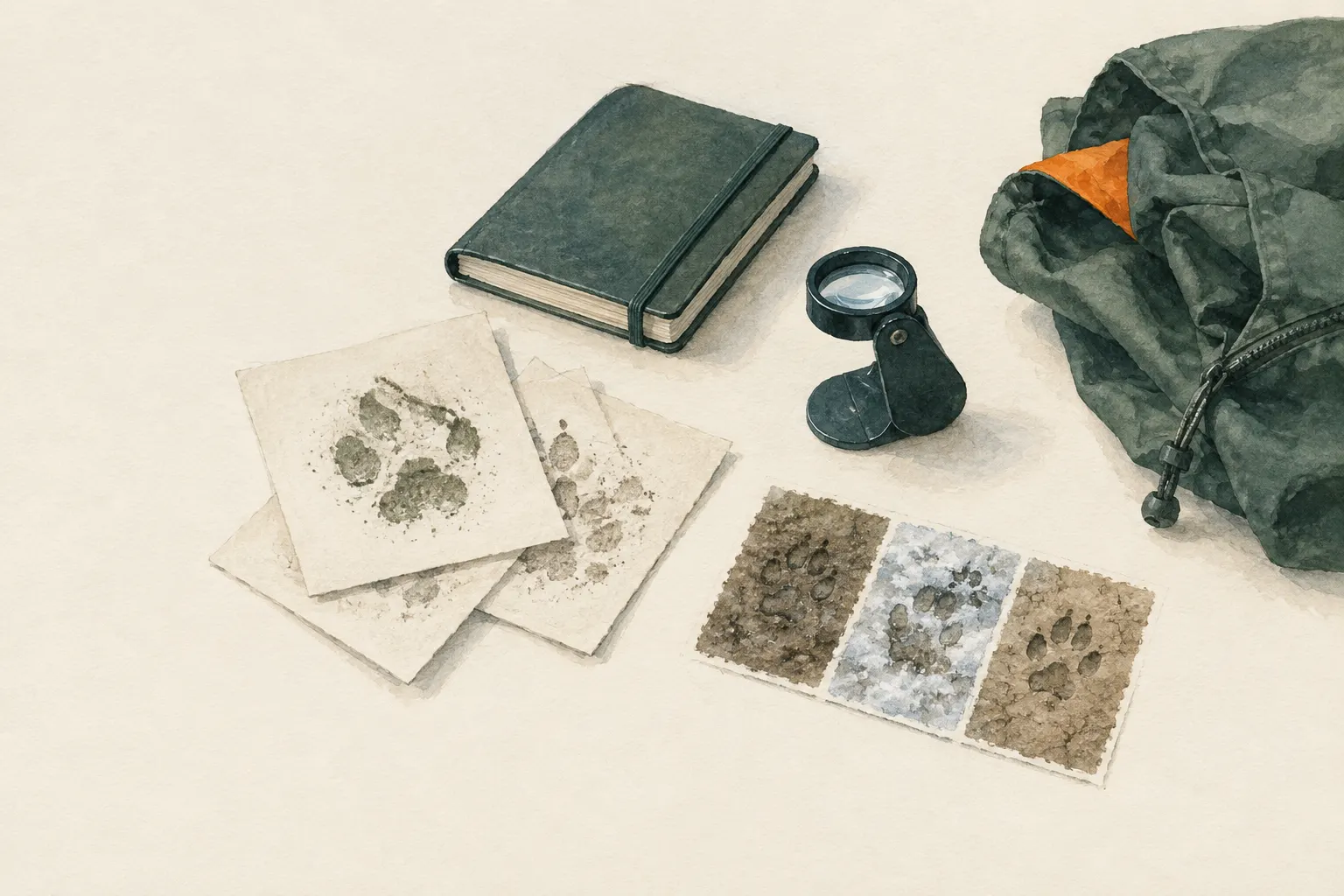
How old a track is can only be estimated roughly – but that is often enough to decide whether a place is currently in use. The most reliable practice method: make your own reference prints in the same substrate and watch how they change over hours and days. Add the weather timeline: when did it last rain, snow or freeze?
- A few minutes per observation, over several days
Explained simply
A track gets old, just like bread. Freshly baked bread is soft and smells good; old bread is hard and crumbly. Tracks are similar: a fresh print has sharp edges and is damp and dark inside. An old print has dried out, its rims have collapsed, and there may be leaves or needles inside it.
How fast a track ages depends on the ground and the weather, though. In sand it happens differently than in clay, in the sun differently than in the shade. So the best way to practise is with your own prints: you press your knuckles into the soil and check every day how they change.
You can almost never say exactly how old a track is. But you can learn to tell “just now” from “already old”. And if a track of a large animal looks very fresh, you do not investigate further – you take another route.
How it works
When a foot presses into the ground, it compacts the soil and pushes it aside. Right afterwards the edges are sharp, the walls of the print stand upright, and the soil inside is often damper and darker than the surroundings because fresher, moister soil has been exposed. Fine details such as toe pads or claws are clearly visible.
Then nature starts to change the print. The surface dries and becomes lighter, rims crumble and collapse. Wind blows sand or dust in, rain rounds off the edges and leaves small drop craters. Leaves, needles or insect trails appear inside the print. In snow, rims melt in the sun and freeze hard at night.
The problem: every substrate ages differently. A print in damp clay can stay sharp for a long time, one in dry sand blurs quickly. Sun, shade, wind and temperature also play a part. That is why track ageing can hardly be learned from tables – only by comparison with prints whose age you know.
How to practise it
Find a spot where you are allowed to practise and disturb nothing – ideally in your own garden. Press several prints into soil, sand or mud there with your knuckles, a stick or your shoe. These are your reference prints.
Photograph them immediately and then again and again, for example after one hour, in the evening and the next day. It is important to always photograph from the same angle and to note the weather and the position of the sun. After a few days you have a small series of pictures showing how a print ages in exactly this ground.
Repeat the whole thing in different soil, in sun and in shade, or in different weather. You will be amazed at how different the results are. Precisely this experience will later stop you from simply transferring what you learned on sand to clay. With children it becomes an exciting detective exercise.
What really matters
The most powerful tool is the weather timeline – knowing when it last rained, snowed or froze. If it rained last night and a track shows no raindrop marks, it is younger than the shower. If fresh snow lies in a print, it is older than the snowfall. Such events are like time stamps in the landscape.
Then look at the features you got to know with your reference prints: how sharp are the edges? Is the soil inside the print damp or dry? Have the rims collapsed? Is there debris inside? Only the combination of several features gives a useful estimate.
Give the result as a range, not a time. “This morning to yesterday” is an honest statement; “exactly three hours ago” almost never is. In practice the rough distinction is usually enough anyway: is this place in use right now or not?
Safety: what to watch out for
If a track of a large animal looks very fresh, do not investigate further. That means: do not go closer, do not follow the track, but gain distance and adjust your route. Your estimate of age is never precise enough to be sure the animal is already far away.
Use this knowledge when choosing a rest or camp site too. Many fresh tracks in one place mean there is activity right now – a poor place for your tent. Age estimation also does not replace guidance from area managers: if an area is closed because of wildlife, the closure applies.
Good to know
Making reference prints is a common exercise in tracking courses, because the ageing of a track depends on too many factors to learn by heart. Even experienced trackers therefore usually give ranges rather than exact times.
Snow calls for particular care. Sun and wind quickly melt prints and make them look larger than they originally were. Rims frozen overnight, by contrast, are hard and crusty – a hint that the track has been through at least one cold night.
Step by step
Make reference prints
Press several prints into soil, sand or mud with your knuckles, a stick or your own shoe – somewhere you are allowed to and disturb nothing.
- 1
Make reference prints
Press several prints into soil, sand or mud with your knuckles, a stick or your own shoe – somewhere you are allowed to and disturb nothing.
- 2
Document
Photograph them immediately and then at intervals (e.g. after one hour, in the evening, the next day), always from the same angle. Note weather and sun position.
- 3
Compare features
Look at edge sharpness, moisture, colour, collapsed rims and debris in the print.
- 4
Use the weather timeline
A track without raindrop marks after a shower last night is younger than the shower. If fresh snow lies inside, it is older than the snowfall.
- 5
Apply in the field
Compare animal tracks with what you know from your references and give a range (“this morning to yesterday”) rather than a time.
Common mistakes
- Transferring experience from sand to clay
- Not considering sun and shade
- Giving overly precise times
- Not knowing the weather of the last few days
Quick view
Materials
Field notebook and pencil
Mobile phone
Time-stamped photos
The battery drains quickly in cold and with continuous screen and GPS use.
Do not plan on it as your only means of navigation or emergency calls.
Suitable for
- Practice at home and with children
- Judging whether a game trail is in active use
- Choosing a campsite
Not suitable for
- Exact times
- Decisions that require precise times
Prerequisites
- A patch of your own garden or a permitted practice spot
- Notes on the weather of the last few days
Safety
- If a track of a large animal looks very fresh, do not investigate further: gain distance and adjust your route.
How it works
A fresh print has sharp edges, moist, darker ground and upright walls. Over time the rim dries, crumbles and collapses; wind blows sand in, rain rounds edges, leaves, needles or insect trails appear inside. Because every substrate ages differently, only comparison with a print of known age helps – which is why you make your own reference prints.
Advantages
- Simple, free, can be practised anywhere
- Trains the eye for detail
- Good family activity
Disadvantages
- Results only apply to similar substrate and weather
- Remains an estimate
Deep knowledge
Background
Making reference prints is a common exercise in tracking courses, because the ageing of a track depends on too many factors to be learned from tables.
In practice, the rough distinction between “just now” and “old” matters most – it decides whether you avoid a place.
Variants
- Snow
- In snow, sun, wind and frost change prints quickly: rims melt, prints look larger; rims frozen overnight are hard and crusty.
Common mistakes
- Transferring experience from sand to clay
- Not considering sun and shade
- Giving overly precise times
- Not knowing the weather of the last few days
Limits and risks
- No reliable ages in hours
- Does not replace guidance from area managers
Material alternatives
Derived from material properties: a substitute must have all relevant properties. Observe the notes on the substitute.
- Mobile phone
- Headlamp / flashlight, Battery lantern / LED light
Results come exclusively from structured entries. No improvised instructions are generated.
Sources
Mark Elbroch – Stackpole Books (2003): Mammal Tracks & Sign: A Guide to North American Species
Influence of substrate and conditions on the appearance of tracks