Deer and wild boar: avoiding wildlife collisions and acting correctly
Wildlife collisions happen mainly at dusk and dawn, at forest edges and fields. Driving more slowly, taking deer warning signs seriously and expecting followers reduces the risk. If an animal is on the road: brake in a controlled way, sound the horn, dip the headlights, do not swerve. After a collision secure the scene, inform the police or responsible office and do not touch or take the animal.
- On every drive through wildlife areas
Explained simply
Deer and wild boar cross roads mainly at dawn and dusk, when they move between their hiding places in the woods and their feeding places in the fields. Anyone driving there should slow down and keep a close eye on the road edges. A sign with a leaping deer warns of such places.
If an animal is on the road: brake in a controlled way, sound the horn, switch off the full beam and do not swerve. Swerving sounds right at first but is often more dangerous, because you may hit a tree or end up in oncoming traffic. And where there is one animal, more often follow.
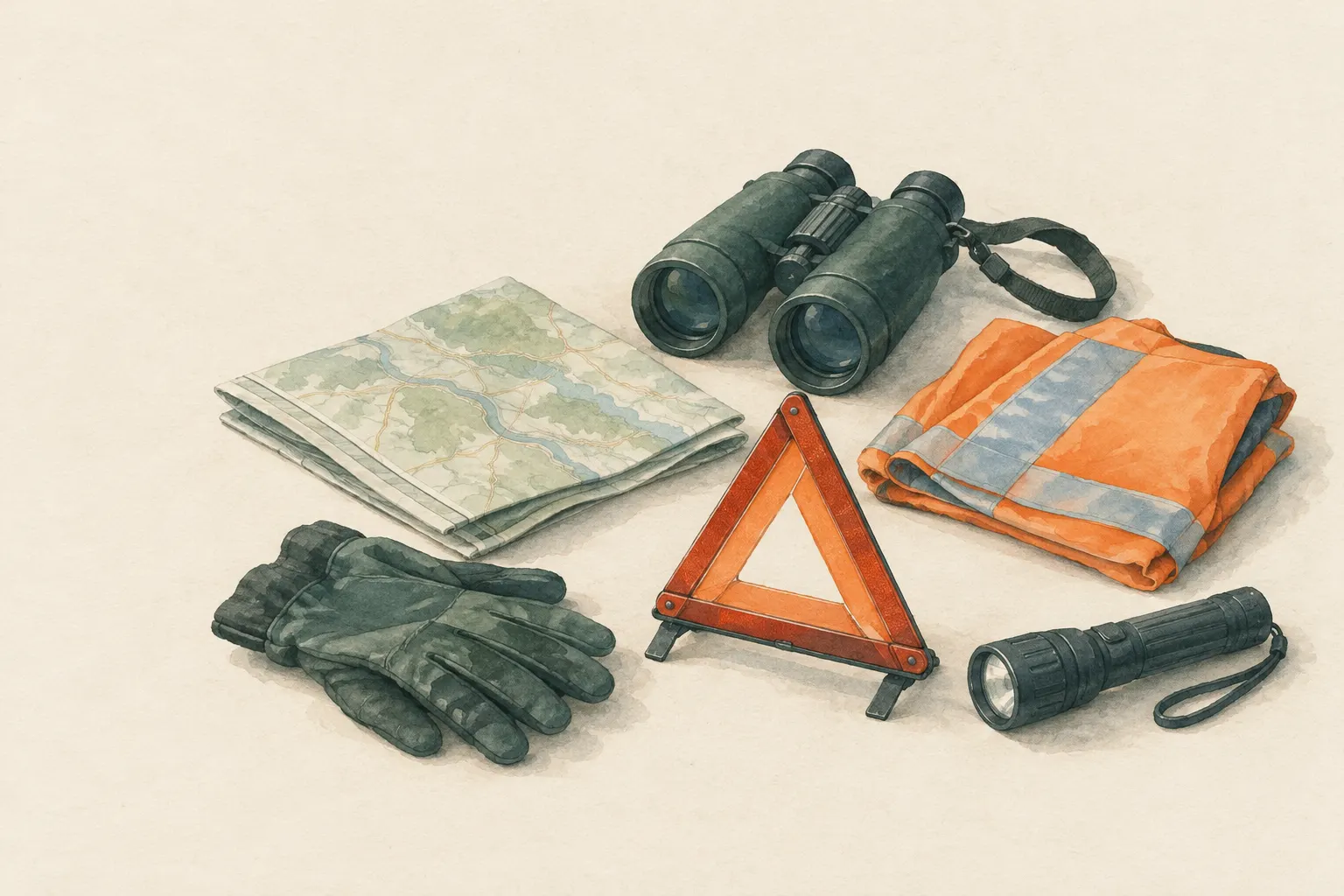
If it has happened: hazard lights on, put on the hi-vis vest, get out on the safe side, set up the warning triangle and move behind the crash barrier. If people are hurt, call the emergency number (112 in the EU). Do not touch the animal – even an injured deer can kick hard.
How it works: why wildlife collisions happen
Many wild animals have a fixed daily rhythm. During the day, deer and wild boar often rest in the cover of the woods; at dusk and at night they move onto meadows and fields to feed. On the way they cross roads that run between woods and fields. The places where they do this regularly are called game crossings.
In some seasons animals are on the move especially often. In spring young animals look for new territories, in autumn dusk coincides with rush-hour traffic, and during the mating season some species are more restless and less cautious. Deer and wild boar also often travel in groups: others frequently follow the first animal.
In headlights, animals often behave differently from what you expect. Strong full beam can dazzle them so that they stand still or run in the wrong direction. Dipping the lights and sounding the horn gives them a better chance of leaving the road.
What really matters: driving with anticipation
The most important protection is speed. Driving more slowly means a shorter stopping distance and more time to react, and an impact at lower speed is far less violent. So reduce speed at forest edges, fields and deer-crossing signs, especially at dusk, at night and in spring and autumn.
Watch the road edges, not just the road ahead. Animals' eyes reflect the headlights and briefly light up. If you have seen an animal cross the road, expect more and do not speed up again straight away.
If an animal is on the road: brake in a controlled way, hold the steering wheel firmly and stay in your lane, sound the horn and dip the headlights. Controlled braking in your lane keeps the car manageable and reduces the impact energy. Risky evasive manoeuvres, by contrast, lead into oncoming traffic or into trees and are often more dangerous than hitting the animal.
Safety: after a collision
First you secure yourself and others. Hazard lights on, put on the hi-vis vest, get out on the side away from traffic, set up the warning triangle at a sufficient distance and stand behind the crash barrier or well away from the road. Passengers also get out and move to safety. If people are injured, call the local emergency number (112 in the EU).
Do not touch the animal, even if it is lying there injured. Wild animals panic, and even an apparently motionless deer or wild boar can suddenly kick, bite or strike. Do not load any animal into the car – not even a dead one. Taking it can count as poaching in many countries, because game often belongs to a holder of hunting rights.
Inform the police or the locally responsible office – in many countries this is mandatory. Give the exact location, even if the animal has fled. An animal that fled injured can then be searched for by experts, so that it does not have to suffer for long. Take photos of the damage and the scene and, where that is customary, ask for a certificate for the insurer.
On foot or by bike
Anyone on foot or by bike also meets wild animals – often closer than in a car. Give wild boar, especially sows with piglets, and deer in the rut a wide berth. Withdraw calmly, avoid hasty movements and always leave the animals an escape route.
Do not feed wild animals and do not get close to take a photo. Animals that get used to people lose their shyness and then also come closer to roads and settlements, which creates new dangers. With lights on your bike and bright clothing, drivers see you better at dusk.
Good to know
The hi-vis vest and warning triangle should be within reach in the car, not under the luggage in the boot. In many countries carrying them is mandatory anyway. It is worth knowing the local reporting requirements for wildlife collisions before travelling in a new area.
Wildlife fences, crossing structures such as green bridges and warning systems reduce collisions at known spots. But they do not replace your own attention, because animals do not stick to fences and signs. Even with the greatest care not every collision is avoidable – acting correctly then protects people and shortens the animal's suffering.
Step by step
Drive with anticipation
Slow down at forest edges, fields and deer-crossing signs, especially at dusk, at night and in autumn and spring. Watch the road edges – eyes reflect in the headlights.
- 1
Drive with anticipation
Slow down at forest edges, fields and deer-crossing signs, especially at dusk, at night and in autumn and spring. Watch the road edges – eyes reflect in the headlights.
- 2
Animal on the road
Brake in a controlled way, hold the steering wheel firmly and stay in your lane, sound the horn, dip the headlights. Expect more animals.
- 3
Secure after a collision
Hazard lights on, put on the hi-vis vest, get out on the side away from traffic, set up the warning triangle, move behind the crash barrier.
- 4
Report
Inform the police or the locally responsible office – this is mandatory in many countries. Give the exact location, even if the animal has fled, so that it can be searched for.
- 5
Document
Photograph damage and the scene, ask for a certificate for the insurer where that is customary.
Common mistakes
- Swerving riskily
- Driving at the animal with full beam
- Touching an injured animal or loading it into the car
- Not reporting because the animal ran away
- Accelerating again right after the first animal
Quick view
Materials
High-visibility vest
Keep within reach inside the cabin, not in the boot/trunk.
Warning triangle
Whether warning triangles are mandatory, or should be placed at all on certain roads (e.g. motorways), differs between countries – check local rules.
Mobile phone
The battery drains quickly in cold and with continuous screen and GPS use.
Do not plan on it as your only means of navigation or emergency calls.
First-aid kit (household)
Does not replace a first-aid course; check contents and expiry dates regularly.
Suitable for
- Driving on rural roads and along forest edges
- Autumn and spring, dusk and dawn
- Cyclists and pedestrians in wildlife areas
Not suitable for
- Killing injured animals – a task for those authorised
Prerequisites
- Hi-vis vest and warning triangle within reach
- Knowledge of local reporting requirements
Safety
- Do not touch injured animals – in panic they may bite, kick or strike. Do not take dead animals; that can count as poaching. Check local rules.
How it works
Deer and wild boar move at dusk and dawn between cover and feeding areas and cross roads on the way. They often travel in groups; others follow the first animal. Full beam can dazzle animals so that they stand still. Controlled braking in your lane keeps the car manageable and reduces the impact energy.
Advantages
- Fewer collisions and injuries
- Legally sound behaviour after a collision
- Shortens the suffering of injured animals
Disadvantages
- Slower driving takes time
- Not every collision is avoidable
Deep knowledge
Background
Road codes such as the UK Highway Code contain rules on animals on the road and on securing accident and breakdown scenes. Reporting rules and rules on taking animals after wildlife collisions differ by country and are set in hunting and traffic law.
Wildlife fences, crossing structures and warning systems reduce collisions at known spots; they do not replace your own attention.
Variants
- On foot or by bike
- Give wild boar, especially sows with piglets, and deer in the rut a wide berth, withdraw calmly and leave them an escape route. Do not feed them and do not photograph them at close range.
Common mistakes
- Swerving riskily
- Driving at the animal with full beam
- Touching an injured animal or loading it into the car
- Not reporting because the animal ran away
- Accelerating again right after the first animal
Limits and risks
- No binding reporting requirements for individual countries
- No first-aid guidance for animals
Material alternatives
Derived from material properties: a substitute must have all relevant properties. Observe the notes on the substitute.
- High-visibility vest
- Emergency blanket (Tears easily once punctured; short-term shelter only.), Signal mirror (Do not flash into the eyes of people nearby or of drivers.), Warning triangle (Whether warning triangles are mandatory, or should be placed at all on certain roads (e.g. motorways), differs between countries – check local rules.), Aluminium foil (heavy-duty) (Edges can be sharp; conducts heat and electricity.)
- Warning triangle
- Emergency blanket (Tears easily once punctured; short-term shelter only.), Signal mirror (Do not flash into the eyes of people nearby or of drivers.), High-visibility vest (Keep within reach inside the cabin, not in the boot/trunk.), Aluminium foil (heavy-duty) (Edges can be sharp; conducts heat and electricity.)
- Mobile phone
- Headlamp / flashlight, Battery lantern / LED light
Results come exclusively from structured entries. No improvised instructions are generated.
Sources
Department for Transport and Driver and Vehicle Standards Agency (United Kingdom): The Highway Code
Animals on the road; securing accident and breakdown scenes