Cruise ship emergencies: take the muster drill seriously, follow the crew
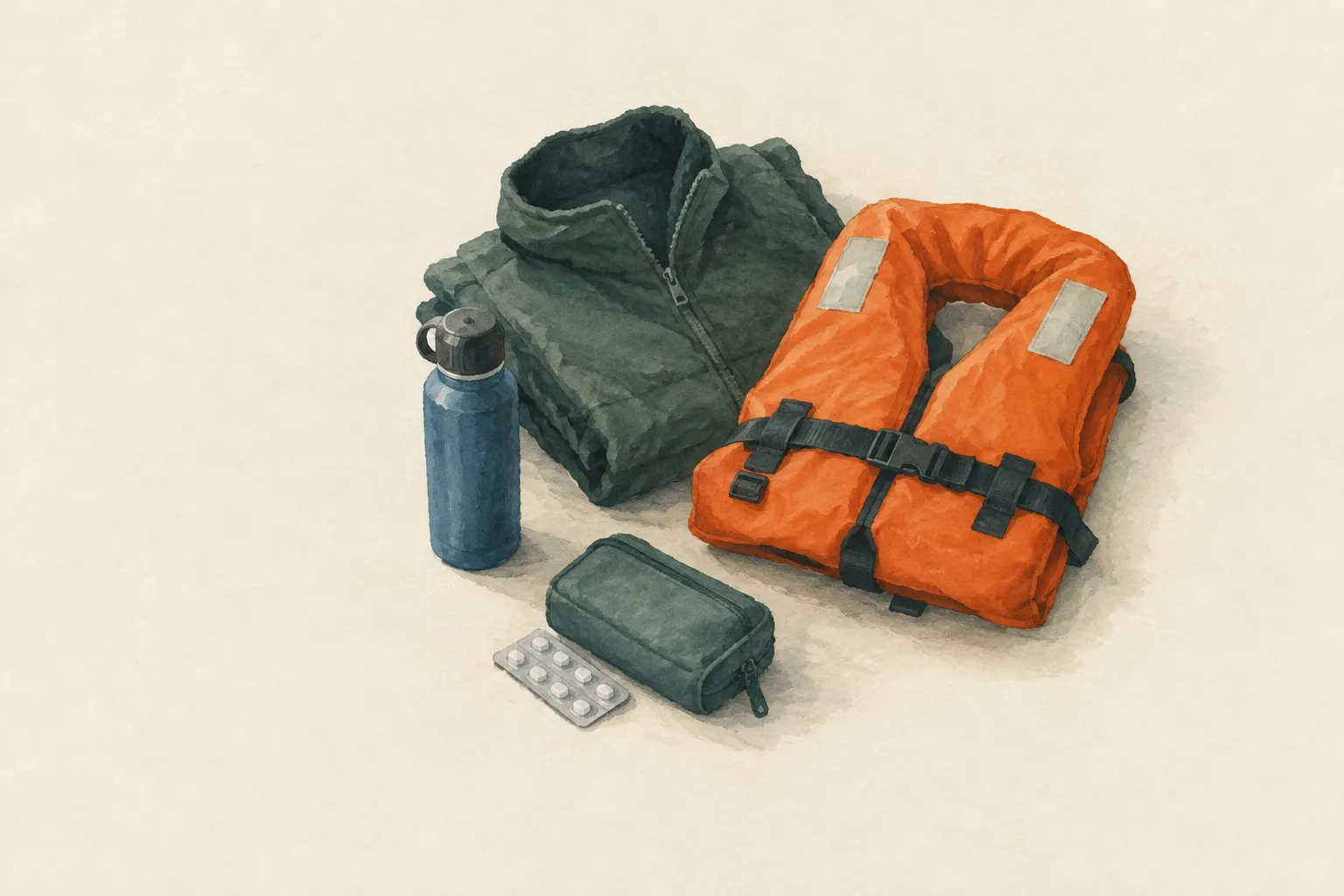
On large ships everything in an emergency depends on order: every passenger has a muster station, shown during the safety drill (muster). Anyone who knows it, has walked the route once and goes there calmly with warm clothing, medication and a life jacket (if instructed) when the general alarm sounds makes the crew's job easier. Do not search cabins for relatives – agree a meeting point beforehand.
- Muster drill about 15–30 minutes, walk the route once
Explained simply
A big cruise ship is like a small floating town, with thousands of people on board. If there is an emergency, not everyone can simply run around. That is why every passenger has a fixed meeting place, the muster station. There the crew counts everyone and leads them on in groups.
At the start of the voyage there is a safety drill, the muster drill. There you learn where your muster station is and what the alarm sounds like. Afterwards it is best to walk the route from your cabin yourself, using two different staircases. Then you will find it even when it is dark or many people are on the move.
The most important point: when the alarm sounds, do not use lifts, do not run back to the cabin to fetch things and do not search for family members. Everyone goes straight to their muster station – if someone is missing, tell the crew.
How it works
Thousands of people can only leave a ship in an orderly way if it is clear who is where. That is why every passenger is assigned a muster station, usually shown on the cruise card or the cabin door. There the crew records who has arrived and so knows who still needs to be found.
The International Convention for the Safety of Life at Sea (SOLAS) sets rules for ships in international service on life-saving appliances, alarms, safety instructions and drills. How the operator carries out the drill – as a gathering on deck, as a video in the cabin or with digital registration – can vary.
Under SOLAS requirements the general emergency alarm usually consists of seven or more short blasts followed by one long blast. Still, listen to the exact announcement on board: it explains what the alarm means on this ship and what you should do.
What really matters
Take the muster drill seriously, even if you have travelled often. Every ship is built differently, and routes on large ships are long and winding. If registration at the muster station is required, get registered.
Afterwards, walk two different routes from your cabin to the muster station and note stairwells and signs. In a real emergency one route may be blocked or crowded. Knowing an alternative helps you stay calm.
Agree as a family: wherever you are, go straight to your own muster station. If children are at the kids' club, ask there what happens to them in an alarm and where you will find them. That way nobody has to run through the ship looking for others in an emergency.
Safety: when the alarm sounds
Take warm clothing, sturdy shoes, your medication and the cruise card. Take or put on a life jacket only if the crew instructs you to – on many ships jackets are handed out at the muster station. Go quickly but without running.
Do not use lifts; take stairs and the signposted escape routes. Lifts can get stuck, and in an emergency they are often needed for other tasks. Do not return to the cabin to fetch luggage and do not go to the lifeboats on your own.
Follow only the crew's instructions. They are trained for these situations and know which areas are safe and when each group's turn comes. Waiting can feel long, but it is part of an orderly process.
Person overboard
If you see someone go overboard, shout “man overboard” loudly so others hear it. Keep the person in sight without interruption and point at them with your outstretched arm. On the open sea you lose sight of a head in the water very quickly.
Throw a lifebuoy if one is within reach, and alert the crew immediately, or make sure someone else does. Do not jump in yourself. The crew knows the procedures and can turn the ship or launch a boat.
Prevention is simple: do not lean over the railing, do not climb, do not sit on railings, and never let children out of your sight on deck. Anyone who falls into cold water should first – as with small boats – lie back and float until their breathing calms down.
Good to know
On expedition ships and for landings by tender or inflatable boats, additional rules apply, for example on wearing life jackets and on getting in and out. The crew explains them beforehand; listen carefully here too.
Operating lifeboats or handling a ship is the crew's job and not part of this entry. Procedures vary between operators. For passengers what matters most is: attend the drill, know the route, recognise the alarm and in an emergency calmly follow the crew.
Step by step
Attend the muster drill
Follow the safety drill or video attentively and register at the muster station if required.
- 1
Attend the muster drill
Follow the safety drill or video attentively and register at the muster station if required.
- 2
Know the route
Walk two routes from the cabin to the muster station; note stairwells and signs.
- 3
Know the alarm signal
Under SOLAS requirements the general emergency alarm usually consists of seven or more short blasts followed by one long blast; follow the exact announcement on board.
- 4
When the alarm sounds
Take warm clothing, sturdy shoes, medication and the cruise card; take or put on a life jacket only as instructed. Go to the muster station quickly but without running.
- 5
Family
Agree beforehand: wherever you are, go straight to your own muster station. Report missing relatives to the crew instead of searching yourself.
Common mistakes
- Skipping the muster drill
- Running to the cabin first to fetch luggage
- Leaving children at the kids' club without knowing the procedure in an alarm
- Leaning or climbing over the railing
Quick view
Materials
Life jacket / buoyancy aid
Size and buoyancy must match body weight; children need children's jackets. Follow manufacturer instructions and service intervals.
Medication supply
Agree any stock of prescription medication with a doctor or pharmacist; observe storage instructions and expiry dates.
Dry spare clothing
Carry it in waterproof packaging – wet clothing barely insulates.
Suitable for
- Cruise ships, large ferries, expedition ships
Not suitable for
- Small boats without a muster organisation – wear a life jacket there and follow the briefing
Prerequisites
- Attending the safety drill
- Cabin number and muster station (usually on the cruise card or cabin door)
Safety
- Follow only crew instructions. Do not go to lifeboats on your own or return to cabins.
How it works
Thousands of people can only leave a ship in an orderly way if they are counted at fixed muster stations and led by the crew in groups. The international SOLAS convention regulates life-saving appliances, alarms and drills for ships in international service.
Advantages
- Little effort
- Shortens routes and confusion in an emergency
Disadvantages
- Depends on organisation and crew
- Procedures vary by operator
Deep knowledge
Background
The IMO SOLAS convention contains requirements on life-saving appliances, alarm signals, safety instructions and drills on ships in international service. The concrete implementation – video, drill on deck, digital registration – is chosen by the operator.
The RNLI "Respect the Water" campaign describes cold water shock and floating on your back if you fall into the water unexpectedly.
Variants
- Expedition ships and tenders
- Landings by inflatable or tender boats have additional rules (life jacket, boarding and leaving). Follow the crew briefing.
Common mistakes
- Skipping the muster drill
- Running to the cabin first to fetch luggage
- Leaving children at the kids' club without knowing the procedure in an alarm
- Leaning or climbing over the railing
Limits and risks
- No seamanship or lifeboat handling
- No information on individual operators
Material alternatives
Derived from material properties: a substitute must have all relevant properties. Observe the notes on the substitute.
- Dry spare clothing
- Sleeping pad, Dry leaves, grass or conifer boughs (Collect only where allowed; no protected plants. Check for ticks and insects.), Backpack, Wool blanket / duvet (Keep away from candles, stoves and heaters.), Insulated cool box (Keeps cold only for a limited time; without ice packs or ice it is not a fridge.), Sleeping bag (Do not store compressed long-term; do not pack away damp.), Newspaper and cardboard (Flammable – keep away from candles, stoves, heaters and embers.), Insulated cooking box (hay box, thermal cooker) (Never put open flame or embers inside – only the hot, closed pot.)
Results come exclusively from structured entries. No improvised instructions are generated.
Sources
International Maritime Organization (IMO) (1974): International Convention for the Safety of Life at Sea (SOLAS), 1974, as amended
Life-saving appliances, alarm signals, drills and safety instructions on ships
Royal National Lifeboat Institution (RNLI), UK: Respect the Water – Float to Live
Cold water shock and "Float to Live"