International distress signals at sea: overview
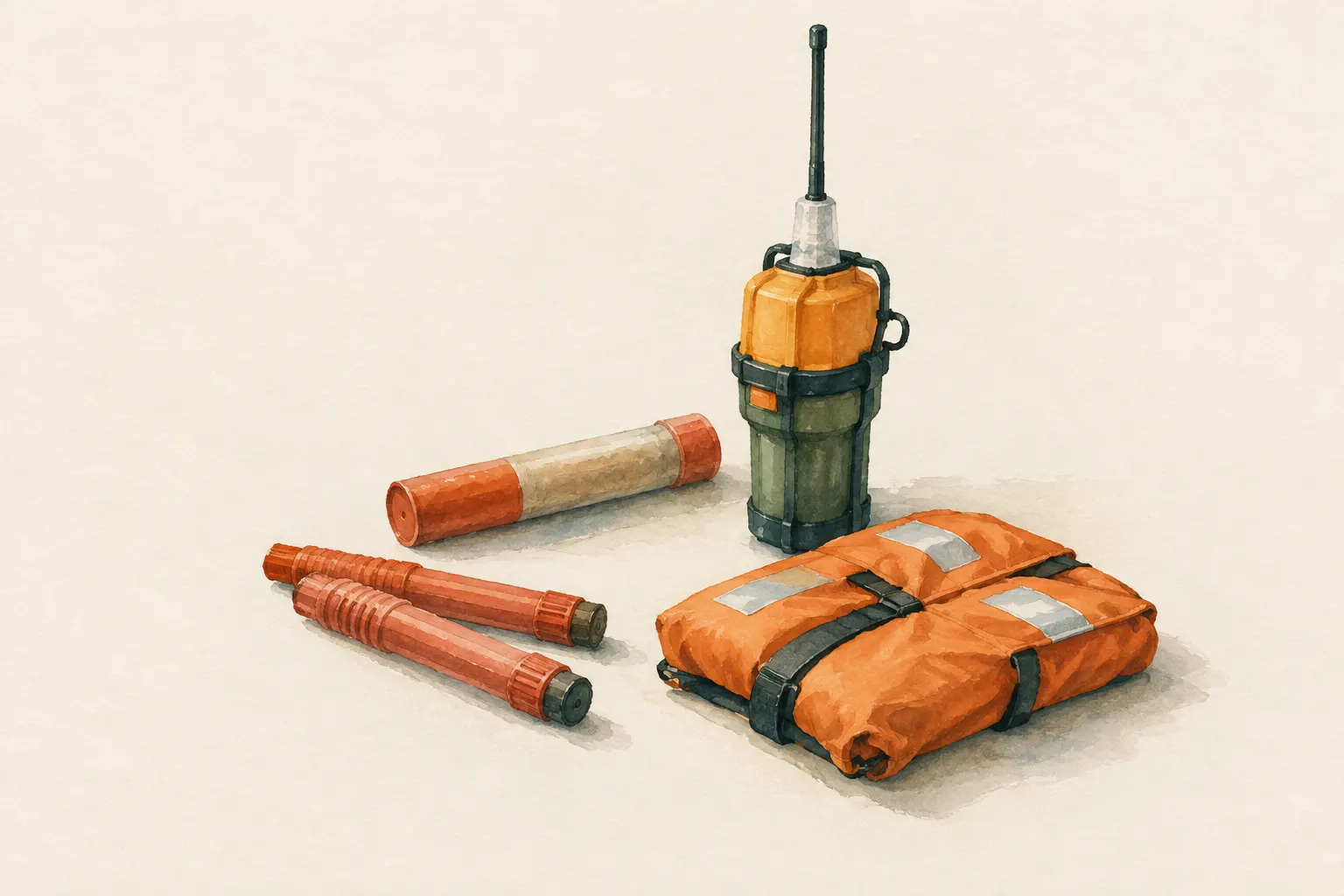
The international collision regulations (COLREGs, Annex IV) list signals that mean 'I am in distress and need help' on the water – including MAYDAY by radio, SOS, red flares, orange smoke, slowly raising and lowering outstretched arms and emergency beacons. Anyone on the water should recognise them and be able to use the signalling equipment they carry.
- Learn in advance; check signalling equipment before setting out
Explained simply
Ships from many countries sail the sea, and their crews speak many languages. So that everyone still understands at once that someone is in distress, there are internationally agreed distress signals. They are like a shared emergency language that is the same all over the world.
Some of them: the word ‘MAYDAY’ over the radio, the SOS signal with light or sound, red flares, orange smoke by day and a simple body signal – both arms stretched out, slowly raised and lowered, again and again. Waving with one hand, by contrast, looks like a friendly ‘hello’.
Very important: distress signals are only for real distress. Anyone who uses them for fun sends out rescuers who are then missing elsewhere. And if you see distress signals from the shore, do not swim out yourself – call the emergency number (112 in the EU) or the coastguard and keep the spot in sight.
How it works
The list of distress signals is set out in Annex IV of the International Regulations for Preventing Collisions at Sea, COLREGs for short. Because ships of every nation follow these rules, a red flare means the same everywhere in the world: someone here is in distress and needs help.
The signals cover different situations. Radio reaches ships over long distances, even ones you cannot see. Light works mainly at night, smoke by day. Sound, such as continuous sounding of a fog horn, helps in poor visibility. Body signals work without any equipment, and emergency beacons report via satellite to rescue coordination centres.
One of these signals alone is enough to show distress. But combining several increases the chance that anyone notices at all – because a visual signal only works if someone happens to be looking.
Recognising the key signals
On the radio, ‘MAYDAY’ is the distress word; it is spoken three times and means immediate danger to life or to the vessel. On VHF marine radio, channel 16 is the international distress and calling channel. Many marine radios also have a button for digital selective calling that can send a distress alert with position. Depending on the country, marine radio requires an operator's certificate – check local rules.
Visual signals: red hand flares or parachute rockets with a red light, orange smoke by day, SOS with a lamp (three short, three long, three short) and slowly, repeatedly raising and lowering both arms stretched out to the sides. Everyone on the water should know the arm signal in particular, including in a kayak or on a SUP.
Audible signals: continuous sounding with a fog horn, or SOS as a sound signal. On small craft a whistle worn on the body is a simple tool. Electronic signals: an activated emergency beacon, for example a maritime distress beacon or a personal locator beacon, raises the alarm via satellite.
What really matters
The order in an emergency: first the distress call by radio or phone, so that rescue centres know. Use visual signals when ships or aircraft are in sight. Pyrotechnics such as flares and rockets only last a short time; do not use them up ‘on spec’, but set them off when someone can see them.
Which equipment must or should be on board depends on boat type, sailing area and country. At least a whistle, a light and a phone in a waterproof case belong on small boats too. Depending on the waters, marine radio, a beacon and pyrotechnics are added. Water sports associations and authorities provide information on the requirements in your country.
Before every trip, check expiry dates, batteries and access: signalling equipment must be reachable even if the boat capsizes. Whatever is deep in a locker is no use in the water. On kayaks, canoes and SUPs, the most important items should be worn on the body or on the buoyancy aid.
Safety: what to watch out for
Pyrotechnic signals are dangerous: they get very hot, can cause burns and start fires. Use, store and dispose of them only according to the manufacturer's instructions and local rules. Do not set off expired signals yourself or throw them in the rubbish – ask about official return points. Depending on the country, certain pyrotechnics require training or authorisation.
Distress signals are exclusively for real distress. A false alarm, such as an accidentally activated beacon or a flare set off for fun, triggers a real search. If an alarm has been raised by mistake, report it immediately to the coastguard or rescue centre so that nobody goes out unnecessarily.
If you see distress signals on the water from land, do not swim or go out yourself. Call the local emergency number (112 in the EU) or the coastguard, describe what you saw and where, and keep the spot in sight until help arrives. You are then the most important witness.
Good to know
Alongside COLREGs there is the International Convention for the Safety of Life at Sea (SOLAS). Among other things it governs which safety equipment large ships must carry. Leisure craft, on the other hand, are subject to their own rules depending on the country.
The complete list of distress signals is only found in Annex IV of the COLREGs itself; this overview names the most important ones. Anyone who is regularly on the water should take a course, for example in marine radio or safety on board. That is also where you learn to handle pyrotechnics safely.
A common misunderstanding: friendly waving with one hand is often taken as a greeting, not a call for help. Anyone who needs help therefore uses the clear signal of both outstretched arms, slowly raised and lowered.
Step by step
Know the signals
Key distress signals: MAYDAY by radio, SOS (light or sound), red flares, orange smoke, slowly raising and lowering both outstretched arms, continuous fog-horn sounding, an activated emergency beacon.
- 1
Know the signals
Key distress signals: MAYDAY by radio, SOS (light or sound), red flares, orange smoke, slowly raising and lowering both outstretched arms, continuous fog-horn sounding, an activated emergency beacon.
- 2
Carry suitable equipment
What must or should be on board depends on boat type, area and country. At least a whistle, a light and a phone in a waterproof case; depending on the waters, radio, beacon and pyrotechnics.
- 3
Check before setting out
Check expiry dates, batteries and access: signalling equipment must be reachable even if the boat capsizes.
- 4
In an emergency
First a distress call by radio or phone, then visual signals when ships or aircraft are in sight. Use pyrotechnics only when someone is in sight; do not use them up 'on spec'.
Common mistakes
- Expired or inaccessible signalling equipment
- Using up all flares at once
- One-handed waving mistaken for a greeting
- Phone not in a waterproof case
- False alarm not reported
Quick view
Materials
Marine VHF radio
Operating it requires an operator certificate and licence in many countries – check local rules.
Personal locator beacon (PLB)
Register under your country's rules and keep the registration up to date.
Activate only in genuine distress; observe battery and expiry dates.
Signal whistle
Carry within easy reach, not deep in the pack.
Do not blow right next to other people's ears.
Suitable for
- Sailing, motor boating, kayaking and canoeing
- Ferry and boat trips (recognising signals)
- Coastal walks (noticing distress on the water)
Not suitable for
- Use for fun or as a test – distress signals only in genuine distress
Prerequisites
- Training or authorisation for radio and pyrotechnics depending on the country – check local rules
Safety
- Use distress signals only in genuine distress. False alarms tie up rescuers and can lead to costs or penalties. Report accidental alerts immediately.
How it works
Because ships of all nations must understand one another, distress signals are agreed internationally. They cover different situations: radio (MAYDAY, digital selective calling), light (red signals, SOS), smoke by day, sound (continuous sounding of a fog-signal apparatus), body signals and satellite beacons. One signal is enough; several increase the chance of being noticed.
Advantages
- Understood internationally
- A suitable signal for many situations
Disadvantages
- Many devices require authorisation or training
- Visual signals only work if someone is looking
Deep knowledge
Background
The list of distress signals is set out in Annex IV of the International Regulations for Preventing Collisions at Sea (COLREGs); the International Convention for the Safety of Life at Sea (SOLAS) governs, among other things, the equipment of ships.
For leisure craft, equipment requirements differ by country; water sports associations and authorities provide information.
Variants
- Kayak, canoe, SUP
- On small craft too, a whistle, a light, bright colours and a phone in a waterproof case or a beacon worn on the body help.
Common mistakes
- Expired or inaccessible signalling equipment
- Using up all flares at once
- One-handed waving mistaken for a greeting
- Phone not in a waterproof case
- False alarm not reported
Limits and risks
- No operating instructions for pyrotechnics
- No national equipment requirements
- Full list only in Annex IV itself
Sources
International Maritime Organization (IMO) (1972): Convention on the International Regulations for Preventing Collisions at Sea, 1972 (COLREGs) – Annex IV: Distress signals
List of international distress signals at sea
International Maritime Organization (IMO) (1974): International Convention for the Safety of Life at Sea (SOLAS), 1974, as amended
International rules on safety equipment of ships
International Maritime Organization (IMO) and International Civil Aviation Organization (ICAO): IAMSAR Manual (International Aeronautical and Maritime Search and Rescue Manual), Volume III – Mobile Facilities
Actions in distress at sea and towards search and rescue units