Being found from the air: helicopters, aircraft, drones
Air searches cover a lot of ground but easily miss small, still, camouflaged people. If you want to be found, move to an open spot nearby, lay out high-contrast colours and move when an aircraft or drone is in sight. Do not touch or throw things at drones, and do not run towards helicopters.
- A few minutes to prepare
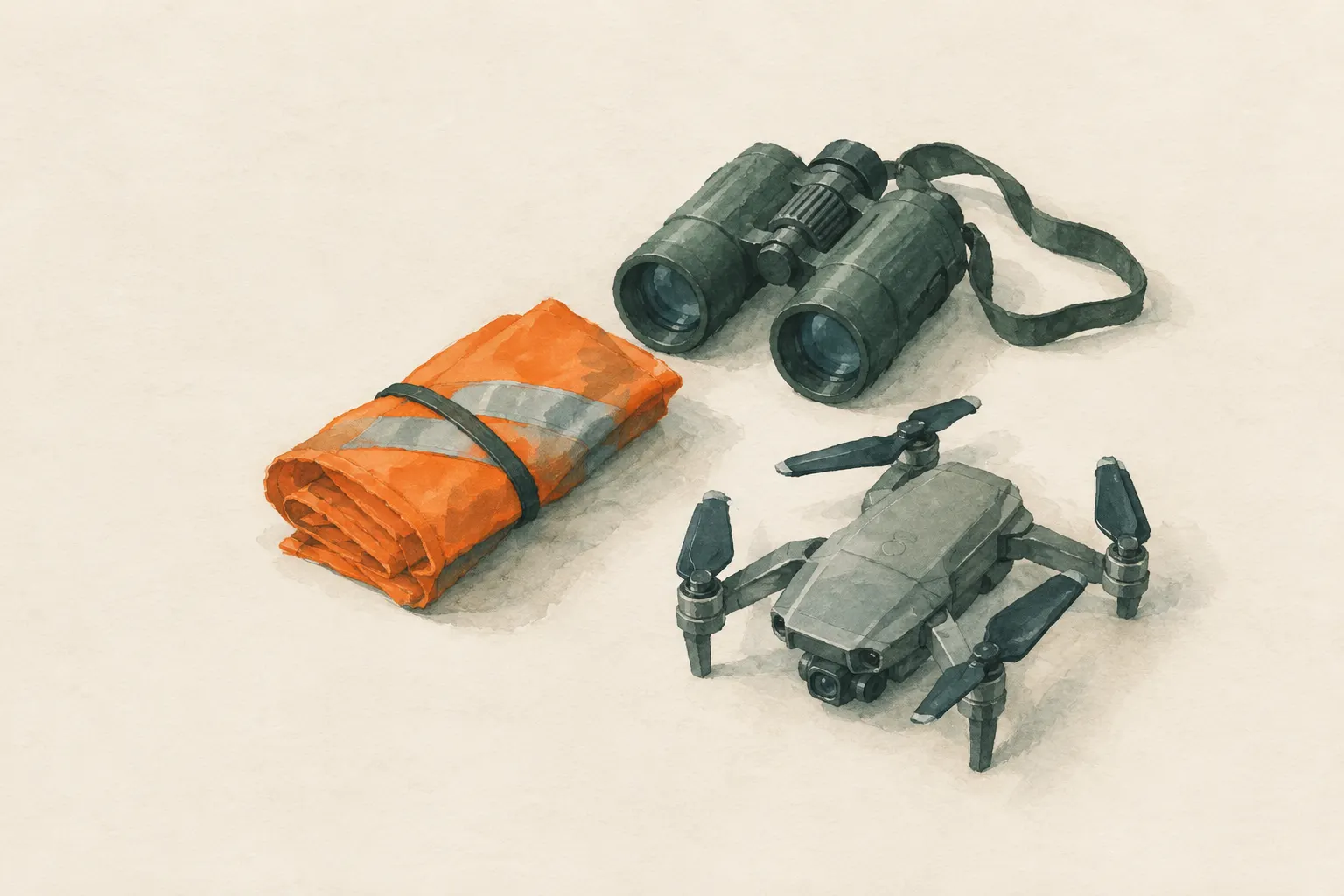
Explained simply
From a helicopter or plane you can see a great deal of land at once. But a single person is tiny from above, like an ant on a carpet. If they sit still under trees wearing green or brown clothes, you can hardly see them at all.
So that you can be found from above, you go – if it is safe – to an open spot nearby, such as a meadow or clearing. You lay out bright, colourful things that stand out from the ground. And when you hear or see a plane, helicopter or drone, you move: wave with both arms or swing a cloth. Movement is especially noticeable from above.
Two important rules: never run towards a helicopter when it is landing – its wind whips things up. And do not touch a drone; its propellers can injure you.
How it works
Anyone searching from the air scans a huge area, often from great height and at high speed. The eye looks for things that do not fit into nature: strong colour contrasts, straight lines, geometric shapes and above all movement. A large X or triangle on a meadow stands out because nature rarely forms such shapes.
Under a dense canopy of leaves you are almost invisible from above. That is why an open area matters so much: a clearing, a meadow, a ridge, a snowfield or a beach. There you can be seen and have room to lay out signs.
At night, lights are visible from the air over long distances, especially in areas without other lighting. Some rescue services also use thermal cameras on helicopters or drones that can detect a person's body heat. But do not rely on that – light and movement always help.
What really matters
Find an open spot nearby, but only if you can reach it safely. Avalanche slopes, rockfall zones and riverbanks are not good ‘open spots’, even if they are clear. Rather stay at the edge of a safe area, where you can shelter under trees if needed.
Spread out bright or fluorescent clothing, your pack or a cloth flat. If possible, lay out a large ground sign of branches, stones or clothing that stands out from the ground. The shiny side of a rescue blanket or a signal mirror can reflect sunlight and create a flash visible from far away.
Overflights often last only seconds. So keep your signals ready so that you can react at once when you hear an engine: swing a cloth, wave with both arms, use the mirror, flash a light at night. Do not wave with just one hand; that looks like a friendly greeting.
Body signals: yes and no
There are simple body signals that rescue crews in aircraft understand. Both arms stretched diagonally upwards, so that your body looks like a big Y, means: ‘Yes, I need help.’ One arm diagonally up and one diagonally down means: ‘No, I do not need help.’
These signals matter so that the crew decides correctly. A friendly wave may be read as ‘all OK’ and lead the helicopter to fly on. So show the Y clearly if you need help.
A simple memory aid: Y for ‘yes’ – both arms up. Practise the sign once so that it comes naturally in an emergency.
Safety: what to watch out for
A helicopter that is hovering or landing creates a very strong downwash. It whips up sand, snow, branches and anything loose lying around. So secure tarps, cloths, rescue blankets and clothing as soon as you have been spotted, so that nothing gets into the rotors. Protect your eyes.
Never run towards a landing or hovering helicopter. Stay where you are and wait until the crew gives you a signal. Then approach only from the front, within the pilot's view, and follow the crew's instructions exactly.
Drones are increasingly used by rescue organisations. Do not touch, grab or throw things at them – the propellers can cause serious cuts. Waving is enough. Some drones have loudspeakers through which rescuers give you instructions. And if you have signal, call the local emergency number (112 in the EU) first.
Typical situations
Lost in the forest: you hear a helicopter, but you are sitting under dense trees. If it is safe, go to the nearest clearing or path and lay out your signals there. When the helicopter comes back, you are ready.
Injured and unable to walk: then make the best of where you are. Spread everything bright you have around you, keep a mirror or lamp within reach and move as well as you can as soon as you hear an aircraft.
At night: keep the lamp ready, but only switch it on or flash it when you hear an engine. That way you save battery for the moment when it really matters. Weather and darkness can also prevent flights altogether – then warmth, patience and the other signals count.
Step by step
Find an open spot
A clearing, meadow, ridge, snowfield or beach nearby – only if safely reachable.
- 1
Find an open spot
A clearing, meadow, ridge, snowfield or beach nearby – only if safely reachable.
- 2
Lay out contrast
Spread out bright or fluorescent clothing, pack, cloth flat; if possible a large ground signal.
- 3
Move when in sight
When you hear or see an aircraft or drone: wave with a cloth or both arms, use a signal mirror, flash a light at night.
- 4
Show you need help
Both arms raised diagonally (Y sign) means 'yes, help needed'; one arm up, one down means 'no'.
- 5
Wait for instructions
Once spotted, stay where you are, secure loose items and follow the crew's instructions.
Common mistakes
- Staying under trees while a helicopter searches
- Running after the aircraft
- Waving with one hand in a friendly way (looks like a greeting)
- Loose tarps during a helicopter landing
- Trying to catch the drone
Quick view
Materials
Signal panel (fluorescent)
Weigh down or hold firmly in wind, especially near landing helicopters.
Signal mirror
Do not flash into the eyes of people nearby or of drivers.
Glass mirrors can break – risk of cuts.
Headlamp / flashlight
Emergency blanket
The shiny side can reflect sunlight
Tears easily once punctured; short-term shelter only.
Conductive – keep away from power lines.
Suitable for
- Lost in forest, mountains, desert or snow
- Injured and unable to walk
- Boating accident near the coast
Not suitable for
- Avalanche slopes, rockfall zones and riverbanks as 'open spots'
Prerequisites
- A safe open spot within reach
Safety
- Do not touch, grab or throw things at drones – propellers cause injuries. Waving is enough; some drones have loudspeakers that relay instructions.
How it works
From the air, contrast, straight lines, geometric shapes and movement stand out. Under dense tree canopy you are almost invisible. At night, lights are visible from far away, and some rescue services use thermal cameras on helicopters or drones. An open area, a conspicuous sign and movement at the right moment multiply the chances.
Advantages
- Large areas are searched from the air
- Simple means are enough
Disadvantages
- Short time window during overflights
- Weather and darkness can prevent flights
Deep knowledge
Background
Survival manuals and international search and rescue manuals describe how survivors make themselves visible to aircraft: contrast, shapes, movement, mirrors and light.
Drones are increasingly used by rescue organisations; they do not replace the basic rules but make them even more important.
Variants
- At night
- Keep a lamp ready and switch it on or flash it only when you hear an engine, to save battery.
Common mistakes
- Staying under trees while a helicopter searches
- Running after the aircraft
- Waving with one hand in a friendly way (looks like a greeting)
- Loose tarps during a helicopter landing
- Trying to catch the drone
Limits and risks
- No figures on visibility ranges or camera technology
- No guidance for winch operations
Material alternatives
Derived from material properties: a substitute must have all relevant properties. Observe the notes on the substitute.
- Signal mirror
- Emergency blanket (Tears easily once punctured; short-term shelter only.), High-visibility vest (Keep within reach inside the cabin, not in the boot/trunk.), Warning triangle (Whether warning triangles are mandatory, or should be placed at all on certain roads (e.g. motorways), differs between countries – check local rules.), Aluminium foil (heavy-duty) (Edges can be sharp; conducts heat and electricity.)
- Headlamp / flashlight
- Mobile phone (The battery drains quickly in cold and with continuous screen and GPS use.), Battery lantern / LED light
Results come exclusively from structured entries. No improvised instructions are generated.
Sources
Headquarters, Department of the Army (USA) (2002): FM 3-05.70 Survival
Visual signals to aircraft, contrast and movement
International Maritime Organization (IMO) and International Civil Aviation Organization (ICAO): IAMSAR Manual (International Aeronautical and Maritime Search and Rescue Manual), Volume III – Mobile Facilities
Signals between survivors and aircraft
ICAR – International Commission for Alpine Rescue: International Commission for Alpine Rescue (ICAR) – recommendations and information (organisation website)
Body signals to rescue helicopters