Travelling with medication: documents, hand luggage, customs
Regular medication belongs in hand luggage, in original packaging, with a reserve for delays and a doctor's certificate (ideally also in English) giving the active ingredient names. Some medicines – such as certain pain, sleep or ADHD medicines – are strictly controlled or banned in some countries. So check the rules of the destination and transit countries with official bodies before travelling.
- A few weeks' lead time for certificates and permits
Explained simply
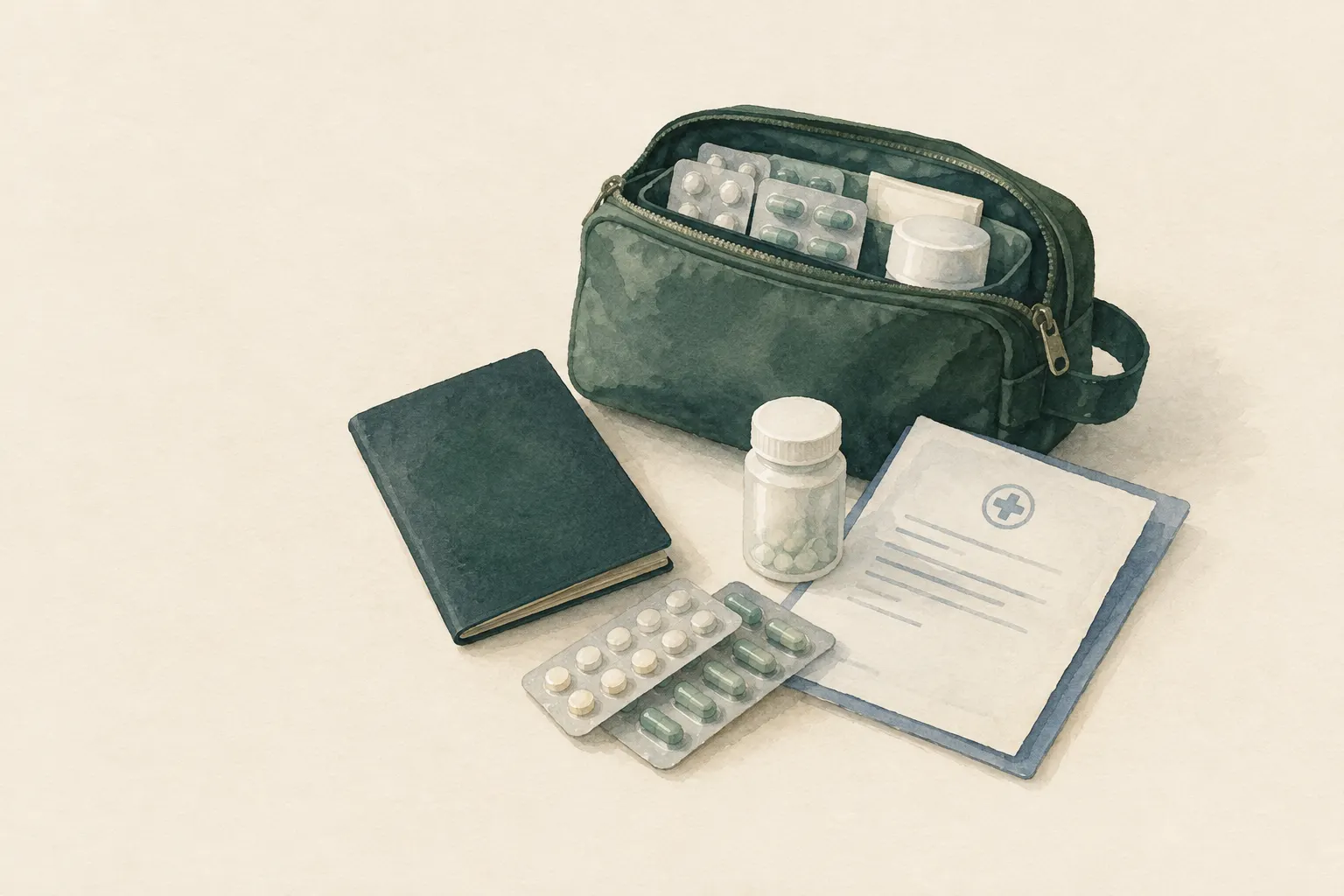
If you need a medicine every day, on a trip it is almost as important as your passport. Suitcases can get lost, flights can be cancelled, and abroad medicines often have different names from at home. That is why your medication belongs in your hand luggage, in its original packaging and with some reserve for delays.
Every medicine has a brand name, which can differ from country to country, and an active ingredient name. The active ingredient is like a person's real name, the brand name like a nickname that each country gives differently. If you write down the active ingredient, a pharmacy abroad can help you much more easily.
The most important point: some medicines that are completely normal at home are strictly controlled or even banned in other countries. So ask your doctor or pharmacist and check the rules of the destination and transit countries with official bodies before the trip. Never change how much of a medicine you take on your own.
Why preparation matters so much here
On a trip much can go wrong with medication: checked luggage does not arrive, a flight is cancelled and the trip lasts days longer, or medicines are spoiled by heat or cold. Anyone who carries their medication on them or in hand luggage and has a reserve stays supplied even then.
Then there are legal questions. Each country decides which medicines may be brought in, in what quantity and with which documents. Some medicines, for example certain pain, sleep or ADHD medicines, are strictly controlled or banned in some countries. This also applies to countries where you only change planes.
An active ingredient name stays the same everywhere; brand names do not. A list of active ingredients is therefore the common language between you, doctors and pharmacies abroad – and at the border, proof that you are carrying the medicines legitimately.
What really matters
Talk to your doctor or pharmacist early, ideally a few weeks before the trip. Ask for a list of all your medicines with their active ingredients and a doctor's certificate, ideally also in English, explaining why you need them. If you carry syringes, inhalers, pumps or meters, the certificate should mention them.
Check the rules of the destination and transit countries with their embassy or health authority. Within the Schengen area there is a special certificate for certain controlled narcotic medicines – ask your doctor or pharmacist whether you need it. Your foreign ministry's official travel advice often points to the responsible bodies.
Pack medicines in their original packaging in your hand luggage and take a reserve for some extra days; keep part of it separately. Medicines that need refrigeration need a cool bag. Show liquids and devices at security – ask the airline and airport about their rules beforehand.
Safety: what to watch out for
Never change the amount or how you take your medication on your own. With a time difference the question arises of when to take a medicine – this applies especially to medicines such as insulin, hormonal contraception or anti-epileptic drugs. Clarify this with your doctor before the trip.
Medicines bought abroad may be counterfeit or have a different strength from at home, even if the packaging looks similar. Buy medicines only in pharmacies and compare the active ingredient and strength with your list. If in doubt, get advice from the pharmacy or a local doctor.
Protect medicines from heat. A parked car in the sun can get very hot; insulin and many other medicines cannot tolerate that. If your medication is lost, see a local doctor or pharmacy with your active ingredient list. In a medical emergency always: call the local emergency number (112 in the EU).
Good to know
The CDC Yellow Book recommends carrying medication in hand luggage and in original packaging, taking reserves and checking the destination's import rules, because some medicines are controlled or banned elsewhere. Which certificate a country requires is set by that country.
For long stays of several months, find out whether your prescription can be filled locally and whether the amount you may bring in is limited. This entry does not replace advice: questions about your medication are for your doctor and pharmacist, legal questions about import are for the destination country's embassy.
Step by step
Make a list
Note all medicines with active ingredient, strength, dose and timing; copy in luggage and digitally.
- 1
Make a list
Note all medicines with active ingredient, strength, dose and timing; copy in luggage and digitally.
- 2
Check rules
Ask the embassy or health authority of destination and transit countries whether medicines are allowed, limited in quantity or need a permit. Within the Schengen area there is a special certificate for certain controlled narcotic medicines – ask your doctor or pharmacy.
- 3
Doctor's certificate
Certificate on the need for the medication, active ingredients and dose, ideally in English, mentioning syringes and devices if carried.
- 4
Pack
In original packaging in hand luggage, reserve for some extra days, part of the reserve separately. Refrigerated items in a cool bag; show liquids and devices at security – ask airline and airport about their rules.
- 5
At the destination
Protect medicines from heat (do not leave them in the car). If lost, see a local doctor or pharmacy with the active ingredient list.
Common mistakes
- Medication only in checked luggage
- Loose tablets in unlabelled boxes
- Only brand names noted
- Forgetting the transit country's rules
- Insulin in a hot car
Quick view
Materials
Medication supply
Agree any stock of prescription medication with a doctor or pharmacist; observe storage instructions and expiry dates.
Copies of travel documents
Keep separate from the originals; store digital copies only in protected form.
Emergency card (contacts and health details)
Note only necessary data; for children do not display the address visibly on clothing but carry the card in a pocket.
Suitable for
- Travellers on regular medication
- Medicines needing refrigeration, injections, inhalers
- Medical devices such as pumps or meters
Not suitable for
- Legal advice on import rules – contact the destination country's embassy
Prerequisites
- List of all medicines with active ingredient and dose
- Consultation with doctor or pharmacy
Safety
- Discuss dosing times across time zones (e.g. insulin, hormonal contraception, anti-epileptic drugs) with a doctor beforehand. Do not change the dose on your own.
- Medicines bought abroad may be counterfeit or dosed differently. Buy only in pharmacies and compare active ingredient and strength.
How it works
Suitcases get lost, flights are cancelled, brand names differ from country to country – the active ingredient name does not. Anyone who carries medication on them, has reserves and can prove it is legitimate stays supplied even when things go wrong and has no problems at the border.
Advantages
- Supply even if luggage is lost
- Avoids trouble at borders
Disadvantages
- Lead time and costs for certificates
- Rules sometimes hard to find
Deep knowledge
Background
The CDC Yellow Book recommends carrying medication in hand luggage and in original packaging, taking reserves and checking the destination's import rules, because some medicines are controlled or banned elsewhere.
Which certificate a country requires is set by that country; your foreign ministry's official travel advice often points to the responsible bodies.
Variants
- Long stays
- For months abroad, clarify whether prescriptions can be filled locally and whether carry-in quantities are limited.
Common mistakes
- Medication only in checked luggage
- Loose tablets in unlabelled boxes
- Only brand names noted
- Forgetting the transit country's rules
- Insulin in a hot car
Limits and risks
- No information on rules of specific countries
- No medication advice
Sources
Centers for Disease Control and Prevention: CDC Yellow Book: Health Information for International Travel
Travelling with medication: hand luggage, original packaging, reserves, import rules