Stranded or evacuated train: how to behave
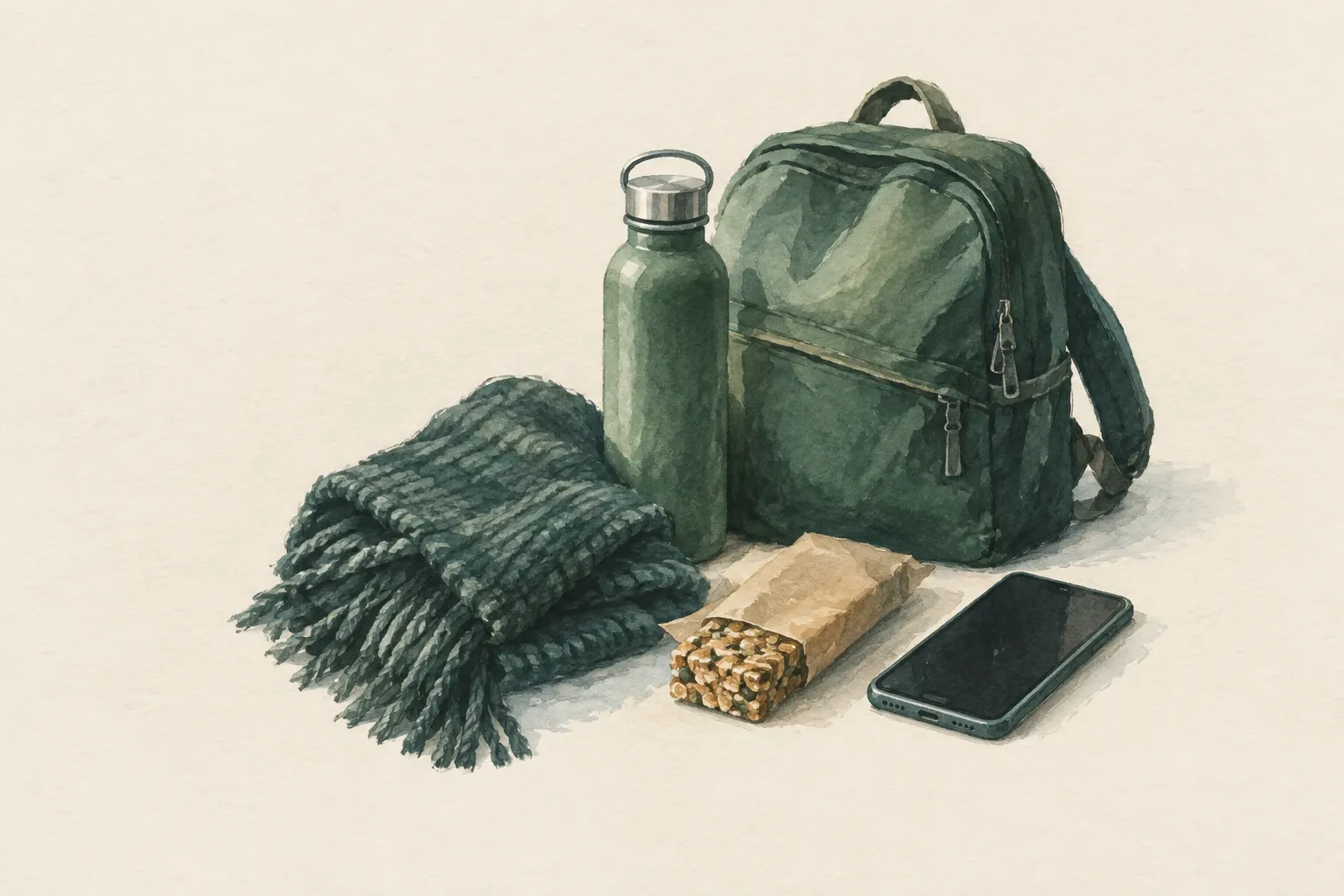
If a train stops on open track or in a tunnel, the train is usually the safest place. Tracks are deadly: other trains, conductor rails and overhead lines. Leave only on staff instructions or if there is immediate danger inside the train (fire, smoke). Water, a snack, warm clothing and a charged phone make long waits bearable.
- No preparation needed; small reserves in hand luggage
Explained simply
Sometimes a train simply stops – in the middle of the line or even in a tunnel. That is annoying, but in almost every case the train is then the safest place there is. Outside on the tracks, on the other hand, it is dangerous: another train may come on the next track, and some lines and rails carry electricity that can kill.
So the rule is: stay seated, listen to announcements and only get off when staff tell you to. The train crew talk to the control centre and know whether everything outside is secured – you cannot see that from inside. Only if there is fire or smoke in the carriage do you need to act at once.
For long waits a small supply in your hand luggage helps: water, a snack, a warm jacket and a charged phone. And the most important point: never step onto the tracks on your own.
How it works
A stationary train protects against weather and against rail traffic around it. Its walls, roof and weight make it a kind of shelter on wheels. Even if lights and air conditioning fail, you are better off inside than on the track bed.
The dangers outside are invisible to passengers. Trains may run at high speed on adjacent tracks, and they are often heard very late. Many railways are powered by overhead lines or conductor rails at track level that can carry high voltage – even if your own train has no power any more. Only railway staff know whether a line has been switched off and earthed.
Staff are in radio contact with the control centre. Before passengers may get off, adjacent tracks must be closed and, if necessary, power switched off. That takes time, but it is exactly why an organised evacuation is safe and leaving on your own is not.
What matters while waiting
Stay seated and watch for announcements and displays. If nobody says anything for a long time, speak to staff in person or via the emergency intercom – not to put pressure on them, but to find out what is happening and roughly how long it may take.
Ration water, food and battery. Lower the screen brightness, use mobile data only when needed and do not stream videos. If you know it could take hours, you plan differently from someone expecting to move on any minute.
Look out for the people around you. In heat or cold, children, older and ill people suffer most. If someone urgently needs water, medication or help, tell the staff. In a medical emergency inform staff and call the local emergency number (112 in the EU).
Safety: fire, smoke and the emergency brake
With fire or smoke in the carriage you must act: alert staff via the emergency intercom or use the emergency brake as explained on the signs in the carriage. Then move into another carriage and close the doors behind you so the smoke spreads less. After that, follow staff instructions.
When and how to use the emergency brake and the emergency door release differs between railways and countries. In some trains the driver can override an emergency brake so the train does not stop in a tunnel or on a bridge but continues to a more accessible place. Read the signs in the carriage instead of relying on what applies at home.
Pulling the emergency brake without a real reason, especially in a tunnel, creates a new danger and delays help. Forcing doors open and walking along the tracks is one of the most dangerous mistakes of all.
If the train is evacuated
Only get off when staff tell you to. Take only the essentials – documents, medication, phone, warm jacket – and keep your hands free. Large luggage stays on the train if staff say so; it hinders you and others.
The drop from a train to the track bed is often surprisingly high, and the ground is uneven and stony. Get down slowly, backwards facing the train, and accept help or help others. Children and people with limited mobility need particular support here.
Outside, stay with the group and only go in the direction staff indicate. In tunnels emergency exits are signposted; staff decide which way you go. Later, ask the rail company about replacement transport, accommodation and your rights as a passenger, and keep receipts.
Step by step
Wait for announcements
Stay seated, follow announcements and displays. If there is long silence, contact staff via the intercom or in person.
- 1
Wait for announcements
Stay seated, follow announcements and displays. If there is long silence, contact staff via the intercom or in person.
- 2
Ration supplies
Ration water, food and battery. Lower screen brightness, use mobile data only when needed.
- 3
Look after others
In heat or cold, look after children, older and ill people; report needs (medication, water) to staff.
- 4
Evacuation
Leave only when instructed. Limit luggage to essentials, keep hands free, follow staff in the direction given and stay together as a group.
When getting off, the drop from the train is often high and the ground uneven: slowly, facing the train, with help.
- 5
Arrange onward travel
Ask the rail company about replacement transport, passenger rights and accommodation; keep receipts.
Common mistakes
- Forcing doors open and walking along the tracks
- Pulling the emergency brake in a tunnel without reason
- No water on hot days
- Draining the battery with videos
Quick view
Materials
Mobile phone
The battery drains quickly in cold and with continuous screen and GPS use.
Do not plan on it as your only means of navigation or emergency calls.
Power bank
Do not use damaged or swollen batteries; do not charge while covered.
Headlamp / flashlight
Dry spare clothing
Carry it in waterproof packaging – wet clothing barely insulates.
Suitable for
- Long-distance, regional and metro trains
- Standstill after storms, power failures or faults
- Evacuation on staff instructions
Not suitable for
- Leaving the train on your own to "take a shortcut"
- Medical emergencies – inform staff and call emergency services
Prerequisites
- Stay calm and wait for announcements
Safety
- When and how to use the emergency brake or emergency door release differs between railways and countries. Read the signs in the carriage.
How it works
A stationary train protects against weather and against rail traffic around it. Staff are in contact with control and know whether adjacent tracks are closed and lines switched off – passengers do not.
Advantages
- No equipment needed
- Avoids the biggest danger: the track area
Disadvantages
- Long waits are possible
- Little influence on the situation
Deep knowledge
Background
General emergency guides such as FEMA's "Are You Ready?" recommend following the instructions of the responsible authorities in emergencies and keeping a small supply of water, food and light at hand. Railways additionally have their own operator rules.
In some trains the emergency brake can be overridden by the driver so that trains do not stop in tunnels or on bridges; details differ by country and operator.
Variants
- Metro and tunnels
- In tunnels follow instructions especially strictly; emergency exits are signposted and staff will indicate the route.
Common mistakes
- Forcing doors open and walking along the tracks
- Pulling the emergency brake in a tunnel without reason
- No water on hot days
- Draining the battery with videos
Limits and risks
- No information on passenger rights in specific countries
- No technical details of emergency brakes or doors
Material alternatives
Derived from material properties: a substitute must have all relevant properties. Observe the notes on the substitute.
- Mobile phone
- Headlamp / flashlight, Battery lantern / LED light
- Headlamp / flashlight
- Mobile phone (The battery drains quickly in cold and with continuous screen and GPS use.), Battery lantern / LED light
- Dry spare clothing
- Sleeping pad, Dry leaves, grass or conifer boughs (Collect only where allowed; no protected plants. Check for ticks and insects.), Backpack, Wool blanket / duvet (Keep away from candles, stoves and heaters.), Insulated cool box (Keeps cold only for a limited time; without ice packs or ice it is not a fridge.), Sleeping bag (Do not store compressed long-term; do not pack away damp.), Newspaper and cardboard (Flammable – keep away from candles, stoves, heaters and embers.), Insulated cooking box (hay box, thermal cooker) (Never put open flame or embers inside – only the hot, closed pot.)
Results come exclusively from structured entries. No improvised instructions are generated.
Sources
U.S. Federal Emergency Management Agency (FEMA): Are You Ready? An In-Depth Guide to Citizen Preparedness
General: follow official instructions, supply of water, food and light
European Commission: 112 – the European emergency number
European emergency number 112