Carrying and transporting water
A litre of water weighs about one kilogram – water is often the heaviest load. Several smaller containers instead of one large one, clear separation of raw and drinking water, carrying close to the body and protection from heat and frost make transport safer and prevent one leak from costing the whole supply.
- A few minutes of planning; carrying depends on distance
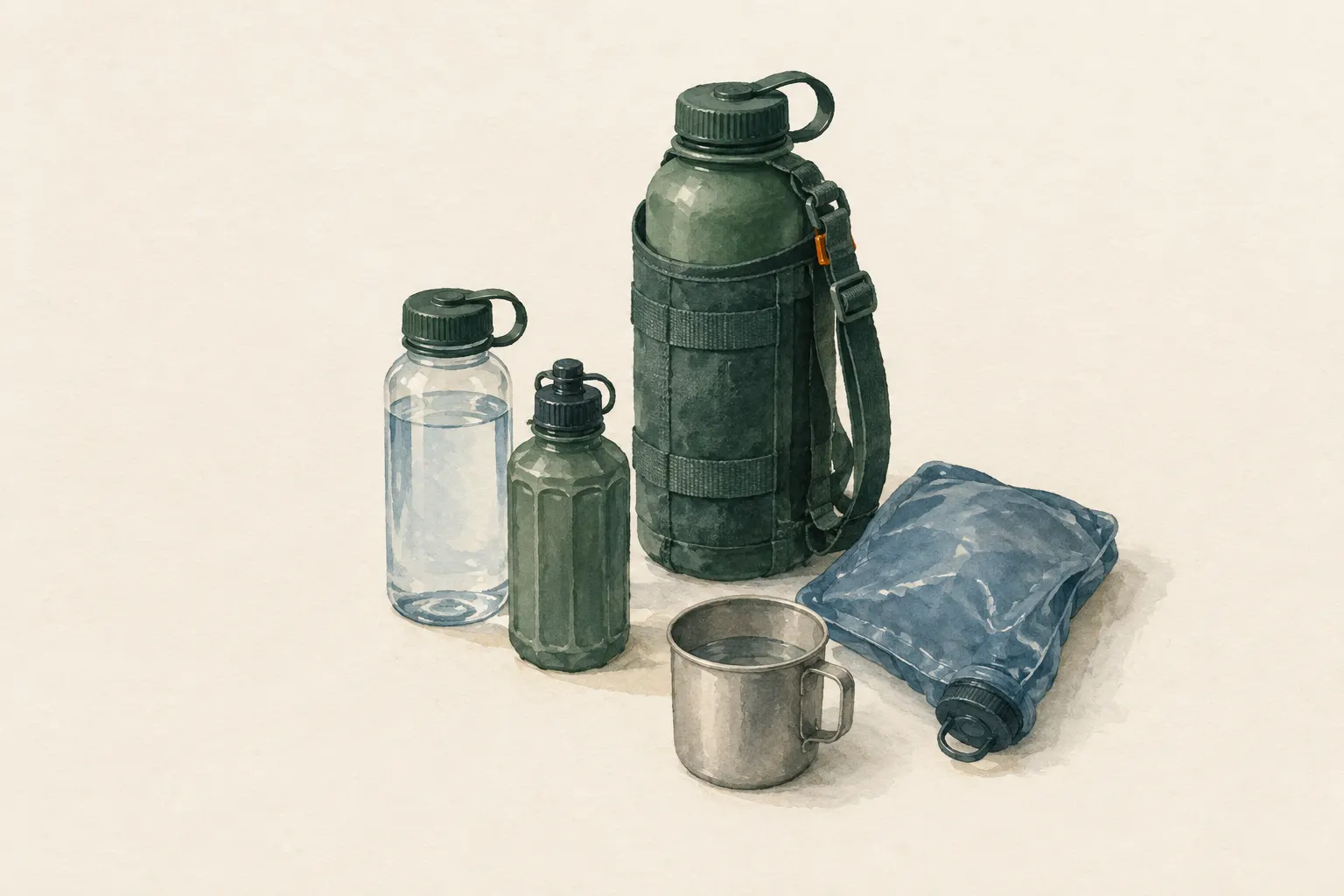
Explained simply
Water is heavy. One litre weighs about one kilogram – as much as a bag of flour. If you have to carry ten litres, that is like ten bags of flour at once. So it is worth thinking carefully about how you carry water.
Several small containers are better than one huge one: if one breaks, not everything is lost. Pack heavy bottles in your backpack right against your back, so the weight does not pull you backwards. And mark clearly which container holds untreated water from the stream and which holds clean drinking water – so nobody mixes them up.
Very important: never use a container that once held petrol, cleaning products or other chemicals – not even after it has been rinsed.
How it works
Your body carries loads most easily when the weight sits close to its centre of gravity, that is centred and close to your back. If a heavy container hangs far from the body, it acts like a long lever: back and shoulders have to work much harder and you lose your balance more easily. That is why heavy water containers go inside the backpack, against your back.
Several containers spread the risk. A leak, a broken cap or a hole in a collapsible container then costs only part of the supply. Collapsible containers save space while empty and can be filled at the source – but they are more vulnerable to sharp objects.
Water reacts to temperature. In the sun it warms up, which encourages germ growth in poorly cleaned containers. In the cold it can freeze; ice expands and can damage containers or filters. When a bottle freezes, the ice forms first at the surface – that is why bottles are stored upside down in frost, so the cap does not freeze shut.
What really matters
Before setting off, think: how far is it to the next safe water source or distribution point? How much do I need until then, plus a reserve? And can I actually carry that weight? Anyone who overloads themselves slows down, sweats more and so needs even more water.
Keep raw water and drinking water clearly apart: different colours, tape, a label such as ‘RAW’ or ‘DRINK’. When transferring, do not touch the openings and never hold raw-water containers against drinking bottles. Even a few drops of raw water on the thread can contaminate clean water.
The containers themselves must be food-grade, leak-proof and clean. Check the caps before every trip, and pack collapsible containers so that no tent pegs, knives or stoves press against them.
Safety: what to watch out for
Containers that held fuel, cleaners, pesticides or other chemicals are off limits for drinking water. Plastic can absorb substances and release them again later, and rinsing does not reliably remove them. For drinking water, use only containers made for that purpose.
Heavy water loads strain back, knees and shoulders. Lift with your legs from a squat, not with a rounded back. Spread the weight on both sides or across several people and plan breaks. Children carry only what is easy for them.
On slippery ground, on stream banks or on stairs, carry less twice rather than too much once. A fall with a heavy container can cause injuries, and the supply is often lost as well.
Typical situations
If the water supply fails at home and there is a distribution point, a handcart, sack truck, pushchair or bicycle makes the trip easier. Secure jerrycans against tipping, for example with a strap. Several medium-sized jerrycans are easier to handle than one very large one.
On a hike to a dry campsite, fill up at the last safe source and carry the water for the final stretch. In summer the containers go inside the backpack or in the shade; in winter they are insulated and close to the body so they do not freeze.
Humanitarian work shows that water is often contaminated only on the way from the tap point to the home – through dirty containers and hands. Properly treated water stays safe only if it is also transported cleanly.
Step by step
Plan the amount
Determine how much is needed until the next safe source, plus a reserve – and whether you can carry the weight.
- 1
Plan the amount
Determine how much is needed until the next safe source, plus a reserve – and whether you can carry the weight.
- 2
Split across containers
Spread the water across several containers; mark raw water clearly differently from drinking water.
- 3
Pack close to the body
Put heavy containers in the backpack close to the back and centred; check lids, protect containers from punctures.
- 4
Protect from heat and frost
In summer carry in shade or inside the pack; in winter insulated and close to the body; in frost store bottles upside down so the lid does not freeze shut.
- 5
Transfer cleanly
When transferring, do not touch openings and do not hold raw-water containers against drinking bottles.
Common mistakes
- All supply in one container
- Not marking raw and drinking water
- Using former chemical canisters
- Carrying heavy loads far from the back
- Packing collapsible containers with sharp objects
Quick view
Materials
Collapsible water container or bag
Protect from sharp objects.
Use only food-grade and only for water.
PET bottle (clear, max. 2 litres)
Do not heat or place in a fire.
Backpack
Food-grade water container
Only use containers that never held chemicals or fuel.
Suitable for
- Trips to dry campsites
- Fetching water during supply failures
- Carrying from source to camp
Not suitable for
- Containers that held chemicals
- Loads beyond your own capacity
Prerequisites
- Leak-proof, food-grade containers
- Marking for raw and drinking water
Safety
- Heavy water loads strain back and joints. Spread the load, carry it close to the body, lift with the legs and plan breaks.
- Mark raw- and drinking-water containers clearly and never mix them up.
How it works
Weight close to the body's centre of gravity is easier to carry. Several containers spread the risk of leaks and mix-ups. Collapsible containers save space while empty. Water in the sun warms up; water in the cold can freeze and damage containers or filters.
Advantages
- Allows dry campsites
- Spread containers reduce the risk of loss
Disadvantages
- High weight
- Collapsible containers can tear
Deep knowledge
Background
In humanitarian operations, clean collection and transport containers are among the minimum standards of water supply, because water is often contaminated on the way from the tap point to the household.
The same applies in the field: properly treated water stays safe only if it is transported cleanly.
Variants
- With a cart or vehicle
- During supply failures, a handcart, sack truck or bicycle eases transporting jerrycans; secure jerrycans against tipping.
Common mistakes
- All supply in one container
- Not marking raw and drinking water
- Using former chemical canisters
- Carrying heavy loads far from the back
- Packing collapsible containers with sharp objects
Limits and risks
- Carrying capacity limits the amount
- No substitute for treatment
Material alternatives
Derived from material properties: a substitute must have all relevant properties. Observe the notes on the substitute.
- Collapsible water container or bag
- Single-wall stainless steel bottle (Heat only single-wall bottles without paint/plastic; remove the lid before heating.), Double-wall insulated bottle (Never heat directly.), PET bottle (clear, max. 2 litres) (Do not heat or place in a fire.), Food-grade water container (Only use containers that never held chemicals or fuel.), Airtight food-grade storage container (Fill only when clean and completely dry; never use containers that previously held chemicals.), Food-grade water bag (Use only for drinking water, never for chemicals or fuel.), Fermentation jar or crock (Use only food-grade containers of glass, food-safe glazed stoneware or food-grade plastic – no metal containers for acidic food.), Resealable food bags (Use only bags intended for food; do not use with boiling water unless the manufacturer explicitly allows it.)
- Backpack
- Sleeping pad, Dry leaves, grass or conifer boughs (Collect only where allowed; no protected plants. Check for ticks and insects.), Dry spare clothing (Carry it in waterproof packaging – wet clothing barely insulates.), Wool blanket / duvet (Keep away from candles, stoves and heaters.), Insulated cool box (Keeps cold only for a limited time; without ice packs or ice it is not a fridge.), Sleeping bag (Do not store compressed long-term; do not pack away damp.), Newspaper and cardboard (Flammable – keep away from candles, stoves, heaters and embers.), Insulated cooking box (hay box, thermal cooker) (Never put open flame or embers inside – only the hot, closed pot.)
- Food-grade water container
- Single-wall stainless steel bottle (Heat only single-wall bottles without paint/plastic; remove the lid before heating.), Double-wall insulated bottle (Never heat directly.), PET bottle (clear, max. 2 litres) (Do not heat or place in a fire.), Airtight food-grade storage container (Fill only when clean and completely dry; never use containers that previously held chemicals.), Collapsible water container or bag (Protect from sharp objects.), Food-grade water bag (Use only for drinking water, never for chemicals or fuel.), Fermentation jar or crock (Use only food-grade containers of glass, food-safe glazed stoneware or food-grade plastic – no metal containers for acidic food.), Resealable food bags (Use only bags intended for food; do not use with boiling water unless the manufacturer explicitly allows it.)
Results come exclusively from structured entries. No improvised instructions are generated.
Sources
Sphere Association (2018): The Sphere Handbook: Humanitarian Charter and Minimum Standards in Humanitarian Response
Clean collection and transport containers as part of water supply
Centers for Disease Control and Prevention: Making Water Safe in an Emergency
Food-grade, clean containers for drinking water