Determining water volumes for correct dosing
Chemical disinfection only works when dose and volume match. Anyone who does not know the volume of their containers doses too weakly (ineffective) or too strongly. With a bottle of known size, jerrycans, pots and bags can be measured once and marked permanently.
- 10–20 minutes once per container
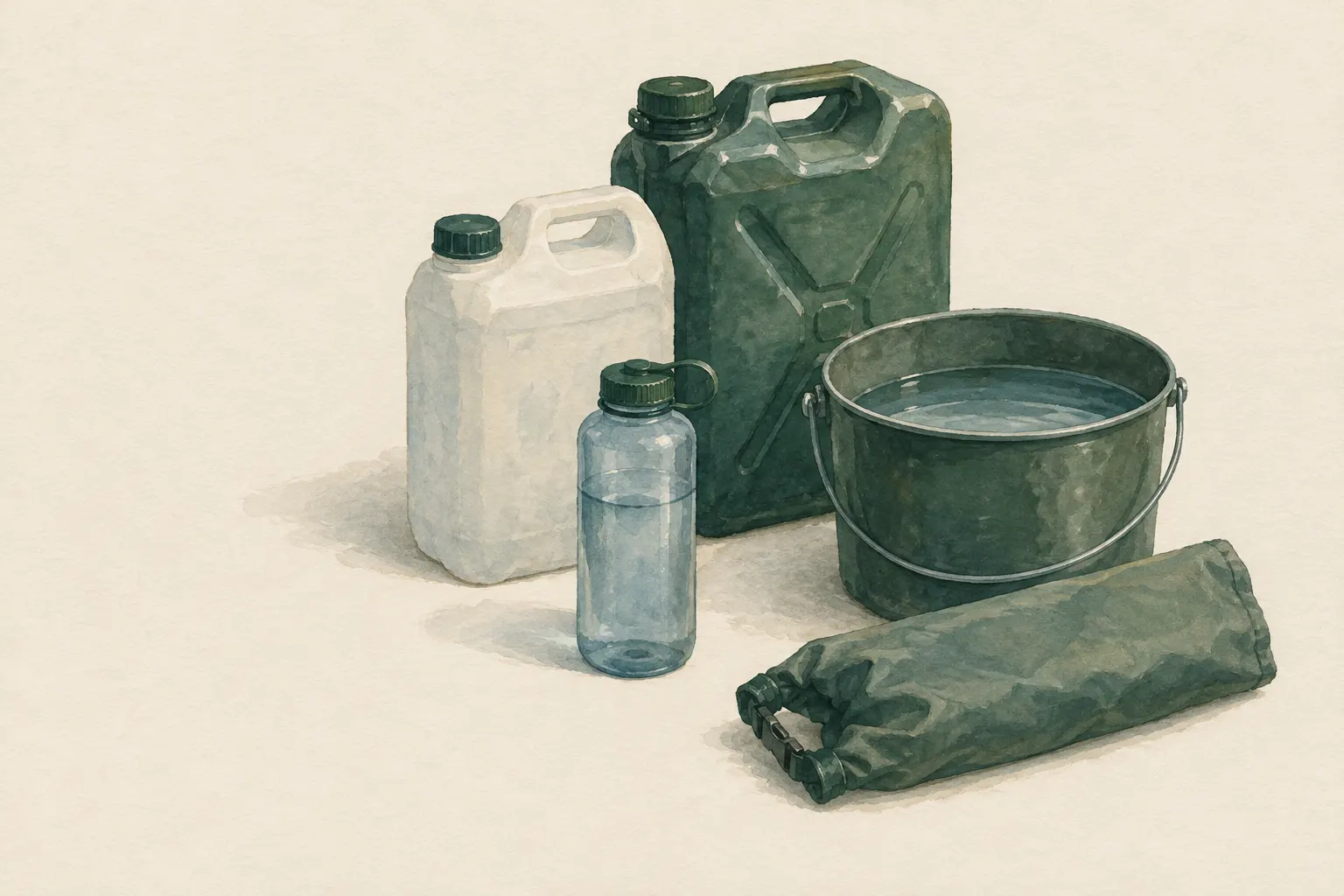
Explained simply
Disinfection tablets or drops are like medicine for water: the amount has to be right. The pack says, for example, ‘one tablet for so many litres’. But if you do not know how much your jerrycan holds, you are just guessing – and then it is too little, so germs survive, or too much, so it tastes horrible.
The solution is simple: take a bottle that says how much it holds, for example one litre. Pour it into your jerrycan again and again and make a line on the outside after each filling. Now your jerrycan has a scale like a measuring jug.
A handy trick: one litre of water weighs about one kilogram. So you can also measure by weight with scales. But you always take the dose itself from the instructions – never make it up.
How it works
Chemical disinfectants only work at the right concentration, meaning a certain amount of active ingredient per litre of water. Too little and the ingredient is not enough to make all germs harmless within the intended contact time. Too much and the water tastes strong and may not be drunk; with some products overdosing is also undesirable for health. That is why manufacturers and authorities always state doses per volume.
The measuring method rests on a simple idea: a vessel of known content serves as a unit. Pour it into a jerrycan five times and it holds five times as many litres. Each mark on the outside of the container records this value permanently, so you never have to measure again.
The scales method uses the fact that one litre of water weighs about one kilogram. Weigh the empty container, then the full one; the difference in kilograms roughly equals the number of litres. This is handy for large or awkwardly shaped containers that would be tedious to fill bottle by bottle.
What really matters
The measuring vessel must really hold the stated volume. A drinks bottle with the content printed on it or a measuring jug works well. Make sure you fill it to the same level every time – for example always up to where the neck starts, as it was filled when you bought it.
A common mistake is confusing nominal volume with actual fill volume. A jerrycan with a number of litres printed on it often holds a bit more when filled to the brim, and many people do not fill it completely. When you measure it yourself, you know how much is really in it at your usual fill level.
Make the marks with a waterproof marker or tape that stays stuck when wet. For opaque containers a dipstick helps: a clean stick on which you mark the water level for each filling and which you use only for this purpose. Write the total volume and, if useful, the matching dose clearly on the container.
Safety: what to watch out for
Measuring does not replace dosing instructions – it makes them usable. Always take the amount of tablets, drops or bleach from the manufacturer's or authority's instructions and only convert it to your measured volume. Inventing your own doses is dangerous, because then the effect is no longer assured.
Only break tablets for smaller volumes if the manufacturer explicitly allows it. Otherwise the active ingredient may be unevenly distributed and a fragment may contain too little. It is better to always prepare the full volume of water for one whole tablet.
Keep disinfectants out of children's reach. The measuring vessel for drinking water should be clean and never used for chemicals.
How to practise it
On a quiet afternoon, go through all the water containers in the house: jerrycans, large pots, water bags, the bucket. Measure each one once, mark the litre steps and write down the result. It only takes a few minutes per container and saves time and mistakes in an emergency.
With flexible water bags the marks are less precise, because the bag changes shape depending on how it sits. It helps to always stand or hang the bag the same way when measuring and later when dosing. A note with a small table (‘blue jerrycan: volume, dose as per instructions’) kept with the supplies makes the knowledge usable for everyone in the household.
Step by step
Choose a measure
Take a bottle or measuring jug with a printed volume.
- 1
Choose a measure
Take a bottle or measuring jug with a printed volume.
- 2
Fill step by step
Fill the container portion by portion and make a mark on the outside after each portion.
- 3
Label
Write the total volume and the marks clearly on the container. For opaque containers, mark inside at the rim or use a dipstick.
- 4
Dose according to instructions
Calculate the dose from the manufacturer's or authority's instructions for the measured volume and note it on the container if useful.
Common mistakes
- Estimating volume by eye
- Confusing nominal and fill volume
- Breaking tablets for partial volumes
- Marking with a non-waterproof pen
Quick view
Materials
PET bottle (clear, max. 2 litres)
With printed volume, as the measure
Do not heat or place in a fire.
Labels and waterproof marker
Measuring jug
Food-grade water container
Only use containers that never held chemicals or fuel.
Suitable for
- Preparing jerrycans, pots and water bags
- Household and camp
- Dosing tablets and bleach according to instructions
Not suitable for
- Inventing your own doses
Prerequisites
- A vessel of known volume
- Waterproof marker or tape
Safety
- Always take doses from the manufacturer's or authority's instructions. Measuring does not replace the instructions; it makes them usable.
- Do not break tablets for partial volumes unless the manufacturer allows it – instead prepare the full volume for one tablet.
How it works
One litre of water weighs about one kilogram. Filling a bottle of known content into a container several times and making a mark after each filling produces a permanent scale. Alternatively, volume can be measured by weight on scales.
Advantages
- Makes dosing reliable
- One-off effort
- Also helps with rationing
Disadvantages
- Preparation needed
- Less precise with flexible bags
Deep knowledge
Background
Official instructions for emergency disinfection always give doses per volume. Errors in determining the volume are therefore among the most common reasons for ineffective disinfection.
Well-marked containers are a simple part of preparedness that saves time and mistakes in an emergency.
Variants
- With scales
- Weigh the empty container, weigh the full container; the difference in kilograms roughly equals the litres.
Common mistakes
- Estimating volume by eye
- Confusing nominal and fill volume
- Breaking tablets for partial volumes
- Marking with a non-waterproof pen
Limits and risks
- Does not replace dosing instructions
- Imprecise with deformable containers
Material alternatives
Derived from material properties: a substitute must have all relevant properties. Observe the notes on the substitute.
- Measuring jug
- Metal pot (stainless steel, aluminium, titanium) (Hot – scalding risk.), Single-wall stainless steel bottle (Heat only single-wall bottles without paint/plastic; remove the lid before heating.), Double-wall insulated bottle (Never heat directly.), PET bottle (clear, max. 2 litres) (Do not heat or place in a fire.), Food-grade water container (Only use containers that never held chemicals or fuel.), Airtight food-grade storage container (Fill only when clean and completely dry; never use containers that previously held chemicals.), Collapsible water container or bag (Protect from sharp objects.), Food-grade water bag (Use only for drinking water, never for chemicals or fuel.), Fermentation jar or crock (Use only food-grade containers of glass, food-safe glazed stoneware or food-grade plastic – no metal containers for acidic food.), Resealable food bags (Use only bags intended for food; do not use with boiling water unless the manufacturer explicitly allows it.)
- Food-grade water container
- Single-wall stainless steel bottle (Heat only single-wall bottles without paint/plastic; remove the lid before heating.), Double-wall insulated bottle (Never heat directly.), PET bottle (clear, max. 2 litres) (Do not heat or place in a fire.), Airtight food-grade storage container (Fill only when clean and completely dry; never use containers that previously held chemicals.), Collapsible water container or bag (Protect from sharp objects.), Food-grade water bag (Use only for drinking water, never for chemicals or fuel.), Fermentation jar or crock (Use only food-grade containers of glass, food-safe glazed stoneware or food-grade plastic – no metal containers for acidic food.), Resealable food bags (Use only bags intended for food; do not use with boiling water unless the manufacturer explicitly allows it.)
Results come exclusively from structured entries. No improvised instructions are generated.
Sources
United States Environmental Protection Agency: Emergency Disinfection of Drinking Water
Dosing for emergency disinfection based on water volume
Centers for Disease Control and Prevention: Making Water Safe in an Emergency
Disinfection with dose per volume of water