Skip to content
In an emergencyAustriaEmergency numbers →
SurviveBetter
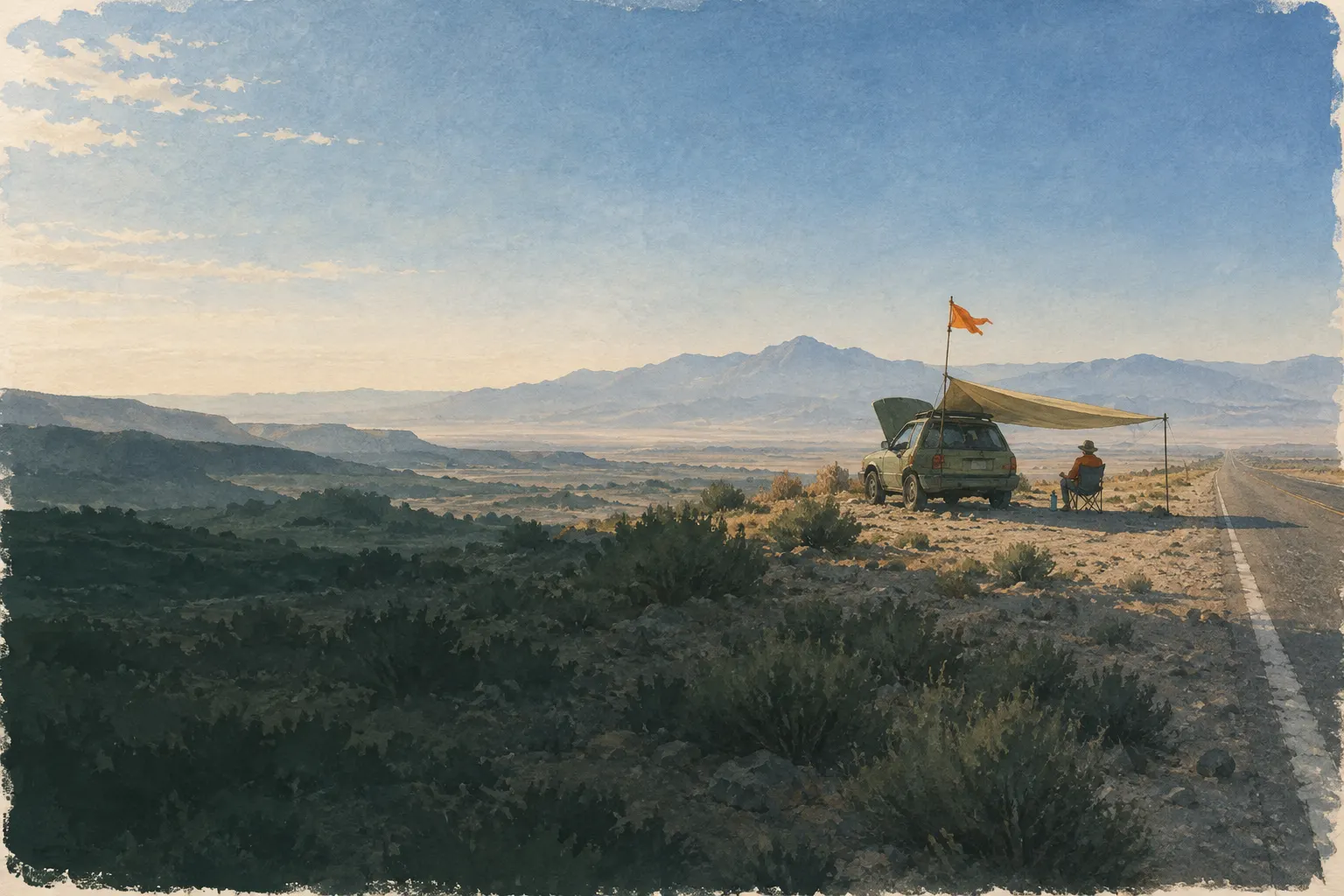
Car with its bonnet open on a remote desert road, person sitting in the shade of a tarp

My car has broken down in a remote, hot area

The car has stopped, nobody for miles, the sun is blazing. Stay with the car, make shade, drink and stand out.

First

  1. Stay with the car. A vehicle is much easier to spot than a person on foot and offers shade and materials.
  2. If you have signal: call breakdown assistance or 112 and give your location with coordinates.
  3. Do not stay sitting in the stationary, heated car – find shade beside the car or build it with a tarp, blanket or sunshade.
  4. Drink what you need – water helps more in your body than in the bottle. Save sweat: no exertion in the midday heat.

Call emergency services if

  • Signs of heatstroke: confusion, hot skin, collapse, seizure
  • Someone is vomiting or can no longer drink
  • Water has run out
  • Children, older or sick people show heat exhaustion
  • Injuries after an accident

What is happening

On trips through southern Europe, North Africa, North America or Australia, roads often lead through wide, hot and sparsely populated areas. A breakdown, a puncture in sand or an empty tank can hold you there for hours or longer. Phone signal is not a given.

The greatest danger is the heat: in a stationary car in the sun the temperature quickly rises far above the outside temperature. On foot in the midday heat you lose a great deal of water through sweat. Many fatal cases involve people who left their vehicle to fetch help.

A car is far easier for searchers to find than a single person. It provides shade, material for signals and protection in the often cold night. So the rule is: stay with the car unless you know for certain that help can be reached on foot quickly and safely.

A common misconception is to save water for as long as possible. Water in the bottle does not help when the body is already drying out. It makes more sense to reduce water loss: shade, rest, covered skin, move activity to the cool hours – and drink what you need.

Step by step

My car has broken down in a remote, hot area – Phase 1 of 4Straight away. Stop safely, hazard lights on, set up the warning triangle if needed. Check for signal: call breakdown assistance, the rental company or 112 and give your location with coordinates. Without signal: use satellite SOS on your phone or a distress beacon if you have one. If you reach nobody: note when you were where and think about who will miss you and when. Get out of the heated cabin; open the doors to let the heat escape.
Phase 1 of 4

Phase 1 of 4

Straight away

Stop safely, hazard lights on, set up the warning triangle if needed. Check for signal: call breakdown assistance, the rental company or 112 and give your location with coordinates. Without signal: use satellite SOS on your phone or a distress beacon if you have one. If you reach nobody: note when you were where and think about who will miss you and when. Get out of the heated cabin; open the doors to let the heat escape.

The animation shows the key actions of each phase schematically; the text below is what counts.

  1. Phase 1

    Straight away

    • Stop safely, hazard lights on, set up the warning triangle if needed.
    • Check for signal: call breakdown assistance, the rental company or 112 and give your location with coordinates.
    • Without signal: use satellite SOS on your phone or a distress beacon if you have one.
    • If you reach nobody: note when you were where and think about who will miss you and when.
    • Get out of the heated cabin; open the doors to let the heat escape.
  2. Phase 2

    In the first hours

    • Make shade: stretch a tarp, blanket or sunshade between the car and the ground or a bush; do not lie under the car.
    • Cover skin, head and neck, wear light-coloured, loose clothing.
    • Drink what you need in small sips spread over the day; with little water still drink and save sweat instead.
    • Stand out: open the bonnet, tie a bright cloth to the aerial or window, make large ground signs from stones or branches.
    • Keep a mirror, CD or shiny surface ready to flash at aircraft or distant vehicles.
  3. Phase 3

    If it takes longer

    • Rest during the day, move work to morning and evening.
    • Dress warmly at night – deserts and steppes can get bitterly cold.
    • At night switch on or flash lights occasionally when vehicles or aircraft can be heard; do not drain the battery.
    • Only set off if the destination and distance are definitely known, there is enough water and it is cool – ideally at night or early in the morning. Leave a note with direction and time at the car.
    • Do not drink coolant, screenwash or urine.
  4. Phase 4

    Afterwards

    • Drink slowly and rest somewhere cool; seek medical help for headache, nausea or confusion.
    • Do not underestimate sunburn and heat injury.
    • Add to your emergency kit for future trips.
    • Arrange with the rental company or insurer how the vehicle will be recovered.

★ Pro tips

What experienced people do differently: proven practice from mountain rescue, fire services, lifeguards and civil protection that beginners rarely know.

  1. Aim a signal mirror properly

    Stretch out one arm and make a V with two fingers so the target (aircraft, vehicle) sits inside it. Bring the mirror's light spot onto your fingers, then rock it slightly so the flash sweeps across the target. The flash can be seen from a long way off.

  2. Don't sit on the hot ground

    Sand, rock and tarmac in the sun get far hotter than the air. In the shade, sit on something – a seat cushion, floor mat, spare wheel or pack. Even a hand's width off the ground makes a noticeable difference.

  3. Know the local emergency number

    112 works across the EU but not everywhere in the world: it's 911 in the USA and Canada, and 000 in Australia. Save the number for the country you're in and your rental company's breakdown line before you set off.

  4. Keep the car usable for the night

    Put a sunshade in the windscreen and leave the windows open a crack. Less heat builds up, and by evening the car turns back into a sheltered place to sleep sooner. During the day you still stay outside in the shade.

What to watch out for

  • Heat in the car

    A closed car in the sun heats up dangerously in a short time. Never leave anyone – children, older people or animals – in a stationary car.

  • Heatstroke

    Confusion, odd behaviour, hot skin, collapse or seizures are signs of heatstroke – a life-threatening emergency. Cool at once (shade, water on skin and clothing, fanning) and call for help.

  • Setting off in the heat

    Walking in the midday heat costs many times as much water. Distances in wide landscapes are almost always underestimated.

  • Cold nights

    After a hot day the night can be surprisingly cold. Do not soak clothing and blankets needed for the night with sweat while using them as sunshade.

  • Toxic fluids

    Coolant contains glycol and is poisonous; screenwash contains alcohols and cleaners. Urine contains salts and waste products and makes dehydration worse.

Common mistakes

  • Leaving the car and walking for help in the midday heat.
  • Staying in the closed, heated car.
  • Saving water until you are already badly dehydrated.
  • Driving remote routes with little water and no route plan.
  • Not telling anyone your route and arrival time.
  • Working in the sun without a hat.

Prepare in advance

  • For drives through hot, remote areas take plenty of water – much more than for the planned driving time.
  • Put sun protection, a tarp or blanket, a hat, a torch and a signal mirror in the car.
  • Fill the tank before remote stretches and plan reserves.
  • Download offline maps; for areas without signal consider a satellite messenger or beacon.
  • Leave your route and expected arrival, with a time for raising the alarm.
  • Check a rental car before departure: spare wheel, jack, coolant, tyres.

Special consideration

Children and babies
Children overheat and dehydrate faster. They get the best shade, drink regularly and must never stay in the car.
Older and chronically ill people
Older people often feel less thirsty, and some medicines (e.g. diuretics) raise the heat risk. Actively offer drinks and watch for confusion.

Sources

  • FM 3-05.70 Survival · Headquarters, Department of the Army (USA), 2002
  • Wilderness Medical Society Clinical Practice Guidelines for the Prevention and Treatment of Heat Illness: 2019 Update · Wilderness & Environmental Medicine (Wilderness Medical Society), 2019
  • Extreme Heat · Ready.gov – U.S. Federal Emergency Management Agency (FEMA)
  • Heat and health (fact sheet) · World Health Organization
  • 112 – the European emergency number · European Commission

Your situation

Water supply
Phone signal
Passengers
Time of day

Matching entries

0 rules apply

No AI decides here. Every recommendation is based on a visible rule.

Add details about your situation above to get more specific guidance.

Basics for this situation

Why: Always applies to this situation – regardless of your answers.

All rules of this situation (7)
  1. [not active] If Water supply = Little or none

    Do not save water until you collapse – postponed drinking does not help. Save sweat instead: shade, rest, covered skin. Do not drink coolant, screenwash or urine.

  2. [not active] If Phone signal = Signal available

    Give your location precisely, save battery and charge in the car only with the engine running or from a power bank.

  3. [not active] If Phone signal = No signal

    Stand out: open the bonnet, tie a bright cloth to the aerial or window, lay out ground signals, flash a mirror or shiny surface at aircraft and vehicles.

  4. [not active] If Passengers = Children or Older or ill people

    Children, older people and the sick overheat faster. They get the best shade and drink first. Never leave anyone in a closed car.

  5. [not active] If Passengers = Pet

    Never leave animals in the car; move them into shade and give them water.

  6. [not active] If Time of day = Dusk / night

    At night deserts and steppes often get surprisingly cold – keep clothing ready. Only set off on foot at night if help is certainly within reach, the distance is known and there is enough water.

  7. [not active] If Time of day = Day, hours of light left

    Rest during the day: cover head and neck, sit in the shade, do not lie directly on hot ground.