Skip to content
In an emergencyAustriaEmergency numbers →
SurviveBetter
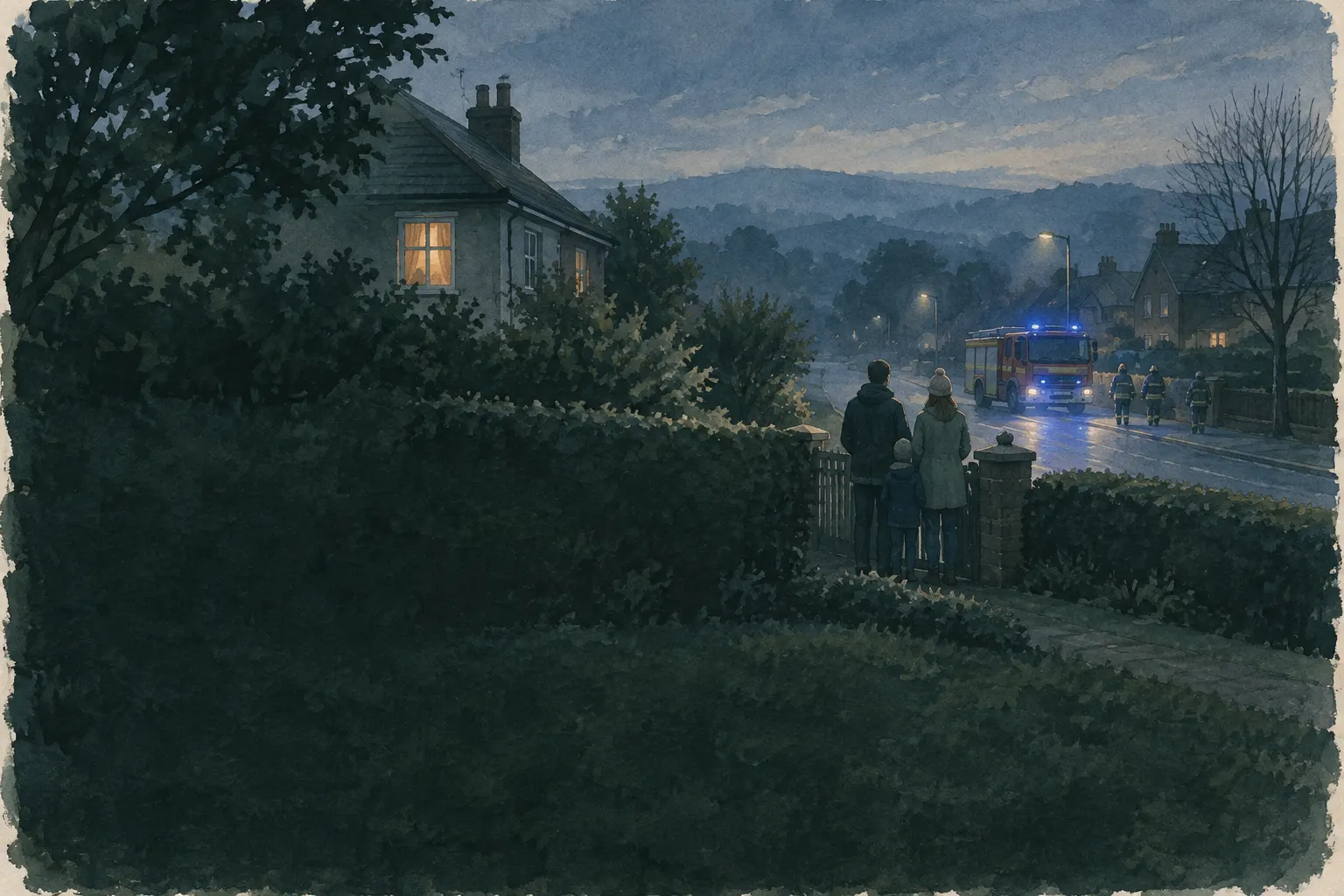
Family standing at the garden gate at night as the fire brigade arrives, faint glow in the house

There is a fire in my home

The smoke alarm beeps and something smells burnt. Now only one thing counts: everyone out, doors closed, 112 from outside.

First

  1. Warn everyone loudly and get out at once – take nothing, do not investigate, do not fight it if it is more than a small fire that has just started.
  2. Stay low in smoke. Test doors with the back of your hand before opening; if a door is hot, use another way.
  3. Close doors behind you – it slows fire and smoke.
  4. Outside, call 112, count heads at the agreed meeting point and do not go back into the building.

Call emergency services if

  • Always with fire or smoke, as soon as you are safe
  • Someone is still inside
  • The escape route is blocked
  • Someone has breathed in smoke or has burns

What is happening

A house fire often develops faster than people expect. The smoke is usually more dangerous than the flames: it is hot, toxic and takes away visibility in a short time. Anyone asleep does not smell it – which is why smoke alarms matter so much.

Authorities and fire services give the same basic rule: get out, stay out, call the emergency number. Anyone who first investigates, looks for valuables or fights the fire for a long time loses time needed for escape. Only a small fire that has just started – in a waste bin or a pan, for example – can sometimes be put out by yourself, and even then only with a suitable extinguishing agent and a clear escape route behind you.

In apartment buildings there is an important exception: if the stairwell is full of smoke, your own flat behind the closed door is often the safer place. Then you stay inside, seal the door, call 112 and make yourself seen at the window until the fire service arrives.

This page summarises the advice for the first minutes. What helps most is what you do beforehand: smoke alarms, an escape route you have talked through and a meeting point outside.

Step by step

There is a fire in my home – Phase 1 of 4Alarm: warn and get out. Wake and warn everyone loudly: “Fire! Get out!” Take nothing but people and, if they are right to hand, pets. Stay low in smoke where the air is better and take the shortest way out. Test doors with the back of your hand before opening. If a door is hot, leave it closed and use another way. Close doors behind you.
Phase 1 of 4

Phase 1 of 4

Alarm: warn and get out

Wake and warn everyone loudly: “Fire! Get out!” Take nothing but people and, if they are right to hand, pets. Stay low in smoke where the air is better and take the shortest way out. Test doors with the back of your hand before opening. If a door is hot, leave it closed and use another way. Close doors behind you.

The animation shows the key actions of each phase schematically; the text below is what counts.

  1. Phase 1

    Alarm: warn and get out

    • Wake and warn everyone loudly: “Fire! Get out!”
    • Take nothing but people and, if they are right to hand, pets.
    • Stay low in smoke where the air is better and take the shortest way out.
    • Test doors with the back of your hand before opening. If a door is hot, leave it closed and use another way.
    • Close doors behind you.
  2. Phase 2

    Outside: emergency call and meeting point

    • Call 112: address, what is burning, whether anyone is still inside.
    • Count heads at the agreed meeting point.
    • Do not go back in – not for pets or documents either. Tell the fire service who or what is still inside.
    • Show the fire service the way and keep the access clear.
  3. Phase 3

    If you cannot get out

    • Go into a room with a window and close the door.
    • Seal the gaps around the door with towels, blankets or clothing.
    • Call 112 and say exactly where you are: floor, room, which side the window faces.
    • Make yourself noticed at the window: wave, shout, a light or a bright cloth. Only open the window if smoke is not drawn in from outside. Do not jump.
  4. Phase 4

    Afterwards

    • Anyone who breathed in smoke, coughs, is hoarse or short of breath needs medical help. With burns, let the ambulance service decide.
    • Only go back in when the fire service allows it.
    • Inform your insurer, photograph the damage, arrange somewhere to stay.
    • Talk about what happened – with children too. Fear and poor sleep in the days afterwards are common.

★ Pro tips

What experienced people do differently: proven practice from mountain rescue, fire services, lifeguards and civil protection that beginners rarely know.

  1. Close bedroom doors at night

    A closed door holds back smoke and heat for a while. Sleeping with the bedroom door shut gives you more time if a fire starts at night. That is why fire services and fire researchers urge people to close doors before going to sleep.

  2. Know two ways out of every room

    Plan a second way out of every room in case the hallway is full of smoke – usually a window you can reach. Check that windows and shutters open easily and nothing blocks them. Practise it together once, including in the dark.

  3. Interlinked alarms, replaced after 10 years

    In larger houses you often cannot hear a basement smoke alarm upstairs. Interlinked alarms all sound at once. Smoke alarms age: replace them after about ten years – the date is usually printed on the unit.

  4. Extinguisher: aim at the base, not the flames

    Pull the pin, aim at the base of the fire and sweep in short bursts. Spraying into the flames wastes the extinguisher. Keep your exit behind you the whole time.

  5. Open a door slowly, from the side

    If the door is not hot, stand to the side, open it just a crack and brace it with your foot. If smoke or heat comes through, you can push it shut at once. Firefighters are taught the same.

What to watch out for

  • Smoke, not flames

    Most people in house fires are endangered by smoke, not by flames. Staying low and closing doors helps more than any attempt to put the fire out.

  • Fat fire

    Never put water on burning fat or oil – it can flare up violently. Put a lid or fire blanket on it, cooker off, and if it does not go out at once: get out and call 112.

  • Smoke-filled stairwell

    Anyone who goes into a smoke-filled stairwell can lose orientation and consciousness there. Better to stay in the flat, door closed, call 112 and go to the window.

  • Clothing on fire

    If clothing catches fire: stop, drop to the ground, cover your face with your hands and roll until the flames are out. Do not run.

  • Lifts

    Never use the lift in a fire. It can stop or open on a smoke-filled floor.

Common mistakes

  • First checking where it is burning or gathering valuables.
  • Putting water on burning fat.
  • Leaving doors open.
  • Going back into the building to fetch someone or something.
  • Disconnecting smoke alarms because they go off when cooking.

Prepare in advance

  • Smoke alarms in bedrooms, children's rooms and hallways; test them regularly.
  • Talk through and practise escape routes and a meeting point outside with everyone.
  • Extinguisher or fire blanket in the kitchen; read the instructions beforehand.
  • Keys for the front door and window grilles to hand in a fixed place.
  • Keep escape routes and the stairwell clear of objects.

Special consideration

Children
Children should know: in smoke, do not hide but shout and get out. Listen to the smoke alarm sound together and practise the way to the meeting point.
People with limited mobility
Where possible sleep on the ground floor or near the exit, keep a phone by the bed and agree with relatives or neighbours who will help in a fire.

Sources

  • Home Fires · Ready.gov – U.S. Federal Emergency Management Agency (FEMA)
  • Are You Ready? An In-Depth Guide to Citizen Preparedness · U.S. Federal Emergency Management Agency (FEMA)
  • 112 – the European emergency number · European Commission

Your situation

What do you see?
Building
With you

Matching entries

0 rules apply

No AI decides here. Every recommendation is based on a visible rule.

Add details about your situation above to get more specific guidance.

Basics for this situation

Why: Always applies to this situation – regardless of your answers.

All rules of this situation (6)
  1. [not active] If What do you see? = Small fire that has just started (e.g. pan, waste bin)

    Only fight a small fire if you have a suitable extinguisher or fire blanket, the fire is small and your escape route stays clear behind you. Never put water on burning fat: lid on, cooker off. If it grows: get out and call 112.

  2. [not active] If What do you see? = Fire or smoke is spreading

    Get out at once. In smoke stay low where the air is better, close doors and stay outside until the fire service says otherwise.

  3. [not active] If What do you see? = Escape route blocked, door hot

    Stay in a room with a window, close the door, seal gaps with cloth, call 112 and say exactly where you are. Make yourself seen at the window. Do not jump.

  4. [not active] If Building = Flat in an apartment building

    If the stairwell is full of smoke, do not go into it: keep the flat door closed, call 112 and wait at the window. Never use lifts.

  5. [not active] If With you = Children

    Children often hide under beds or in cupboards during a fire. Take them by the hand as you leave, count heads outside at once and tell the fire service who is missing.

  6. [not active] If With you = Someone with limited mobility

    Anyone who cannot get out by themselves stays behind a closed door at a window. When calling 112 say at once exactly where that person is.